
You are a good dentist… so why does it feel this hard?
You are a skilled dentist, yet your diary has gaps and patients are not saying yes. Discover why it is not your dentistry that is the issue and what actually changes patient decisions

You are a skilled dentist, yet your diary has gaps and patients are not saying yes. Discover why it is not your dentistry that is the issue and what actually changes patient decisions
Anxiety in Dentistry: What If It’s Not the Problem, But the Message? If you are a dentist, clinician, or part of a support team, you will likely recognise this: The racing heart before a difficult conversation The quiet worry about whether a patient may complain The sense of pressure building throughout the day The mental…

If you are worried about complaints, unhappy patients, or difficult conversations, the issue is unlikely to be your clinical ability. The real gap sits elsewhere. Understanding and managing patient expectations is the key to confidence, clarity, and better outcomes for both you and your patients.

As dentists, you would never begin treatment without first gathering baseline information. Yet when it comes to your practice, how often do you pause to diagnose before you act? As Q1 comes to a close, this is your opportunity to step back, assess where you truly are, and create clarity before moving forward. Your balance wheel offers a powerful, visual way to uncover what is really driving your results and where your next focus should be.

You talk to patients all day, yet they still delay, decline, or disappear. The difference is not your clinical skill, it is what patients understand and feel. Discover how small shifts in communication build trust, reduce hesitation and turn uncertainty into confident decisions.

In Formula One, races are won or lost on tyre choice. In dentistry, the same is often true of remuneration decisions. This article explores why percentages alone are a poor guide, and why data, context, and regular review matter far more than opinion.

Being self-employed in the UK is often described as freedom, flexibility, and control. But it only works when everyone understands the rules of the game. Using the analogy of football, this article explains why self-employment has clear benefits and equally clear responsibilities, how HMRC acts as referee and VAR, and why clauses in self-employed agreements are not punitive but protective. If you are a clinician or practice owner navigating self-employed status, this piece will help you understand why you cannot play rugby on a football pitch and expect the game to work.

When a patient fails to attend or cancels late, the question we often ask is who should be paid. But what if that is not the most useful question. Missed appointments are a form of non-verbal communication. If we listen more carefully to what patients are telling us through their behaviour, we may find better answers and fewer empty chairs.
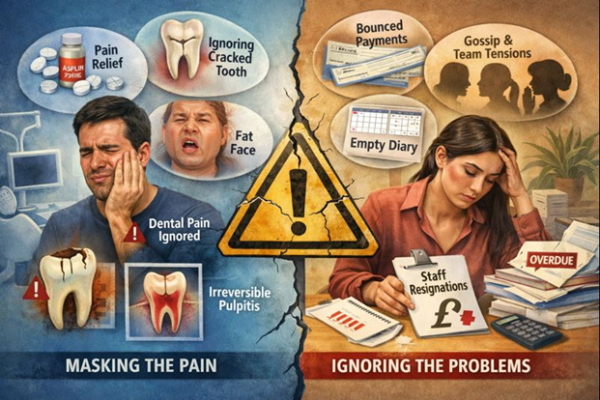
Dentists recognise denial instantly in patients, yet the same pattern often plays out in practice ownership. Small warning signs are ignored, symptoms are treated in isolation, and deeper causes remain unexamined until crisis hits. This blog explores the powerful parallel between dental pain and practice problems, and invites principals to move from reactive firefighting to proactive, preventative practice care

If you are hoping 2026 will feel different, but nothing has really changed over the last two years, this may explain why. Lasting change does not come from trying harder. It comes from changing how you think.