
Your Q2 Starts Before It Begins: A Clinical Approach to Practice Growth

As dentists, you are trained to diagnose before you treat.
You would never begin a course of treatment without first gathering baseline information. Whether it is a BPE, radiographs, scans, CBCT, photographs, or a careful visual examination, these records guide your clinical thinking. They allow you to diagnose accurately, plan effectively, and achieve outcomes that genuinely serve your patients.
Yet when it comes to your practice, your business, and even your own life, how often do you pause to gather that same level of baseline data?
As we reach the end of Q1, this is your moment.
Not to rush forward into Q2 with good intentions and vague goals.
But to assess. To diagnose. To understand where you are right now.
Your Baseline: The Balance Wheel
Your balance wheel is exactly that, a diagnostic tool.
It gives you a visual snapshot of how you feel your practice, or your life, is functioning across multiple key areas. Instead of guessing where the problems are, you can see them clearly.
Because the truth is, your practice does not sit in isolation. Your energy, clarity, relationships, and wellbeing all influence how you lead and perform.
Dental Practice Balance Wheel
Each segment represents a critical area of your practice, from vision and leadership to patient-centred sales, team performance, and financial systems.
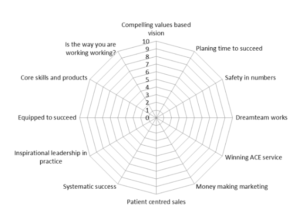
Life Balance Wheel

How to Use the Balance Wheels
For each segment, ask yourself one simple question:
“How satisfied am I in this area right now?”
Then score it from 0 (centre) to 10 (outer edge).
This is not about perfection. It is about honesty.
You are not measuring success. You are measuring satisfaction.
You are not answering for your team, your patients, or your peers.
You are answering for you.
Careful not to be super severe or over generous with your scores, be honest.
Understanding the Scale
To help you calibrate your thinking, here is a spectrum you may find useful:
| Score | Description | Level |
| 0 | Failure | Ignorant |
| 1 | Unacceptable | Beginner |
| 2 | Incompetent | Novice |
| 3 | Ineffective | Apprentice |
| 4 | Inadequate | Probationer |
| 5 | Complacent | Intern |
| 6 | Satisfactory | Experienced |
| 7 | Competent | Practised |
| 8 | Commendable | Proficient |
| 9 | High quality | Specialist |
| 10 | Excellent | Master |
This is not about judgement.
It is about clarity.
Two Critical Distinctions
- “How satisfied am I…”
This is subjective.
It is not about what others think.
It is not about external measures of success.
It is about your internal experience.
You can have a “successful” practice and still feel deeply dissatisfied.
That matters.
- “Right now”
This is a snapshot.
Your scores will change:
- Week to week
- Day to day
- Even hour to hour
Do not search for perfection or permanence.
Simply capture the truth of this moment.
What Your Wheel Will Show You
When you join the dots, your wheel will reveal one of two things:
- A smooth, balanced shape → momentum, alignment, ease
- An uneven, jagged shape → friction, stress, hidden problems
This is where your real insight begins.
Because the lowest scores are not your weaknesses.
They are your starting points for growth.
From Diagnosis to Action: Preparing for Q2
Once you have your wheel, ask yourself:
- Where am I most dissatisfied?
- What is the cost of leaving this unchanged?
- What would a one-point improvement look like in this area?
You do not need to fix everything.
You need to start somewhere.
Just like in clinical dentistry, small, well-planned interventions lead to meaningful, lasting outcomes.
A Different Way to Think About Growth
Many dentists approach Q2 with targets:
- Increase revenue
- Fill the diary
- Improve conversions
These matter.
But they are outcomes.
Your balance wheel helps you focus on the drivers behind those outcomes:
- Communication
- Leadership
- Systems
- Team alignment
- Personal clarity
When these improve, results follow naturally.
Where to Access Your Balance Wheels
You can download and complete your own balance wheels here:
https://iodb.co.uk/self-evaluation/
Take the time to do this properly.
Not quickly. Not superficially.
Honestly.
If You Don’t Like What You See
This is the most important part.
If your wheel feels uncomfortable…
If it highlights gaps you have been avoiding…
If it confirms what you already suspected…
That is not failure.
That is awareness.
And awareness is where change begins.
Your Next Step
If you would like to improve your balance wheel results, these are exactly the kinds of conversations we explore in coaching.
Together, we:
- Diagnose what is really going on
- Identify the thinking patterns driving your current results
- Create a clear, practical plan for change
- Support you as you implement it
You do not need to work it out alone.
Final Thought
You would never treat a patient without a diagnosis.
Do not run your practice that way.
Pause.
Assess.
Understand.
And then move into Q2 with clarity, confidence, and purpose.