Time: Dentistry’s Eternal Bugbear
In almost every practice I visit, and coaching sessions complete, conversations about time are never far away. Dentists, associates, hygienists, nurses, and practice managers alike often say, “There just isn’t enough time.”
Appointments overrun, clinicians feel pressured, patients can become frustrated, and stress levels rise across the team. If this sounds familiar, you’re not alone. Time in dental practice has long been an eternal bugbear — too much to do, not enough time to do it.
Beyond the daily frustration, poorly structured appointments carry real risks. When we rush, corners are inevitably cut. Communication may be compromised, expectations may not be aligned, and if something goes wrong, complaints or GDC referrals can follow, with all the additional stress, worry and frustration, not to mention additional work and even more pressure on your time.
The good news is that by understanding the different elements that make up an appointment, you can start to schedule more intelligently, protect yourself, and improve the experience for you, the patients and the team.
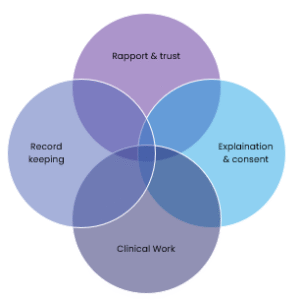
The Four Overlapping Elements of Every Appointment
Think of your appointment time as a Venn diagram with four overlapping circles. Each circle represents a core activity that must take place to deliver safe, effective, patient-centred care. These elements are:
- Building Rapport and trust
- Explanation and Consent
- Clinical Work
- Record-Keeping
All four happen within the same appointment, often overlapping, but each requires its own allocation of time. Skipping or rushing any of these increases the likelihood of stress, miscommunication, or clinical risk.
- Building Rapport and Trust
Every appointment begins with the human connection between clinician and patient.
Rapport is not a ‘nice to have’; it is fundamental to effective communication, cooperation, and consent. Taking the time to connect allows you to understand your patient’s concerns, set expectations, and establish trust.
The time needed will vary depending on the patient’s personality, level of anxiety, familiarity with you, and communication style. Some patients click instantly; others require more time and reassurance. The crucial point is to recognise that rapport-building takes time — and that time needs to be factored into your schedule, not squeezed out.
- Explanation and Consent
Before any examination or treatment begins, the patient must understand what will happen and give valid consent.
For treatment appointments, this often means re-explaining and re-consenting at the start of the session, even if you’ve discussed the plan previously and obtain a signature. Consent is a process of multiple steps not a single signature. For examinations, it means taking time to explain findings, offer a clear diagnosis, and outline options, this may even take two or three visits depending on complexity of treatment.
How long does this stage realistically take? It depends on the complexity of the situation, the patient’s understanding, and the quality of your communication. Underestimating this time can lead to misunderstandings, delays, or even invalid consent.
- Clinical Work
This is the hands-on part of dentistry: examinations, restorative work, periodontal treatment, or other procedures.
Many clinicians underestimate how much time is needed when booking appointments, particularly for treatments they can technically complete quickly. Speed is not the only factor. You must also allow for patient variability, local anaesthetic onset, unexpected findings, or additional questions.
Allocating sufficient time for the clinical element reduces pressure and minimises the temptation to rush through steps or cut corners. If you don’t know how long a procedure will take, time yourself In a time and motion study. Adjust the time to fit the procedure not the procedure to fit the time. If you cut corners, rush and compromise this element of the treatment, what are the risks and potential consequences?
- Record-Keeping
Finally, there’s the essential task of contemporaneous record-keeping.
While computer systems may date-stamp entries at midnight, contemporaneous means “at the time” — write your notes before you move on to the next patient. Writing clear, comprehensive notes, storing photographs, and updating records is an integral part of safe practice.
This part is often squeezed when appointments overrun, but it is critical for continuity of care, legal protection, and team communication. Building in the time to complete records properly and In a timely manner is non-negotiable.
Where Are You Compromising?
When appointments are shortened, usually buy a receptionist or PM, without consulting the clinician, something has to give. Are you conscious of the compromises that will be made and are you prepared to take the risk?
Ask yourself honestly:
- Are you skipping rapport-building and jumping straight into treatment?
- Are explanations rushed, leaving patients uncertain or misinformed?
- Are you hurrying through clinical steps or not allowing for variability?
- Are your notes written hastily at lunch or the end of the day, risking omissions?
Every shortcut has a potential consequence — increased stress, patient dissatisfaction, clinical errors, or regulatory risk.
Scheduling with Intention
There is no one-size-fits-all appointment length. Different treatments, patients, and clinicians will require different timings. What matters is that each of the four elements is consciously allowed for.
A well-structured appointment benefits everyone:
- Patients feel heard, understood, and confident in their care.
- Clinicians work with less stress and more focus.
- Teams run more smoothly, with fewer overruns.
- Practices reduce complaints, improve outcomes, and support sustainable growth.
If you or your team frequently say, “We don’t have enough time,” it may be worth revisiting how appointments are structured — not just how long they are.
Reflect and Rebalance
Take a moment to reflect on your current appointment structure. Do your allocated times genuinely allow for all four overlapping elements? Or are some areas consistently squeezed?
By making small adjustments to scheduling and being honest about what’s needed, you can create calmer, safer, more effective working days — for you, your team, and your patients.
Valuing Your Time and Charging with Confidence
Ultimately, the time allocated for appointments must be financially sustainable, which means it needs to be covered by what patients pay. This requires developing the skill of valuing yourself and your colleagues and having the confidence to charge appropriately for the care you provide. If you are faced with the realisation that, under the NHS, you cannot cover your costs without compromising on quality, communication, or safety, then it is important to be honest with yourself. Are you willing to accept those risks and their potential consequences, or is it time to consider freeing yourself from the shackles of the NHS system to create the space, time, and resources to deliver the standard dentistry you believe in, and your patients deserve?
If you are doing a restoration that will take 50 minutes on a nervous ‘difficult’ patient who likes to reaffirm everything each visit and it takes 10 minutes to settle the patient and reestablish rapport and trust, 10 minutes to re-explain, answer questions and reconsent and 10 minutes to write your notes, you must schedule 1 hour 20 minutes, not 50 or even 40. You need adequate time for all four steps.
Take the Next Step
If you’re struggling with time management, appointment book scheduling, running late, managing emergencies, feeling like there’s never enough time, or considering stepping away from the NHS, these are exactly the areas I help clinicians and teams to resolve. If you would like to talk through your situation, challenges, and frustrations, you can schedule a complimentary SPEAK WITH JANE conversation through my website. Together, we can explore practical solutions to create a calmer, more sustainable way of working.
👉 Schedule your complimentary conversation
How to Book
Visit: www.iodb.co.uk Use the SPEAK WITH JANE button to access our appointment diary.
We use Software of Excellence as our client management software so just please book as a new patient.
A guide to booking appointments online can be found here.
https://iodb.co.uk/wp-content/uploads/2025/10/How-to-book-an-online-appointment-Oct-2025.pdf