SUPERvision in Dentistry: Are You Reflecting or Just Looking Back?
We do not learn from experience. We learn from reflection on experience.
How often have you finished a challenging appointment, experienced a difficult conversation with a patient or team member, or found yourself dealing with something that didn’t go according to plan, and thought, “I could have handled that better”?
Perhaps you’ve replayed the conversation in your mind, questioned what happened, considered what you might have done differently, or simply decided to put it behind you, forget about it and move on and then a similar scenario reoccurs, you recognise you learnt nothing from the first time.
Have you ever finished a clinical appointment knowing that something didn’t go according to plan? Perhaps you extracted the wrong tooth, perforated a root canal during treatment, or found yourself increasingly frustrated because, despite your best efforts, a patient simply wasn’t engaging with improving their oral hygiene.
Maybe you’ve replayed the experience in your mind, questioned what happened, wondered why things unfolded as they did, considered what you could have done differently, or simply decided to forget about and move on, alternatively you ruminate constantly and consider leaving the profession.
How much learning actually takes place during the reflection process?
We spend years developing our clinical knowledge and skills, attend countless hours of CPD and gain experience every day we work with patients. We’re encouraged to reflect on our experiences, particularly when things go wrong, and the General Dental Council recognises reflection as an important part of professional development.
Yet, how many of us have ever been taught how to reflect effectively?
How do you know whether you’re learning from an experience or simply remembering it, justifying your actions, reinforcing your existing beliefs or going over the same thoughts without discovering anything new?
Could it be that the very experiences which hold the greatest opportunities for professional and personal development are the ones we’re not exploring deeply enough?
When Reflection Becomes a Tick-Box Exercise
Reflection is something we’re all familiar within dentistry, particularly in relation to CPD, complaints, significant events and professional development. We are encouraged to record what we’ve learnt, consider how it relates to our practice and identify what we might do differently in the future.
However, without an effective structure and time, reflection can easily become a tick-box exercise, something we complete because we’re expected to rather than because we’ve discovered something genuinely valuable. Think about the reflection process on the reverse of a CPD certificate.
You might write that a consultation went well because the patient accepted treatment, or that another consultation was disappointing because the patient declined your recommendations.
Yet what have you actually learnt?
What if the patient who accepted treatment didn’t fully understand their options, and the patient who declined treatment felt disrespected, not understood and had in sufficient confidence to make the choice that was right for them?
What if the issue you’re reflecting requires more than the superficial, thoughts about what happened, but requires you to explore deeper and consider your assumptions, expectations, communication, relationships, emotional responses or the wider environment in which you’re working?
Meaningful reflection requires us to explore beyond the obvious, including the things we don’t realise we’re overlooking.
Coaching, Mentoring and SUPERvision: Three Complementary Approaches to Professional Development
Many other professions have embraced coaching, mentoring and supervision as a core triad of approaches to professional development, dentistry is lagging behind. The disciplines may overlap, yet each offers a different focus and opportunity for learning, growth and improvement.
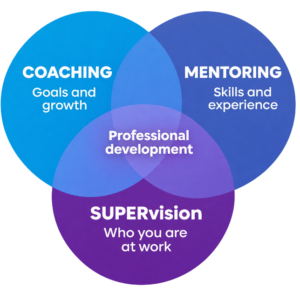
Coaching focuses primarily on your goals, development and future possibilities. It helps you explore where you are now, where you would like to be, what’s getting in your way and how you can move forward.
Mentoring focuses more specifically on the development of knowledge, skills and professional capability, drawing upon the experience and expertise of somebody who can support your learning.
SUPERvision focuses on you as a person within your professional role, exploring how your experiences, thinking patterns, behaviours, emotions, relationships and working environment influence the way you practise.
In SUPERvision, we have the opportunity to zoom in and zoom out, exploring a particular moment, conversation or experience in detail before stepping back to consider the bigger picture.
We might explore what happened between you and a patient during a consultation, then zoom out to consider your wider communication patterns, the expectations you place upon yourself, the pressures within your practice or how your personal experiences influence your professional relationships. SUPERvision gives you the tools look look through the microscope and through the telescope.

These three approaches are not mutually exclusive, and together they provide opportunities to develop not only what you know and what you can do, but also your understanding of who you are at work and how that influences your professional life.
Why Reflecting With Someone Else Can Make Such a Difference
Whilst self-reflection is valuable, there are limitations to trying to explore everything on your own.
After all, how can you recognise a blind spot when, by its very nature, you cannot see it?
Your interpretation of an experience is influenced by your beliefs, values, previous experiences, emotional responses and the assumptions you make about yourself and other people. These influences can be so familiar that you don’t even recognise them.
Working with an external coach, mentor or SUPERvisor, either individually or in a group, creates opportunities to explore your experiences from different perspectives.
A skilled practitioner holds the structure of the conversation, helps you remain focused, notices patterns, asks questions you may never have considered and challenges assumptions that might otherwise go unquestioned.
Rather than simply agreeing with your interpretation or offering advice, they create opportunities for you to discover something about yourself, your circumstances or your relationships that you hadn’t previously recognised.
The value isn’t simply in having somebody to talk to. It’s in the quality, depth and direction of the thinking that takes place.
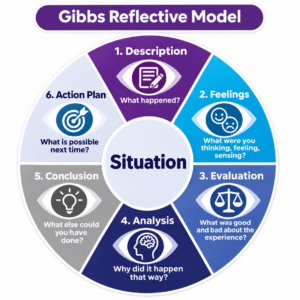
Gibbs’ Reflective Cycle: Bringing Structure to Reflection
Within SUPERvision, we can draw upon established evidence-based reflective practice models to create structure, stimulate deeper thinking and turn experiences into meaningful learning.
One particularly useful frameworkis Gibbs’ Reflective Cycle, developed by Graham Gibbs in 1988.
The model has six stages, each encouraging us to explore an experience from a different perspective before identifying what we’ve learnt and how we might apply that learning in the future.
It can be used to reflect on clinical situations that went particularly well, experiences that were challenging, unexpected complications, conversations with patients or colleagues, and even non-events, where something we expected to happen didn’t happen at all.

- Description: What Happened?
The first stage is about establishing the facts, understanding the context and creating a clear picture of what actually took place, without immediately jumping to conclusions, explanations or judgements.
For example, perhaps you accidentally extracted the wrong tooth, perforated a root canal during treatment, or struggled to engage a patient in improving their oral hygiene.
Rather than starting with why you believe something happened, your SUPERvisor might explore:
- What was the context of the situation?
- Who else was involved, and what was their role?
- What was the specific sequence of events?
This helps establish a shared understanding of the experience before exploring its wider meaning.
- Feelings: What Were You Thinking, Feeling and Sensing?
Our thoughts, feelings and emotional responses influence our behaviour, communication and decision-making, sometimes without us being consciously aware of what is happening.
Perhaps you felt shocked, distressed or overwhelmed when you realised you’d extracted the wrong tooth, anxious or frustrated when a perforation occurred during root canal treatment, or disappointed and increasingly frustrated when a patient continued to struggle with their oral hygiene despite your repeated efforts to encourage improvement.
These responses are valuable information, particularly when we become curious about where they originate and how they influence what happens next.
Your SUPERvisor might ask:
- How did you feel before and during the event?
- In what ways might your feelings have affected your behaviour?
- In what ways might your feelings have been influenced by previous experiences?
Exploring our emotional responses isn’t about judging whether they were right or wrong, but understanding the influence they may have had on our actions and relationships.
- Evaluation: What Was Good and Bad About the Experience?
It’s easy to focus our reflection on what went wrong, particularly when something has left us feeling disappointed, frustrated or concerned.
Yet there is just as much value in recognising what worked well, understanding why it worked and considering how we might repeat those positive experiences.
Even within a challenging clinical situation, there may be aspects of our clinical skills, communication and patient management skills, decision-making or behaviour etc that were particularly effective.
Your SUPERvisor might ask:
- What worked well and what contributed to that?
- What didn’t go well and what contributed to that?
- How did you and others contribute to the outcome?
This stage encourages a more balanced understanding, recognising both the strengths we can build upon and the opportunities for improvement.
- Analysis: Why Did It Happen That Way?
This is often where the most interesting discoveries begin.
Having established what happened, how you felt and what worked well or less well, we can explore the underlying influences that contributed to the outcome.
Perhaps, when reflecting on extracting the wrong tooth, you begin to question how the tooth was identified, what checks were undertaken and whether assumptions influenced your actions.
When exploring a perforation during root canal treatment, you might consider the clinical challenges, your decision-making and the circumstances that contributed to what happened. Alternatively, when a patient hasn’t improved their oral hygiene despite repeated advice, you might begin to question whether you truly understood their priorities, motivations and barriers to change, or whether your approach to communication was having the effect you intended.
Your SUPERvisor might explore:
- What underlying clinical, human or system factors influenced what happened?
- In what ways did verbal and non-verbal communication influence the situation and its outcome?
- In what ways might assumptions, expectations or biases have influenced your clinical decisions, behaviour or interactions with the patient?
This is where we begin moving beyond what happened and towards understanding why it happened, including the part we ourselves may have played.

- Conclusion: What Else Could You Have Done?
Having explored the experience from several perspectives, the next stage is to identify what you’ve learnt and what other possibilities may have been available.
Perhaps you’ve recognised that you made an assumption about which tooth required extraction, that there were opportunities to approach the root canal treatment differently, or that repeatedly giving oral hygiene advice wasn’t helping your patient to make changes because you hadn’t sufficiently explored what was preventing them from doing so.
Equally, you may have recognised aspects of your clinical judgement, communication or behaviour that were effective and that you would want to repeat in similar circumstances.
Your SUPERvisor might ask:
- What did you learn about yourself?
- What could you have done differently?
- What might you do again in a similar situation?
The purpose isn’t to create a catalogue of everything you should have done differently, but to recognise what you’ve learnt, acknowledge what worked and expand the choices available to you in the future.

- Action Plan: What Is Possible Next Time?
Reflection becomes particularly valuable when our new understanding influences what we do next.
Once you’ve identified what you’ve learnt, the final stage is to consider how you will apply that learning to future situations, whether that involves strengthening the checks you undertake before extracting a tooth, developing your clinical skills and decision-making during root canal treatment, or changing the way you communicate with patients to better understand their motivations and help them take greater responsibility for improving their oral hygiene.
Your SUPERvisor might ask:
- If this happened again, how would you handle it?
- What specific actions will you take to improve?
- How will you monitor your progress or improvement?
The action plan brings the reflection back into your everyday professional life, creating opportunities to experiment with different approaches, evaluate their effectiveness and continue learning from the results.
The cycle then begins again, allowing each experience to contribute to your ongoing development.
Reflection Is About More Than Learning From Mistakes
One of the most important things to recognise about structured reflection is that it isn’t reserved for occasions when something has gone wrong.
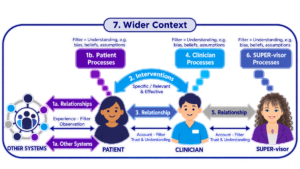
Whilst Gibbs’ model provides a valuable structure, some experiences, particularly those involving clinical adverse outcomes, other situations involving colleagues or team members, may benefit from exploring a different SUPERvision framework, such as The Seven-Eyed Model of SUPERvision, developed by Hawkins and Shohet. This model provides opportunities to explore relational dynamics from multiple perspectives, including the practitioner, the other person, the relationship between them and the wider organisational context.
Different situations benefit from different reflective approaches, which is one of the reasons having a skilled SUPERvisor to guide the process can be so valuable.
You may wish to consider what you could learn if you used SUPERvision to reflect on consultations that went well, treatment plans that went to plan, team meetings where everyone contributed, the challenging conversations that were resolved or the days when everything seemed to seemed to flow effortlessly.
How often do you take the time to explore why those experiences were successful?
What did you do that made the difference?
What conditions contributed to that outcome?
What did you notice about yourself, your communication or the relationships involved, and how could you recreate those conditions more consistently?
Equally, consider the things that didn’t happen. The patient who didn’t ask questions, the treatment that didn’t go well, the team member who remained silent, the concerns that weren’t raised or the conversation that never took place.
There may be just as much to discover from what was absent as from what was present.
Creating Space for Meaningful Reflective Learning
Dentistry provides us with an enormous variety of experiences, opportunities and challenges, yet being experienced doesn’t automatically mean we’ve learnt everything those experiences have to offer.
Without the time, space and structure to reflect effectively, we risk repeating familiar patterns, reinforcing unhelpful assumptions or overlooking opportunities to improve our professional lives and the experiences of the people around us.
SUPERvision provides a dedicated space for structured reflection, where the focus is not simply on what you do, but on you as the person doing it.
Through meaningful reflective conversations, supported by established models and skilled questioning, we can develop a deeper understanding of ourselves, our relationships, our professional behaviours and the wider systems in which we work.
It gives us opportunities to recognise what we’re doing well, explore what’s getting in our way and consider possibilities that we may not previously have recognised.