Are You Unintentionally Giving Your Patients the Hard Sell?
Lessons from a Bad Shopping Experience
You became a dentist to care for patients, improve their oral health and make a positive difference to their lives, not to become a pushy salesperson. Yet could the very processes designed to increase treatment uptake actually be creating the sales experiences you dislike?
At a recent Patient Centred Sales – BEST CHOICES workshop, we had a fascinating conversation about selling, and something rather interesting emerged.
The delegates were all dentists who genuinely cared about their patients and wanted to provide the very best care, yet many shared how uncomfortable they felt about selling dentistry. They disliked the thought of being perceived as pushy, putting patients under pressure or becoming the sort of salesperson they themselves would avoid.
This led us to explore a rather different question.
What is it about being sold to that we actually dislike?
Rather than talking about dentistry, I invited everyone to reflect on their own experiences as customers, particularly occasions when they had felt uncomfortable, pressured or dissatisfied when buying something.
The stories came flooding out. Buying make-up, a washing machine, a car, a mobile telephone, shoes and all sorts of other products.
Different products, different prices, different circumstances, yet despite these differences, the poor experiences had a remarkable number of things in common.

What makes a bad sales experience?
As we explored what had happened, we discovered some very familiar patterns.
The salesperson’s behaviour
- Being pushy, persistent or appearing desperate to secure a sale.
- Trying to convince someone to buy rather than helping them decide.
- Talking more than listening, with little curiosity about what the customer actually wanted.
- Making little or no eye contact and appearing more interested in the transaction than the person.
- Not understanding the product, how it worked or what it could offer, sometimes simply reading the information on the label.
- Criticising competing products or other salespeople to make their own offering appear better.
The buying process
- Unclear pricing, unexpected changes in price or conditional offers.
- Being offered only one product, chosen by the salesperson, without exploring alternatives.
- Being presented with so many options that making a decision became overwhelming.
- Feeling rushed or pressured to make an immediate commitment.
- Having little opportunity to browse, explore or make an independent decision.
- Experiencing persistent and frequent follow-up after an initial enquiry.
- Feeling that the entire conversation was driven by the salesperson’s agenda rather than their own needs.
The relationship
- Feeling that the salesperson had no genuine interest in them or why they wanted the product.
- Recognising that the interaction was about securing a one-off sale rather than developing a long-term relationship.
- Being encouraged to buy something they neither wanted nor needed.
- Feeling that their freedom to choose had been taken away.
As the conversation developed, it became increasingly obvious that it wasn’t necessarily the product, the price or even the fact that someone was selling something that created the poor experience.
It was how they were being treated, how the relationship was being managed and how much control they felt they had over their own decisions.
How does a bad sales experience make you feel?
I then asked the delegates to reflect on how those experiences had affected them.
The answers were revealing.
Some had walked away without buying anything, even though they had originally intended to make a purchase. Others had gone ahead, only to regret their decision afterwards, experiencing what is commonly called buyer’s remorse.
They described feeling badgered, intimidated, defensive and distrustful. Some felt that the salesperson was only interested in their money, whilst others described feeling like nothing more than a sales target on a graph in somebody’s office.
Perhaps most importantly, many said they would never return to that business.
Consider that for a moment. The business may have had exactly the product the customer wanted, at a price they were willing to pay, yet the experience of buying it resulted in either a lost sale or a lost relationship. Sometimes both.
I wonder whether you have experienced something similar.
Think about the last time you had a particularly poor experience buying something. What happened? What did the salesperson do or fail to do? How did you feel, and what did you decide to do as a result?
Now, here’s where our workshop conversation became particularly interesting.
Could your patients be having the very experiences you dislike?
Despite being absolutely adamant that they did not want to become pushy salespeople, the delegates began to recognise something they hadn’t previously considered.
The processes and systems within their own practices were unintentionally creating the very experiences they disliked as customers?
Many dental practices devote considerable time and energy to improving treatment uptake, increasing conversion rates and meeting financial targets. Treatment coordinators follow up enquiries, clinicians explain treatment options, reception teams arrange appointments and practice managers monitor the numbers.
All of these activities can be helpful, necessary and appropriate.
However, how often do we stop to consider how the whole experience feels from the patient’s perspective?
Are we designing the patient journey around what the patient needs to understand, experience and achieve, or around what the practice wants the patient to buy?
How many of those negative sales experiences we had identified might actually have been unconsciously designed into our own patient journeys?
It was fascinating to watch the realisations emerge.

When good intentions create poor patient experiences
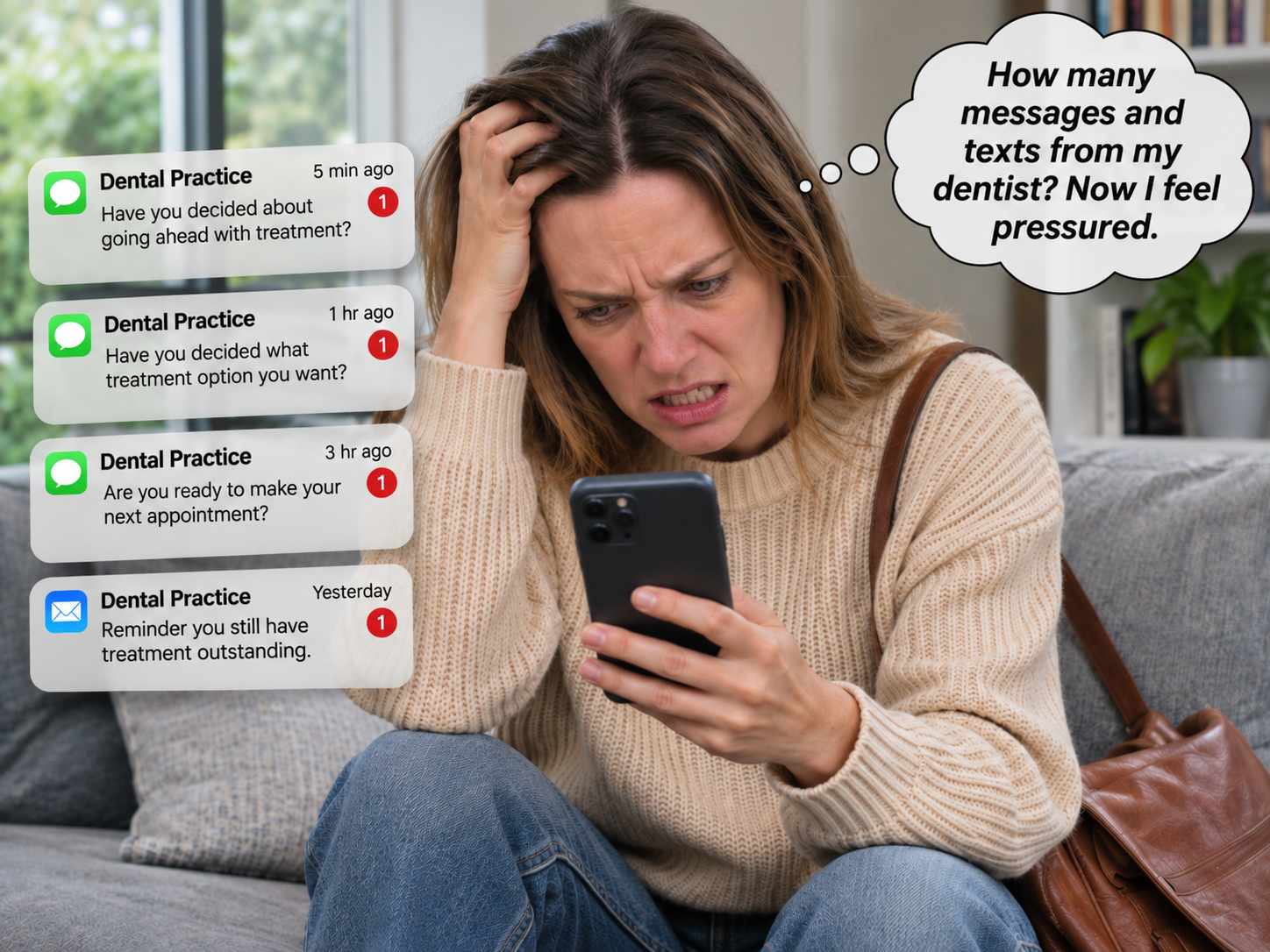
One delegate reflected on the number of times their treatment coordinator contacted patients who had not yet committed to treatment.
The intention was to be helpful, keep in touch and encourage patients to proceed. However, as they considered the experience from the patient’s perspective, they recognised that the frequency of contact could actually feel like bullying.
They began to wonder whether this might explain why some patients simply stopped responding or never returned.
Another delegate recognised that they rarely asked patients how they perceived the health of their own mouths or what they actually wanted to achieve.
They were carrying out thorough clinical examinations, identifying problems and explaining appropriate treatments, yet the conversation was largely driven by their own clinical assessment rather than exploring the patient’s understanding, priorities and concerns.
Someone else shared an equally important realisation.
They frequently presented patients with numerous treatment options, believing they were doing the right thing by giving them as much choice as possible. Then they admitted they sometimes felt confused and overwhelmed when explaining all the possibilities. Then the realisation, if they were feeling overwhelmed by the number of options, imagine how was the patient is feeling? Perhaps it wasn’t surprising that some patients struggled to reach a decision.
Another delegate commented that they had never really stopped to consider how the processes within their practice might feel to patients, and how closely some of those processes resembled the bad shopping experiences they had just been discussing.
None of these clinicians intended to create pressure, confusion or discomfort.
Quite the opposite. They cared deeply about their patients and believed they were doing their best to provide excellent care.
Yet good intentions do not automatically create good experiences.
Are your patients being cared for or being sold to?
This is where I believe we have an important opportunity to reflect on how we practise dentistry.
We are in the healthcare business, and both parts of that description matter.
Without the healthcare, we lose sight of our professional purpose, our ethical responsibilities and the difference we want to make to our patients’ lives.
Without the business, we cannot provide sustainable care, invest in our teams, maintain our facilities or develop our practices.
The challenge is not to choose between healthcare and business, but to create a healthy balance in which both can thrive.
What if improving patient treatment uptake wasn’t primarily about becoming better at convincing people to accept treatment?
What if it was about becoming better at understanding people, building relationships, helping patients explore what matters to them and supporting them to make decisions they feel confident and comfortable with?
After all, when you have a positive buying experience, when somebody listens to you, understands what you want, explains things clearly, respects your choices and gives you the time and freedom to decide, how do you feel?
Perhaps you feel respected, valued, understood, reassured and confident.
Perhaps you are more likely to buy, more likely to return and more likely to recommend that business to others.
Isn’t that exactly how we would like our patients to feel about us and our practices?

An invitation to look at your own patient journey
I’d like to invite you to revisit that earlier list of negative sales experiences, this time considering how your patients might experience your practice.
Think about the entire patient journey, from the very first enquiry through to the consultation, treatment planning, follow-up and ongoing care.
- How transparent and consistent are your treatment fees, and do patients understand what is included?
- How much time do you spend discovering what patients want, what matters to them and why they are seeking help now?
- Do patients feel listened to, or are conversations predominantly driven by what you want to explain?
- Are you presenting treatment options in a way that helps patients understand and decide, or potentially overwhelming them with information?
- Are your follow-up processes helpful and welcome, or could they be experienced as persistent pressure?
- Do patients feel they have genuine choice, control and permission to take the time they need?
- Is your patient journey designed around developing long-term relationships and improving health outcomes, or achieving an immediate treatment acceptance?
You can complete a self assessment here
If you would like to you can use one of our free self assement tools
Evaluate your current approach to patient Communication
Evaluate your perfect patient Journey
You may discover that many aspects of your patient journey are already excellent. You may also identify a few things that, despite being introduced with the very best intentions, could be creating experiences that are quite different from those you intended.
The most important question isn’t simply, ‘Are we selling enough treatment?’ It is, ‘What is it like to be a patient in our practice, and how might that experience be influencing the decisions our patients make?’
Better relationships.
Better experiences.
Better treatment uptake.
One of the most rewarding aspects of facilitating Patient Centred Sales – BEST CHOICES is watching dentists discover that improving treatment uptake does not require them to become pushy salespeople.
In fact, quite the opposite.
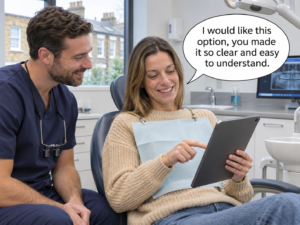
When you develop the skills to understand your patients more deeply, communicate in ways that make sense to them, explore their motivations and concerns, and support them in making informed decisions, the relationship changes.
The conversation becomes less about convincing somebody to accept what you are offering and more about helping them understand what is possible, why it may matter to them and what they would like to do.
Patients retain control of their decisions, whilst clinicians remain confident in their professional recommendations and responsibilities.
Not every patient will choose to proceed, and that is absolutely fine. A successful consultation isn’t simply one that results in a sale. It is one in which the patient feels heard, respected, informed and supported in making a decision that is right for them.
When patients feel confident about their decisions and understand the value of their care, treatment uptake can improve, patient relationships can strengthen and the practice can become a more enjoyable and rewarding place to work.
You don’t need to become a better salesperson. You need to become an even better communicator.
Discover Patient Centred Sales – BEST CHOICES
https://iodb.co.uk/patient-centred-sales-best-choices/
If you would like to improve the experiences your patients have, strengthen relationships, help more patients achieve better oral health through appropriate treatment uptake and develop a financially successful practice without feeling that you are selling dentistry, there is another way.
At Patient Centred Sales – BEST CHOICES, we share the approach, practical tools and communication skills that help dentists achieve these outcomes whilst remaining true to their professional values and their desire to care for people.
Because building trust, understanding patients and helping them make their BEST CHOICES should never feel like a hard sell.
Discover more about Patient Centred Sales – BEST CHOICES
I’d also love to hear your thoughts.