Are You Playing Catch or Just Throwing Words?
Rethinking Communication in Dental Practice
Running a dental practice isn’t easy. Whether you’re a dentist, a practice manager, or a team member, your day is likely packed with back-to-back patients, decisions, compliance tasks, and unexpected challenges. It can often feel as if you’re chasing your own tail, busy being busy.
And when communication breaks down—because someone didn’t hear, didn’t understand, or simply interpreted things differently—mistakes happen. Stress builds. Relationships become strained. Systems falter. At the root of much of this dysfunction is not laziness or lack of care, but ineffective communication.
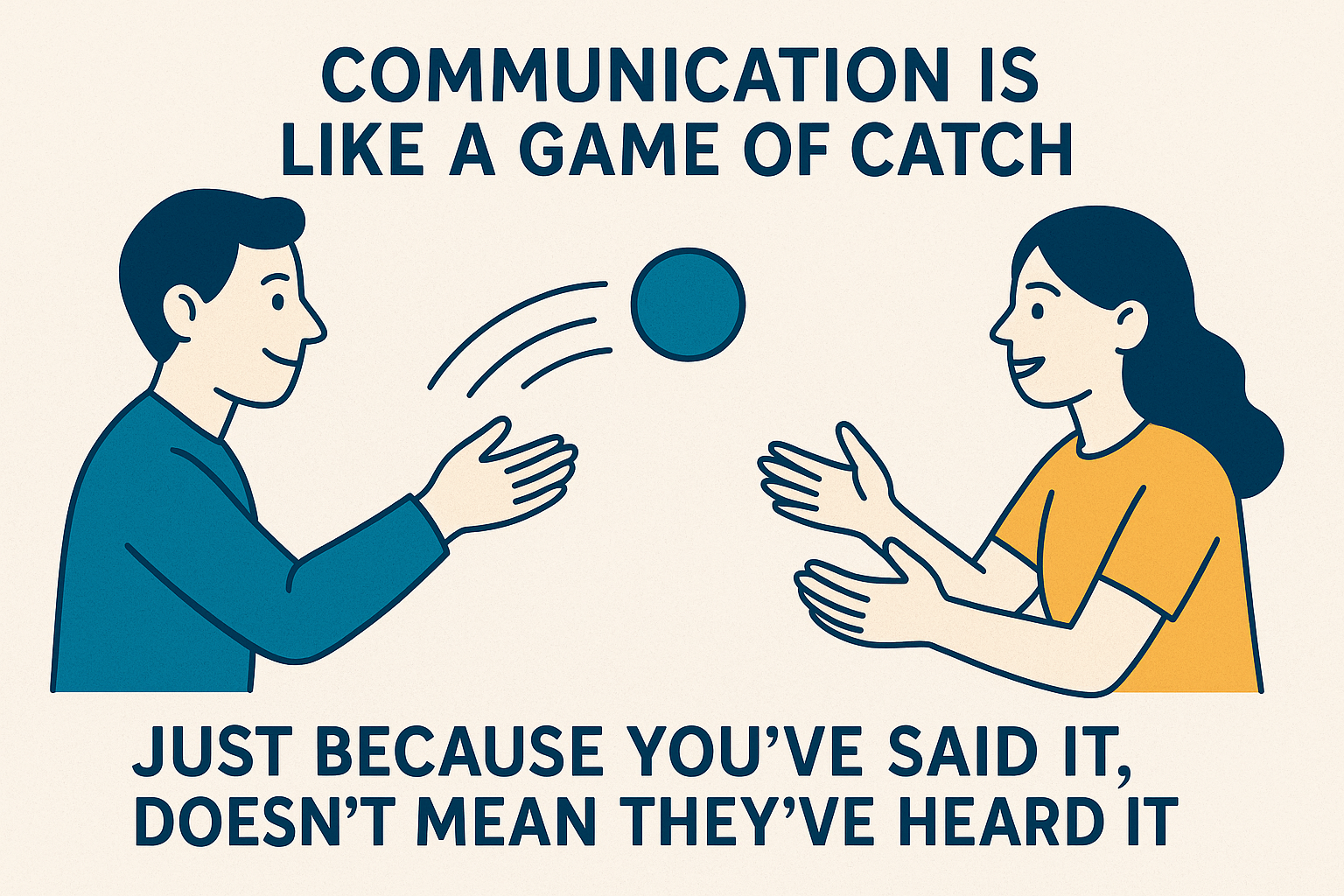
Let’s look at it this way: communication is like a game of catch.
When you play catch, you don’t just lob a ball and assume the other person has caught it. You watch them, make eye contact, and check that they’re ready. You might adjust how hard you throw, the direction, or even the size and shape of the ball depending on who’s on the other end. You don’t throw a medicine ball at a child and expect them to catch it easily.
In communication, it’s no different.
Just Because You’ve Thrown the Ball Doesn’t Mean They’ve Caught It
In a conversation, you may think, “Well, I’ve told them.” But the question is—did they hear you? Did they understand? Were they in a position to receive what you said?
They might have been:
- Distracted by a patient or a pressing task
- Thinking about something else
- In an environment with too much background noise
- Needing to lip-read because they’re hard of hearing and you were facing away
- Overwhelmed and unable to process more information in that moment
And even if they did hear the words, did they decode the meaning the way you intended?
We assume that speaking English is enough. But communication has dialects beyond regional accents—it includes thinking styles, sensory preferences, and personal filters. We each have a preferred way of catching the ball, so to speak—whether it’s a soft throw, a quick toss, or a slow roll.
The Shape and Feel of the Ball Matters
Some people prefer precise instructions, with timelines and lists (your Blues—measured, structured thinkers). Others want the big picture, the vision, the purpose behind the task (your Yellows—enthusiastic and future-focused). Some want to know the impact on others and if everyone is okay with it (your Greens—supportive and harmony-driven). Others simply want to know what result is expected and how quickly it can happen (your Reds—direct and action-oriented).
When you give a message in a way that’s right for you but not for them, it’s like tossing a ball they weren’t expecting, can’t see coming, or simply can’t hold onto. It drops.
And when balls drop in a dental practice, stress rises. Mistakes creep in. Trust erodes. You lose time, patients, and peace of mind.
So, How Do You Know the Ball’s Been Caught?
The most reliable way? Get the ball thrown back. Ask:
- What have you understood from what I’ve said?
- What’s your takeaway from this conversation?
- What will you do next?
- Is there anything unclear or needing clarification?
This isn’t about catching people out. It’s about making sure everyone is playing the same game, with the same rules.
Speak Their Language
Some of your team are visually oriented—they think in images, pictures, and layouts. Others are auditory—they need tone, clarity, and rhythm. Some are kinesthetic—they respond to touch, feeling, and environment. And others are internal dialogue driven—they process information through thinking and self-talk.
If you’re not sure what kind of “ball” someone can catch, observe:
- Do they say, “I see what you mean”? Visual.
- “That sounds right to me”? Auditory.
- “That feels like a good idea”? Kinesthetic.
- “I think this makes sense”? Internal dialogue.
By learning to adapt your throw—your message—to match their catch, you reduce stress, increase understanding, and build stronger, more collaborative teams.
In Summary
In your practice, communication is the glue that holds everything together—or the gap through which everything can fall apart. When you improve your communication, you don’t just get fewer misunderstandings—you get a team that feels seen, knows where they’re going, and wants to be part of the journey.
If you’ve ever wondered, “Am I speaking a different language to everyone else?”—you’re not alone. There are tools you can learn to translate your thoughts into language others can truly receive.
At the Institute of Dental Business, we teach communication skills, thinking pattern profiling, and decoding strategies to help you and your team move away from confusion and towards clarity, away from tension and towards trust.
To learn more about how we can support your practice, drop me a message. Because when we all play catch well, everyone wins.
Find out more by having a conversation with Jane.
Book a complimentary 30-minute conversation online www.IODB.co.uk