Are You Consenting or Contracting? Could This Be the Missing Link in Preventing Patient Complaints?
What if the secret to avoiding difficult patient relationships isn’t becoming better at spotting red flags, but becoming better at establishing the relationship before treatment begins?
Dentists frequently talk about identifying red flags. Those early warning signs that a patient might be difficult to please, have unrealistic expectations or potentially become a source of complaints.
We discuss the importance of recognising these warning signs and knowing when to say no.
But here’s something I’ve been wondering about.

Are we looking for the red flags too late?
Perhaps you’ve experienced a situation where everything initially seemed fine.
The patient agreed to treatment. You discussed the options, explained the risks, obtained consent and began what you believed would be a successful course of treatment.
Then, somewhere along the way, things started to unravel.
The patient wasn’t happy. Their expectations seemed to have changed. They questioned your decisions, became frustrated about the time treatment was taking, or expressed dissatisfaction with a result you considered clinically successful.
Communication became increasingly strained.
Trust deteriorated, suddenly, you found yourself dealing with a complaint, an unhappy patient, or a treatment relationship you wished you’d never started. In truth you had an uneasy feeling about this patient and the course of treatment (COT) as soon as you started treatment.
Looking back, you would recognise the red flags.
But what if the problem wasn’t that you failed to identify a difficult patient? What if the problem was that you and your patient never established a genuinely shared understanding of if you could and how you would work together? Afterall dentistry is all about relationships and partnerships in care.
Consenting and Contracting: What’s the Difference?
As dentists, we’re familiar with obtaining informed consent.
We understand our professional responsibility to explain treatment options, benefits, material risks, costs and alternatives, including the option of having no treatment.
We know consent must be voluntary, informed and ongoing.
I wonder whether we sometimes confuse agreeing to a treatment plan with agreeing on how we are going to work together.
Consent establishes whether a patient agrees to the proposed treatment.
Contracting establishes a shared understanding of how the dentist and patient will work together throughout that treatment journey.
They’re connected, but they’re not quite the same thing.
You might have a patient who fully understands the proposed clinical procedure but has entirely different expectations about the experience, the outcome, their involvement or your responsibilities.
Yet, neither of you realises that you are operating from different assumptions about how care is provided and what each of you expect from one another, until something goes wrong.

What Dentistry Could Learn from Coaching and SUPER-vision
Although my background is dentistry, I work as a coach and SUPER-visor. One of the fundamental principles of both professions is that meaningful work requires an effective working relationship.
In coaching and SUPERvision, before we begin the work, we spend time establishing that relationship through a process called contracting.
We explore what the client wants to achieve, what they expect from the relationship, what they need from us and what we need from them.
We agree how we will communicate, manage disagreements, review progress and recognise when something needs to change.
Importantly, contracting isn’t a one-off exercise, we contract for the overall relationship. And we contract for individual sessions. Sometimes we contract midway through a session, we pause and re-contract because something has emerged that may change the direction of our work, we don’t leave that to chance, we change the course of the conversation or not by design.
This isn’t about creating more paperwork.
It’s about making the unspoken spoken, the assumed understood and the uncertain clear.
That got me thinking.
What would happen if we introduced a similar approach into dentistry, particularly before beginning complex, expensive or long-term treatment?
Could we prevent some of those relationship problems before they develop?
Could we recognise incompatible expectations earlier, while there’s still time to explore and resolve them?
Could we create a stronger partnership in which both parties understand what they’re agreeing to and feel comfortable raising concerns?
I acknowledge this approach is difficult or rather impossible in the NHS framework, and for those working privately the initial contracting or chemistry session conversation can be absorbed into the treatment plan fees.
Introducing CONTRACTING: A Different Approach to the Dentist–Patient Relationship
I’ve taken the CONTRACTING framework that I use in coaching and SUPER-vision and explored how its principles could be adapted for dentistry.
There are eleven areas to consider.
Not every patient needs an eleven-part discussion. Because a routine appointment is very different from a year-long rehabilitation involving several clinicians, you can use what elements are appropriate.
The framework is intended to guide conversations, not become another form to complete.
The conversation is particularly valuable when the consequences of misunderstanding are significant, in terms of time, money, reputation and stress.
C – Context and Purpose
Why are we here, and what really matters?
Before we discuss what dentistry could provide, do we genuinely understand why the patient is seeking treatment?
Two patients requesting exactly the same procedure may have entirely different reasons for wanting it.
Consider asking:
- What has brought you here to explore this treatment, and why now?
- What is it about your current situation that you’d most like to change?
- What previous dental experiences might influence how you feel about treatment this time?
Understanding the context helps us recognise whether we’re addressing the patient’s actual priorities rather than making assumptions based on their presenting complaint.
O – Outcomes and Expectations
What does a successful result mean to each of us?
This is potentially one of the most important conversations we can have.
A dentist might define success as a clinically sound, functional and aesthetically acceptable result.
The patient might define success as looking twenty years younger, feeling confident enough to smile in photographs, or finally being free from embarrassment.
Neither perspective is necessarily wrong.
If we don’t explore the differences, disappointment can be almost inevitable.
Consider asking:
- Imagine your treatment has been everything you hoped for. What would be different in your life?
- What would make you feel delighted with the result?
- Is there anything that might leave you disappointed, even if the treatment is clinically successful?
This conversation also gives us an opportunity to explain what is realistically achievable, what cannot be guaranteed and where expectations may need to be reconsidered.
A shared understanding of success is far more valuable than two people privately assuming they mean the same thing.
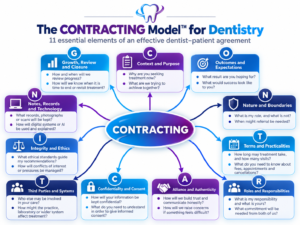
N – Nature and Boundaries
What are we agreeing to do, and what sits outside that agreement?
Patients don’t necessarily know where the boundaries of dentistry lie.
They may have expectations about the clinician’s availability, what can be achieved, how decisions will be made or the extent to which treatment can be modified.
Consider exploring:
- What are you expecting from me as your dentist?
- Are there aspects of treatment you’re particularly uncomfortable with or would prefer to avoid?
- If you want something I don’t believe is clinically appropriate, how shall we explore the alternatives?
This also allows the clinician to explain their professional boundaries, clinical limitations and responsibilities.
We cannot promise a particular outcome, agree to inappropriate treatment or remove a patient’s right to make their own decisions.
A strong relationship isn’t one in which the dentist agrees to everything the patient wants. It’s one in which both parties can have honest conversations about what is and isn’t possible.
T – Terms and Practicalities
How is this actually going to work?
Many disagreements arise not because the dentistry is poor, but because the practical arrangements were misunderstood.
Consider discussing:
- How many appointments might be needed, and what could affect the timescale?
- What are the costs, payment arrangements and potential reasons those costs could change?
- How will we communicate about appointments, delays, concerns or unexpected developments?
For complex treatment, agreeing these practicalities before starting can prevent a great deal of frustration later.
R – Roles and Responsibilities
Who is responsible for what?
This is where contracting can become particularly powerful.
The dentist is responsible for providing appropriate professional care. The patient has an important role in making decisions and participating in their care.
However, we should never assume the patient understands what their participation might involve.
Consider asking:
- What do you understand your role will be in helping us achieve the best possible result?
- What might make it difficult for you to follow the agreed home-care instructions, attend appointments or complete the recommended stages?
- What do you need from me and the team to help you participate confidently?
For example, periodontal treatment, orthodontics and complex restorative care may all require ongoing patient participation.
Discussing this openly, before treatment starts, allows us to identify practical difficulties before they affect treatment, it will also allow you to refine the treatment plan, defer it and to agree what additional support could be helpful.
This is not about transferring the dentist’s clinical responsibility to the patient or blaming a patient if outcomes are disappointing, it about understanding what each person can reasonably contribute.
A – Alliance and Authenticity
Can we be open and honest with each other?
Perhaps the most important element of any working relationship is the ability to have an honest conversation, particularly when something feels uncomfortable.
Consider asking:
- What helps you feel comfortable, listened to and able to ask questions?
- If something about your treatment worries or disappoints you, how would you prefer to raise it?
- If we have different opinions or something isn’t going as expected, how shall we approach that conversation together?
Imagine the difference if a patient felt genuinely comfortable saying, early in treatment, “I’m not sure this is what I expected.”, rather than remaining silent, becoming increasingly frustrated and eventually making a complaint.
The aim isn’t to avoid disagreement. It’s to create a relationship in which disagreement can be explored before it becomes conflict.
C – Confidentiality and Consent
Do we understand how information, choices and permissions will be managed?
This stage brings the contracting conversation back to our legal and professional responsibilities.
Patients need to understand how their personal information will be handled, who may be involved in their care and what they are consenting to.
Consider exploring:
- Is there anything about sharing your clinical information with other professionals that you’d like clarified?
- Do you have any concerns about clinical photographs, scans or records?
- What questions do you still have about your treatment choices, risks, benefits or alternatives?
- How do you feel about transcription of our conversations, to be used to create your records?
Separate permission may be needed for uses of photographs or information outside direct clinical care, such as marketing, training etc.
Critically, the contracting conversation does not replace valid clinical consent.
Patients retain the right to refuse treatment, change their minds or withdraw consent. Consent must be revisited as treatment progresses.
T – Third Parties and Systems
Who else might influence or be affected by our work together?
Complex treatment rarely involves only one dentist and one patient.
There may be dental nurses, hygienists, specialists, laboratories, treatment coordinators or other clinical professionals who make up the multidisciplinary team (MDT)
Family members, partners and carers may also influence the patient’s experience or decisions.
Consider exploring:
- Who else, if anyone, would you like involved in discussions about your treatment?
- There other professionals who need to contribute to your care, how would you like to engage with them?
- Is there anyone whose expectations or opinions might influence how you feel about the proposed treatment?
Where others are involved, we need to be clear about their roles, respect confidentiality and make sure the patient’s own wishes remain central.
This helps prevent confusion about who is making decisions, who is providing care and who should be contacted when questions arise.
I – Integrity and Ethics
How will we ensure that decisions remain appropriate, honest and in the patient’s best interests?
Occasionally, the treatment a patient wants is not the treatment we believe is clinically appropriate.
Sometimes the clinical outcome the patient expects isn’t realistically achievable, there may also be financial, personal or external pressures influencing decisions.
We need to establish that clinical recommendations will be made honestly, within professional standards and with the patient’s interests at the centre.
We might explore:
- What matters most to you when choosing between different treatment options?
- How would you like us to approach a situation where my clinical recommendation differs from your preferred option?
- What further information or support would help you make a decision you feel comfortable with?
Ethical dentistry requires more than obtaining agreement. It requires the willingness to have conversations that may result in the patient deciding not to proceed.
N – Notes, Records and Technology
How will we make sure important information is accurately recorded, understood and accessible?
How often do misunderstandings occur because the clinician believes something has been explained, while the patient remembers it differently?
For larger cases, written treatment plans, appropriate clinical photographs, summaries of discussions and documented changes can support a shared understanding.
Consider asking:
- How would you prefer to receive information about your treatment?
- What would help you remember the options, decisions and advice we’ve discussed?
- Is there anything about the technology we use, including digital records, photographs or AI-assisted systems, that you’d like explained?
Appropriate record-keeping and data protection remain the responsibility of the clinician, practice and clinical team.
The objective is not simply to create evidence that information was given, but to help ensure that the information was provided in a manner that it was understood by the patient.
G – Growth, Review and Closure
How will we know things are going well, and what happens when treatment ends?
In coaching and SUPER-vision, reviewing progress is an essential part of the relationship.
Why should dentistry be different?
For a long course of treatment, the relationship and expectations may evolve.
We might ask:
- How shall we check that treatment is progressing in a way you understand and feel comfortable with?
- If your priorities or circumstances change, how would you like us to revisit the plan?
- What will you need to know and do once active treatment has finished?
- What would you like to know about ongoing maintenance and recall now?
This provides an opportunity to agree arrangements for reviewing progress, discussing unexpected developments, understanding aftercare and recognising when treatment is complete.
A successful treatment journey isn’t just about how it begins or the clinical result. It’s also about how the patient experiences everything in between.
The Importance of Re-Contracting
One of the most valuable lessons I’ve learnt from coaching and SUPER-vision is that an agreement made at the beginning of a relationship doesn’t necessarily remain appropriate forever.
Circumstances change.
New information emerges.
Priorities shift.
What seemed straightforward at the beginning can become much more complicated.
Imagine a patient who begins orthodontic treatment, then several months later experiences a significant change in their personal or financial circumstances.
Or a patient undergoing a full-mouth rehabilitation who, loses their job, begins to question whether they can continue with treatment or if a revised planwill meet their expectations.
Wouldn’t it be better to pause, review and re-contract rather than continue simply because the original treatment plan was agreed?
Re-contracting might sound like:
“When we started, we agreed that this was what you wanted to achieve and how we would work together. Things seem to have changed a little. Shall we revisit what matters most to you now and explore the options available?”
Such a conversation can help restore clarity and confidence.
Of course, when clinical treatment or costs change, renewed informed consent and appropriate documentation are also necessary.
Perhaps Red Flags Aren’t Always Signs of a Difficult Patient
Here’s another thought worth exploring.
We tend to think of red flags as characteristics or behaviours belonging to the patient. what if some of those warning signs are actually indicators of a relationship that hasn’t yet been properly established?
A patient repeatedly questioning your recommendations might not be difficult, perhaps they are not difficult or picky, they just haven’t yet understood your reasoning or felt able to express what matters to them.
A patient with exceptionally high expectations might not be unreasonable, and maybe nobody has explored those expectations sufficiently to establish what’s achievable.
A patient who doesn’t follow home-care advice might not be uncooperative, possibly the practical obstacles, their understanding or their motivation haven’t been adequately explored.
Sometimes, we may discover the “chemistry” between us and them is not right, and we must acknowledge that we are not the right clinician to provide the treatment to that particular patient, if we do and we ignore our gut instinct, we run the risk of things going badly wrong.
The purpose of contracting is not to make every patient suitable for every dentist. It’s to discover whether we can establish an appropriate working relationship before either party makes a significant commitment.
That’s a very different perspective from simply labelling someone as a potentially troublesome patient.
What Could Change If We Contracted Before We Treated?
I wonder what the positive impact might be if we routinely invested more time in establishing the working relationship before beginning complex treatment.
Perhaps we would experience fewer misunderstandings because expectations had been explored rather than assumed.
Maybe, patients would feel safer expressing concerns, asking questions and sharing information that might otherwise remain hidden.
Potentially dentists would feel more confident discussing realistic outcomes, professional boundaries and situations where proceeding might not be appropriate. If you were to identify possibly difficulties much earlier, there would have been an opportunity to resolve them.
Conceivably, some complaints, failed relationships and stressful treatment experiences could be prevented.
There would undoubtedly still be disagreements, unexpected outcomes and complaints. No conversation can eliminate clinical uncertainty or guarantee a successful relationship. Despite that, I suspect the quality of those relationships, and the experience of everyone involved, could improve considerably.

Before Your Next Complex Case, Ask Yourself…
Have I simply obtained consent for the treatment, or have we also established a shared understanding of how we’re going to work together?
Do I really know what success means to this patient?
Does the patient understand what they can reasonably expect from me, and what participation may be required from them?
Have we established how we will communicate when things don’t go according to plan?
Most importantly, have we created a relationship in which both of us can have an honest, respectful conversation, even when that conversation is uncomfortable?
Invariably, the most valuable clinical decision is to delay starting treatment until we have established whether the right working relationship is possible.
Perhaps the solution to managing red flags isn’t simply learning to recognise them earlier and refusing to see the patient. Maybe, it’s learning to have the conversations that reveal them, explore them and, where possible, prevent or resolve them before they become problems.
I’d be interested to hear your thoughts.
How much time do you spend agreeing how you and your patient will work together, rather than simply agreeing what treatment you’re going to provide?
And could CONTRACTING be the missing step between consultation, consenting and beginning treatment?