Do you ever feel like you’re saying one thing, but people hear something completely different?
In dental practices, where every interaction affects both team dynamics and patient experience, miscommunication can be costly. Sometimes it’s not about what is said, but how it’s heard and interpreted.
Consider these questions:
- Are you (or others) treading on eggshells around a specific team member or subject?
- Do you upset people – or find yourself upset by others – without understanding why?
- Are certain people or conversations deliberately avoided?
- Do practice meetings constantly get postponed or taken off the calendar?
- Are there team members who refuse to work with specific nurses or clinicians?
- Do you delegate tasks, only to find your requests ignored?
If you answered yes to any of these, the communication within your practice may be falling short – leading to misunderstanding at best, or full-blown conflict and disengagement at worst.
Why We Misunderstand Each Other
To understand why communication breaks down, it’s helpful to look beneath the surface. What we say is not always what is heard, because every message is filtered by the mind before it’s interpreted. This is beautifully explained by The Communication Model.
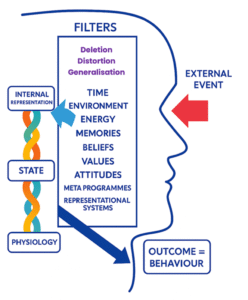
The Communication Model
Here’s a simplified view of what happens when we receive information:
- An external event occurs.
You see, hear, feel, taste, or smell something. - Your brain filters the information.
Because we are constantly bombarded with information, the mind must delete, distort, or generalise data to make sense of it. - Additional filters come into play, including:
- Time orientation: past, present, or future focus.
- Environment: where you are and how it affects your perception.
- Energy levels: positive, negative, calm, stressed, or tired.
- Memories: past experiences that influence current reactions.
- Beliefs and values: whether the message aligns or conflicts with what you hold true.
- Attitudes: personal, cultural, or familial attitudes that colour interpretation.
- Meta programmes: thinking patterns such as “towards vs. away from” (motivated by goals or avoidance), “action vs. reflection,” or “matching vs. mismatching.”
- Representational systems: your preferred way of processing information – visual, auditory, kinaesthetic, olfactory, or gustatory.
- Your mind creates an internal representation.
This could be an image, a sound, a feeling, or a combination of all three. - Your state of being changes.
The chemicals in your body shift according to how you interpret the event. - Your behaviour and response follow.
In a split second, this entire chain of events determines how you react – often outside your conscious control.
The Power of Triggers
We all know the power of a song or a scent to transport us back to a moment in time. Words and gestures can act in the same way – as emotional triggers. For example, if someone has been criticised or bullied in the past, a simple phrase or look can bring back all those feelings, resulting in what appears to be an “overreaction”. It’s not that the person is being unreasonable – they are simply responding to a deeply ingrained emotional memory.
That’s why, when we communicate, it’s important to understand not just the words we say, but the impact they have on others’ internal filters. Communication is both a psychological and physiological event.
Why Your Team Might Be Struggling
If you’re seeing signs of tension, avoidance, or misalignment in your team, the problem often isn’t the individuals – it’s the lack of understanding of each other’s communication and thinking patterns. When people don’t feel understood, morale drops, meetings become a chore, and collaboration suffers.
How Jane Can Help
As a dental business coach, I work with practice owners, managers, and entire teams to decode these invisible communication barriers. Through programmes such as:
- F5 Team Reboot – resetting your team’s energy and dynamics.
- Speak the Same Language as Your Patients – aligning language patterns for better patient connections.
- Bespoke In-House Training – tailored to your unique team challenges.
- 1-2-1 Leadership Coaching – helping owners and managers become confident communicators and leaders.
These approaches give you the tools to:
- Recognise and adapt to different thinking and communication styles.
- Create a culture of open, respectful dialogue.
- Reduce conflict and increase team harmony.
- Build stronger connections with patients.
The First Step
Understanding your own filters – and learning to identify those of your team – is the first step towards clear, collaborative communication.
Would you like to explore how your team could work together more effectively?
Let’s start a conversation. Together, we can find the right approach – whether that’s an in-house training session, a team reboot, or leadership coaching – to bring harmony and productivity back to your practice.
Contact me today to begin.
Jane@IODB.co.uk