What Course Should I Do Next? Using a Balance Wheel to Plan Your Professional Development
“What course should I do next?”
It is a question I am frequently asked by dentists and other dental professionals.
My answer is often another question:
“What do you think you need to develop?”
That can be an irritating answer when what you really want is for someone to tell you whether you should book the endodontic course, learn more about implants, improve your restorative skills or finally tackle occlusion.
Coaching is not about somebody else prescribing the answer, it is about developing your capacity to reflect, think critically, recognise what you need and have the confidence to make decisions that are right for you.
Your Personal Development Plan should be personal.
Not a collection of courses other people are doing.
Not whatever happened to appear in your inbox this week.
Not simply a scramble to accumulate CPD hours.
So how do you decide where to focus?
One simple coaching tool can be surprisingly revealing.
Meet the Balance Wheel
Recently, I was talking with a dentist whose field of practice is general dentistry, They were trying to decide where they should focus their clinical development over the next three years.
There were plenty of possibilities and that part of the problem that was preventing them from making a decision.
When almost everything could be developed, how do you decide what should be developed?
I introduced them to a classic coaching exercise: the Balance Wheel. You may have seen a version of a Balance Wheel used for areas of life such as health, relationships, career and finances and you can apply the same principle to your personal development plan.
Imagine a bicycle wheel.
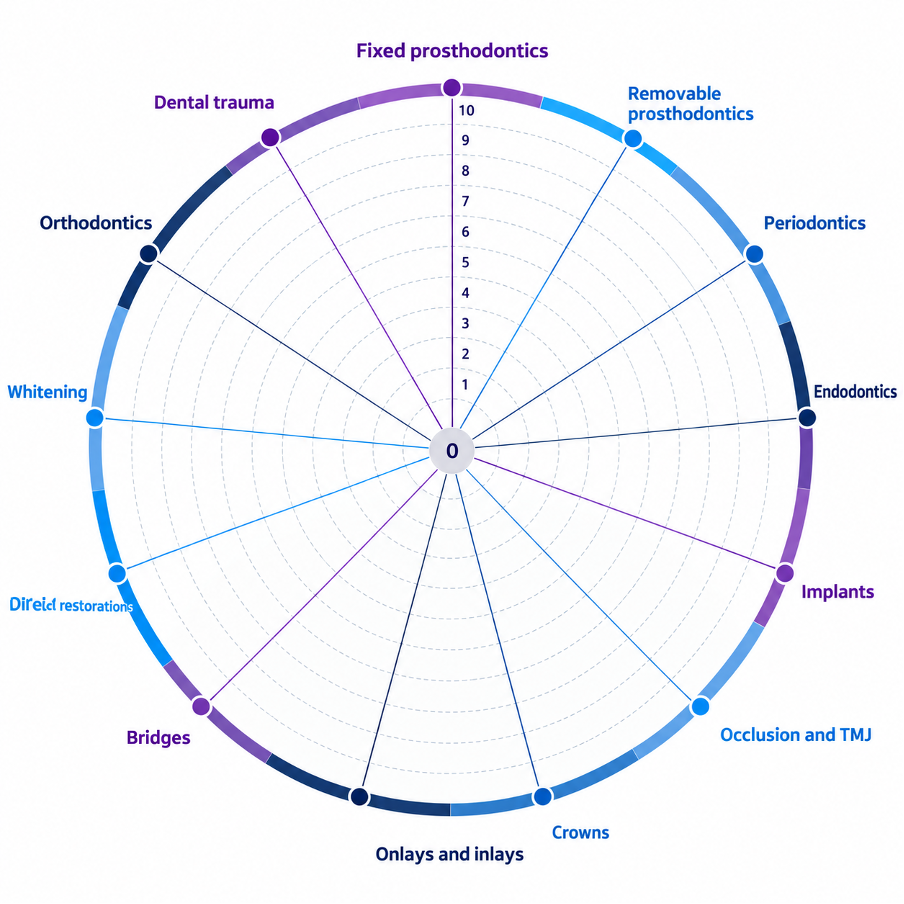
Each spoke represents a different area of your clinical work.
For a general dentist, those spokes might include:
- Fixed prosthodontics
- Removable prosthodontics
- Periodontics
- Endodontics
- Implants
- Occlusion and TMJ
- Crowns
- Onlays and inlays
- Bridges
- Direct restorations
- Whitening
- Orthodontics
- Dental trauma
There could be more. There could be fewer. This is a bout designing the balance wheel around you
That is the point, It is your wheel.

Now score each spoke
Place 0 at the centre of the wheel and 10 at the outer edge.
Then consider each spoke individually.
Ask yourself:
How satisfied am I with my current level of confidence and competence in this area?
Give yourself a score between 0 and 10 and mark it on the spoke.
Once you have worked your way around the whole wheel, join the points together.
You have now created a new perimeter inside your original circle.
Take a good look at it.
Then ask yourself:
If this were the wheel of a bicycle, what would the ride be like?
Smooth? A little bumpy? Some rather uncomfortable thuds along the way?
become curious.
What does your wheel tell you?
Look at the shape you have created and ask yourself:
What do I notice?
What surprises me?
What does this wheel tell me?
A Balance Wheel is a self-reflection tool, not an objective assessment of clinical competence. Your scores can therefore be explored alongside other evidence such as clinical audit, patient feedback, peer review, outcomes, significant events, complaints or discussion with colleagues.
You might even choose to score confidence and competence separately.
That could produce an interesting and entirely different conversation in itself.
Your lowest score is not automatically your priority
Instead, ask yourself, if I were to make a change in any area, which one would have most impact on the others?
Suppose you score yourself 3/10 for implants.
Does that mean you should immediately book an implant course?
Not necessarily.
If you have no intention of placing implants and your patients are appropriately assessed and referred, developing that skill may not currently be relevant to your field of practice.
Meanwhile, perhaps you score yourself 6/10 in endodontics, but you provide endodontic treatment several times a week and regularly encounter cases that stretch your confidence.
Moving from 6 to 8 there might have far greater value than moving implants from 3 to 5.
The question is not:
“Where is my lowest score?”
It is:
“Where would development be most useful, relevant and valuable?”
There is no perfect dental Balance Wheel
Ovoid copying, the spokes on somebody else’s wheel are yours and someone else’s may be different. There is no definitive dental Balance Wheel.
A specialist endodontist would create very different spokes from an orthodontist. A dental hygienist’s wheel might look completely different from a dental therapist’s. A dental nurse moving towards a leadership, patient care coordination or management role may choose different areas again.
Even two general dentists working in the same practice may create quite different wheels because their interests, current skills, patients and future ambitions are different.
The first part of the exercise is therefore deciding what belongs on your wheel.
That decision itself requires reflection.
What does your current role require?
Where do you want your career to go?
What are you doing frequently?
What would you like to do more of?
What would you like to become better at?
What does your patient population need from you?
Your answers determine your spokes.
Turn your wheel into a Personal Development Plan
The Balance Wheel becomes particularly useful when you move from reflection to planning.
The GDC requires dental professionals to maintain a Personal Development Plan as part of their CPD record. The PDP should identify CPD relevant to your current or intended field of practice, link activity to development outcomes and include the timeframe in which you plan to complete it. The GDC also encourages professionals to review their PDP as their role and learning needs change.
I invite you to take the insights from your wheel and consider three timeframes:
- Short term
What would be most useful for me to develop during the next 6–12 months?
Perhaps there is one particular area where additional knowledge, mentoring, observation or hands-on training would make an immediate difference.
- Medium term
Where would I like to be in the next 1–3 years?
This may involve developing greater depth in aspects of dentistry you already provide or beginning to expand your skills into another area.
- Long term
What sort of dental professional do I want to become?
Perhaps your longer-term development is not simply about another clinical technique at all.
It might involve leadership, communication, mentoring, education, management, behavioural skills or an entirely different direction within dentistry.
Now your PDP starts becoming a deliberate plan rather than a list of courses.
You might need more than one wheel
You don’t have to squeeze every aspect of professional development onto one enormous, unreadable diagram.
In fact, I wouldn’t.
You might create one wheel for clinical development and another for professional, regulatory and compliance-related learning.
The GDC currently identifies several CPD topics as particularly relevant to many dental professionals. These include medical emergencies, disinfection and decontamination and, where relevant, radiography and radiation protection. It also recommends areas including legal and ethical issues, complaints handling, oral cancer and safeguarding.
Depending upon your role and workplace, your second wheel might therefore contain compliance areas such as:
- Medical emergencies
- Infection prevention, disinfection and decontamination
- Radiography and radiation protection, where relevant
- Safeguarding
- Legal and ethical issues
- Health and safety
- Information governance and data security
- Other role-, employer- or setting-specific training

Again, ask yourself not only, “Have I done the course?”
Ask:
“How confident am I that my knowledge is current and that I can apply it?”
That creates a much more meaningful conversation about development.
Could you create Balance Wheels as a dental team?
I think this exercise could become particularly interesting when used across a practice.
Imagine each member of the team creating their own wheel before an appraisal or as I prefer to call them Achievement and Planning reviews (APR)
Nobody is being told where they are deficient.
Nobody is being handed a generic list of courses they must attend.
Instead, each person has an opportunity to stop, reflect and think:
Where am I now?
Where do I want to develop?
What support would help me get there?
The completed wheel could form part of your pre-appraisal preparation and provide the starting point for a genuinely useful development conversation. It may also reveal opportunities for learning within the team, one person’s area of strength may be another person’s development goal.
And remember not every learning need requires another external course.
As renewal approaches, don’t just count your CPD
For dentists, the GDC CPD year runs from 1 January to 31 December, with the annual CPD statement due by 28 January. For DCPs, the CPD year runs from 1 August to 31 July, with the statement due by 28 August.
So, as dentists move towards the end of the year and annual renewal, this can be a useful moment to do something more valuable than simply checking how many hours you have accumulated.
Take a blank piece of paper.
Draw a circle.
Add your spokes.
Score yourself.
Join the dots.
Then sit with what you have created for a moment.
What do you notice?
What is the wheel telling you?
What would make the greatest difference to your patients, your career and your enjoyment of dentistry?
And perhaps most importantly:
What do you now know about the answer to the question, “What course should I do next?”
Because your next course shouldn’t necessarily be the one everybody else is doing. It should be the learning that helps you move from where you are now towards the dental professional you want to become.
If you would like to discover more about coaching and how it can be applied to dentistry, just get in touch Jane@IODB.co.uk