Where Are You Emotionally in Dentistry Right Now?
The world of dentistry can be experienced in many very different ways.
Two clinicians can work in similar practices, see similar patients and face similar pressures, yet experience their working lives completely differently.
One clinician may finish the day energised, proud and excited about what they have achieved, another may leave feeling tense, frustrated and anxious. Someone else may feel calm, secure and quietly satisfied, another clinician may simply feel exhausted, disappointed and increasingly disconnected from a profession they once loved.
Our emotional experience is not simply about whether we feel “good” or “bad”. There are two important dimensions at play:
How pleasant or unpleasant the experience feels
and
How activated or energised we feel physically and emotionally.
When we combine these two dimensions, our emotional experience can broadly sit within four different zones.
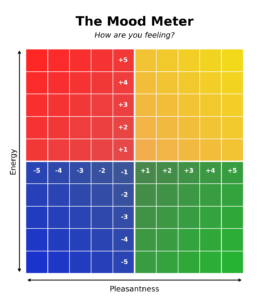
The Red Zone: unpleasant feelings with high energy
In this zone, our thoughts may feel pessimistic, threatening or uncomfortable while our body is highly activated.
Our heart may beat faster.
Our breathing may become quicker.
Our muscles may tighten.
Our mind may race.
The emotional cluster might include feelings such as:
- Angry
- Anxious
- Frustrated
- Frightened
- Annoyed
- Panicked
- Tense
In dentistry this might look like lying awake thinking about tomorrow’s difficult patient, feeling your heart race when you see a complaint arrive, becoming increasingly irritated with the diary or feeling constantly “on edge” throughout the clinical day.
There is plenty of energy here.
Unfortunately, it may not be energy that feels particularly helpful.
The Yellow Zone: pleasant feelings with high energy
This is also a highly activated state, but the experience feels positive. Highly optimistic, upbeat , very pleasant thoughts combined with being highly energised, stimulated, rapid heartbeat, fast breathing and possibly high temperature
You may feel:
- Happy
- Excited
- Ecstatic
- Energised
- Inspired
- Focused
- Proud
Perhaps you have completed a case you are particularly pleased with.
Maybe a patient has thanked you for changing the way they feel about dentistry.
Perhaps your team has worked brilliantly together, you have learned something new or you suddenly feel excited about where your career could go next.
The physical energy may be similar to the Red Zone, yet our interpretation and emotional experience are very different.
The Green Zone: pleasant feelings with lower energy
Not every positive emotional state needs to feel exciting.
Some of the most valuable experiences in dentistry may be quieter.
In the green zone you will likely be, Highly optimistic, upbeat , very pleasant thoughts combined with being low energy, sluggish, low level of stimulation, slow heartbeat, slower breathing and possibly low temperature
You might feel:
- Calm
- Content
- Relaxed
- Grateful
- Secure
- Serene
- Thoughtful
This could be the feeling of finishing your clinical day knowing you did good work.
It may be sitting with a patient and having the time to really listen.
It might simply be feeling comfortable in your own competence without needing to prove anything to anyone.
For many clinicians, spending more time here can feel enormously restorative.
The Blue Zone: unpleasant feelings with lower energy
Here the experience is unpleasant, but instead of feeling highly activated, you may feel depleted or withdrawn. Here you ma you will commonly be, highly pessimistic, downbeat , very unpleasant thoughts combined with being low energy, sluggish, low level of stimulation, slow heartbeat, slower breathing and possibly low temperature
Feelings might include:
- Sad
- Lonely
- Exhausted
- Disappointed
- Hopeless
- Bored
- Ashamed
You may notice yourself thinking:
“I don’t know how much longer I can do this.”
“Dentistry isn’t what I thought it would be.”
“Everyone else seems to be coping better than me.”
Or perhaps there is no dramatic thought at all.
Just tiredness.
Disconnection.
A gradually disappearing enthusiasm for a career that once mattered deeply to you.
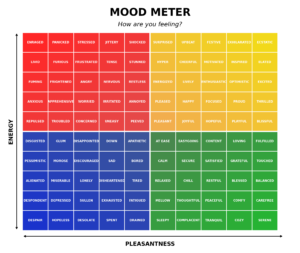
Which zone are you spending most of your time in?
When I read conversations within dental Facebook groups and speak with clinicians, I notice how frequently people describe experiences that appear to sit within the Red and Blue Zones.
Anxious.
Tense.
Frustrated.
Exhausted.
Disappointed.
Sometimes even hopeless.
Quite understandably, the next question is often:
“How do I get out of here?”
How do I move from anxious to calm?
From exhausted to energised?
From frustrated to focused?
From disappointed to hopeful?
There are ways of changing our emotional experience.
But there is an important catch.
There isn’t one solution that works for everybody
The strategy that helps one clinician may do very little for another.
Going for a run might be enormously helpful for one person, for somebody else, the thought of adding another activity to an already exhausting day may make things worse.
Positive self-talk may help one person, another may find it irritating or unbelievable.
Meditation may work beautifully for somebody, someone else may need movement, conversation or practical change rather than sitting quietly with their thoughts.
Your emotional regulation strategy needs to begin with you.
Where are you starting?
Where would you like to move towards?
And what actually helps you make that transition?

PRIME your emotional state
One useful way to think about emotional regulation is through the acronym PRIME.
We can develop strategies that help us:
P — Prevent
Prevent unwanted emotional states where possible.
R — Reduce
Reduce the intensity, duration or frequency of feelings that are not serving us.
I — Initiate
Create more of the emotional states we would like to experience.
M — Maintain
Help desirable emotional states last for longer.
E — Enhance
Strengthen the emotional experiences that support us, our patients and our lives outside dentistry.
The aim is not to walk around feeling permanently happy.
That would neither be realistic nor particularly human.
All emotions carry information.
The opportunity is to become increasingly skilled at recognising what we are experiencing, understanding what may be contributing to it and developing choices about what we do next.

Your strategy needs two legs
Imagine trying to walk using only one leg.
It is possible to make progress, but it is unnecessarily difficult.
Emotional wellbeing is similar.
A useful strategy often combines two elements:
Thought strategies
and
Action strategies.
The overlap between the two is where significant change can begin to happen.
- Thought strategies
Our interpretation of an experience can have an enormous influence on how that experience feels.
Thought strategies might include:
- More helpful self-talk
- Reframing a situation
- Acceptance of what cannot currently be changed
- Gratitude
- Questioning assumptions or predictions
- Recognising your strengths and talents
- Short-term distraction when some immediate breathing space is needed
This is not about telling yourself everything is wonderful when it clearly isn’t.
It is about becoming curious about whether the thoughts accompanying an emotion are accurate, useful and giving you access to the choices you need.
- Action strategies
Sometimes the most useful change is not inside our head.
It is something we need to do.
Action strategies might include:
- Good sleep, nutrition & hydration and physical health
- Moving your body
- Spending time outdoors, particularly in nature
- Talking with someone you trust
- Reading or journalling
- Doing something creative
- Changing your physical environment
- Changing something within your working environment
And sometimes the appropriate action could include
- Changing your diary.
- Setting a boundary.
- Having a conversation.
- Asking for help.
- Changing the way the practice works.
- Or recognising that something you have been tolerating for far too long actually needs to change.

What works for you may change
You are not a static human being.
The strategies that helped you as a newly qualified dentist may not be the strategies you need as a practice owner.
What worked before parenthood, illness, menopause, bereavement, business ownership, financial pressure or changing career expectations may not be what works now.
Our emotional strategies need to evolve with us, this is also one of the reasons self-coaching can have limitations, it is difficult at best and usually impossible to see all of our own patterns while we are living inside them.
You don’t always need to work it out alone
A coach or supervisor can provide a space in which you can think more clearly about what you are experiencing without immediately trying to fix, minimise or dismiss it.
Together you may explore how to:
- Recognise what you are feeling
- Understand what may be contributing to those feelings
- Label emotions more precisely rather than simply describing everything as “stressed”
- Express what you are experiencing safely
- Regulate your emotional state by developing personalised thought and action strategies
Sometimes simply discovering the right word for what you are feeling can change the conversation.
“Stressed” might actually mean frightened, overwhelmed, angry, ashamed, lonely, disappointed or exhausted.
Each of these feelings will likely require a very different approach.

You are not trying to eliminate the Red and Blue Zones
- There will always be difficult patients.
- here will be days when things go wrong.
- There will be complaints, mistakes, uncertainty, difficult conversations and moments when dentistry asks more of us than we would like.
The goal is not to create a life in which unpleasant emotions never appear, it is to develop greater emotional agility.
Recognise where you are in this moment.
Understand what is happening.
Label the feeling
Express your emotions
Then you can discover what helps you regulate your feelings and nervous system, then you will have a greater ability to move towards the emotional states that allow you to think, communicate and practise at your best. (Yellow and green)
Perhaps that means moving from anxious to calm.
From frustrated to focused.
From exhausted to secure.
From disappointed to hopeful.
Or simply spending a little more of your working life in the Yellow and Green Zones: happy, inspired and proud, or calm, content and secure.
Where are you today?
If your emotions are beginning to interfere with your ability to be the clinician you hoped you would become, it may be worth paying attention to them rather than simply pushing through.
And if you are beginning to wonder whether you even want to remain in dentistry, exploring what is happening before making a major decision may reveal possibilities you cannot currently see.
You do not necessarily need someone to tell you what to do.
Sometimes you need a confidential space in which you can hear yourself think.
If this has connected with you and you would value a space to explore what you are feeling, what is triggering it and what your own personalised PRIME strategy could look like, you are welcome to book a coaching conversation with Jane.
Here is a guide to booking appointments using our SOE booking system on line
Wherever you are starting from, the first question may simply be:
Where would you like to be instead?