Is It a Hardware Problem or a Software Problem?
A new way to think about your mental and emotional wellbeing
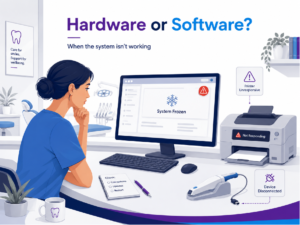
You arrive at the practice, switch on the computer and nothing happens. Perhaps it turns on, but it is painfully slow. Your e mails wont load, the scanner will not connect, the practice management system has decided it does not want to speak to the printer. You press buttons, turn it off and back on again, all to no avail.
This is not want you want on a Monday morning the computers are just not working.
Is this a hardware problem or a software problem?
Is there something wrong with the physical equipment, or is there something wrong with what is running on it, maybe a virus? Sometimes it is a bit of both.
This is a useful metaphor for those times when you are not functioning at 100%.
Perhaps you are more anxious than normal, maybe you are struggling to concentrate, potentially small things are irritating you.
Its Monday morning, your resilience has disappeared, you are exhausted before the clinical day has really started, your confidence is at rock bottom.
Before immediately deciding that something is fundamentally wrong with you, and you need to change job or leave the profession, it may be useful to ask:
Is this a hardware problem, a software problem, or a combination of both?

Your hardware: the physical system
Your hardware is your body and the physical environment in which you are asking your brain and nervous system to operate.
This will include:
- sleep and genuine recovery
- nutrition and hydration
- movement and exercise
- Being outside
- daylight, fresh air and time outside
- physical health
- rest and downtime
- workload and physical exhaustion
We sometimes expect extraordinarily sophisticated performance from rather poorly maintained hardware.
Imagine expecting your surgery computer to run eight different programmes simultaneously when it has not been updated for years, its memory is full and it is overheating.
Yet as clinicians we usually ask something remarkably similar of ourselves.
You may be sleeping for only five hours a night, starting early, finishing late, missing lunch, when you do, it is reheated ultra processed food, and you bounce from sugar hit to sugar hit, no fresh vegetable or fruit, drinking coffee instead of water, spending ten hours in artificial light, sitting or standing in highly concentrated positions and carrying the emotional responsibility of one patient after another.
Then you wonder why you feel irritable, anxious, emotional, overwhelmed or unable to concentrate.
Your psychological and emotional experiences are not independent of your physical system.
Sometimes what initially looks like a thinking problem is at least partly an exhausted-human-being problem.
Before analysing everything, check the hardware
You might ask yourself:
How well am I sleeping?
Am I eating properly and regularly?
Am I adequately hydrated?
Am I moving my body?
When did I last spend meaningful time outside?
Am I allowing myself to recover?
Is the workload I am asking my body to sustain actually sustainable?
It sounds almost too simple.
But simple does not mean insignificant.

Your software: what you are running
Then there is the software.
Your software includes your thoughts, beliefs, assumptions, interpretations, memories, expectations and internal representations.
In other words, it includes the way your mind is making sense of what is happening.
Some of this software comes from within:
- the pictures you create in your mind
- your internal dialogue
- the meaning you attach to an event
- beliefs about yourself and other people
- assumptions
- expectations
- memories
- predictions about what might happen next
Imagine that a patient says:
“I need to think about it.”
One clinician hears those words and thinks:
That is perfectly reasonable. I have given them the information they need. They can decide when they are ready.
Another clinician hears exactly the same words and thinks:
I have explained this badly. They don’t trust me. I am terrible at discussing treatment. They are probably going to complain.
Same patient.
Same words.
Very different software operating
The results are a very different emotional experience.
Software also comes from what you consume
Not all of the software running through your mind originated inside you.
Think about what you repeatedly expose yourself to.
What are you:
- watching
- listening to
- reading
- scrolling through
- discussing
- comparing yourself with
- surrounding yourself with?
If you spend an hour before bed looking at apparently perfect dentistry on social media, reading arguments in professional groups, checking emails, following distressing news stories and mentally replaying the one difficult patient interaction from your day, you are giving your brain a particular set of material to process.
It should hardly surprise us when the resulting internal experience is not especially peaceful. What you repeatedly give your attention to becomes part of the software your mind is running.
That means you can become more deliberate about what you install.
Software can be updated
Unlike a computer programme, your internal software does not arrive with a helpful notification saying:
Version 3.7 is no longer supported. Please update now.
You can continue running beliefs and thinking patterns that were installed years or even decades ago.
Perhaps:
- I must never make a mistake.
- Patients must always like me.
- If somebody questions me, I have done something wrong.
- I ought to cope on my own.
- Asking for help means I am not good enough.
- I need to know the answer immediately.
- If another dentist is better at this than I am, it means I am failing.
At some point, those beliefs may even have served a purpose. Old software can become increasingly unhelpful when we try to run our present life through it.
The good news is your software can be upgraded
You can learn how to notice your internal representations.
You can learn how can question limiting assumptions.
You can alter the language you use with yourself
Usually, it is much easier to see what software is running when somebody such as a coach or therapist helps you examine it.
This is one of the valuable roles of coaching and therapeutic coaching. We rarely have a completely objective view of our own thinking because we are attempting to examine the software using the same software.
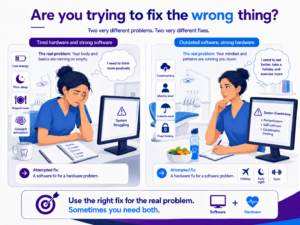
Are you trying to fix the wrong thing?
This is where the hardware and software distinction becomes particularly useful.
Sometimes we try to solve a hardware problem with software upgrade.
You may tell yourself to think more positively when what you actually need is sleep.
You may challenge your lack of motivation when your body desperately needs nutritious food, movement or recovery.
You may have searched for a sophisticated psychological explanation for why everything feels overwhelming when you have been working without a proper break for weeks.
There are also times when we try to solve a software problem with hardware.
We take a holiday.
We go to bed earlier.
We start exercising.
We improve our diet.
We reduce our hours.
All of which may be extremely helpful.
But when we return, the same beliefs and internal representations are unchanged, because you did not know how to upgrade the software.
As with how well the computers function, your mental and emotional performance, very often, needs both a hardware and software upgrade.
Rather than asking:
“Is this physical or psychological?”
try asking:
“What is happening in my hardware, what is running in my software, and which part of the system needs some attention?”
If you are feeling unusually anxious before a clinical session, for example, consider both.
Check the hardware
- Am I tired?
- Have I eaten?
- Have I had enough water?
- Have I been sitting in a windowless surgery all day?
- Has my body had any opportunity to move?
- Have I had any recovery time recently?
- Is the workload realistic?
Then check the software
- What am I imagining is going to happen?
- What picture am I creating in my mind?
- What am I saying to myself?
- What am I assuming about this patient?
- What am I assuming about myself?
- What am I predicting?
- Is that prediction actually true?
- What am I repeatedly exposing my mind to?
Neither hardware nor software should automatically be assumed to be the cause.
The purpose of the framework is to encourage us to look at the whole system before deciding what needs to change.
The words you use become part of the software
There is another important part of this.
Language matters.
- Stop using words that instil permanence
The words we use to describe our experience can influence how large, permanent and manageable that experience appears to us.
There is an enormous difference between:
“I am a failure.”
and:
“That did not go as well as I wanted.”
Between:
“I can’t cope.”
and:
“I am finding today particularly difficult.”
Between:
“Everything is going wrong.”
and:
“There are three things I need to deal with.”
The first version can feel global, permanent and overwhelming, the second begins to give the experience boundaries and an opportunity to make the situation manageable.
- Stop using identity-level language
Listen to the difference between:
“I am anxious.”
and:
“I am noticing some anxiety at the moment.”
Or:
“I am completely overwhelmed.”
and:
“There are several things competing for my attention and I haven’t yet decided what needs dealing with first.”
One makes the experience sound as though it is you, the second describes something you are currently experiencing.
That does not mean genuine anxiety disorders, depression, burnout or other mental health conditions should simply be renamed or thought away. Persistent, severe or concerning symptoms deserve appropriate assessment and professional support.
This is about something rather different, it is about avoiding language that unnecessarily turns a temporary experience into a permanent identity.
Where it is accurate to do so, use language that leaves room for movement.
- At the moment…
- Today…
- Recently…
- I have noticed…
- I am experiencing…
- There are times when…
Language can either close down possibility or create it.
- Stop using umbrella words
Words such as anxiety, stress, burnout and overwhelm can also become umbrella terms.
They may accurately describe something important, but sometimes the umbrella is so large that we can no longer see what is underneath it.
If I simply say:
“Dentistry is making me anxious,”
what exactly am I supposed to change?
Dentistry is rather large.
If I become more curious, however, I might discover:
I feel anxious about tomorrow’s patient.
More specifically:
I am worried about the crown preparation.
Underneath that:
I am worried there will not be enough reduction.
Underneath that:
I am worried the technician will criticise the preparation.
And underneath that:
I am charging the patient a lot of money for this treatment and I have not done any post grad courses to learn how to do this correctly.
Now we have something quite different to work with.
We have moved from the enormous umbrella of:
“Dentistry makes me anxious.”
to a much more specific observation, belief, or prediction that can be addressed.
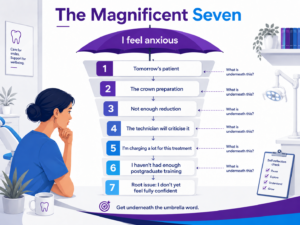
The Magnificent Seven
One way of getting underneath an umbrella word is to keep asking what sits beneath it.
If your starting point is:
“I feel anxious.”
ask:
“What is underneath that anxiety, or what triggers it?”
Perhaps the answer is A.
Then ask:
“What is underneath A, or what triggers A?”
That may reveal B.
Then explore what sits underneath B.
And continue until you get to G
I call this using The Magnificent Seven: gently exploring beneath the first answer rather than assuming the first label gives us the whole explanation.
The first answer is often the headline, the truth and most useful information is always several layers underneath. When you discover the root, you will discover a much smaller belief, trigger, memory, expectation or prediction that feels considerably more manageable than the original umbrella term.
You would expect to maintain your computer equipment are you prepared to look after Yourself?
If the practice computer repeatedly froze, you would not simply shout at it to try harder.
- You would check the hardware.
- You would update the software.
- You would uninstall the thing that is causing problems.
- You would delete the old unhelpful programmes running in the background.
- You would increase its capacity.
- You would call somebody who understands the system better than you do.
- You would probably introduce some routine maintenance rather than waiting for it to fail completely again.
What would be different if you cared for yourself in this way?
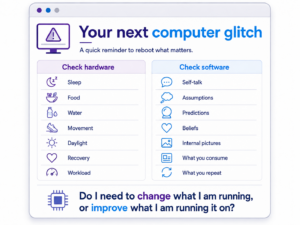
Your next computer glitch
So, the next time the computer freezes, the scanner stops talking to the software or the printer decides it has never met your practice management system before, perhaps allow it to become a reminder.
Ask yourself:
How is my hardware?
And:
What software am I running?
- Do I need more sleep, better nutrition, movement, daylight, recovery or a change in workload?
- Do I need to change an assumption, challenge a prediction, update an old belief or become more deliberate about what I am watching, reading and listening to?
- Perhaps both need some maintenance.
- Because improving your hardware can change the way your software runs.
- Changing your software can alter the way you experience what is happening through your hardware.
And sometimes the most useful question is remarkably simple:
Do I need to change what I am running, or improve what I am running it on?
If you would like to improve your mental and emotional health and resilence and would like to schedule a call wioth Jane, please book an appointment through our online booking platform. www.IODB.co.uk