
When Dentistry Hurts: Burnout, Moral Injury and the System Around Us
It is 3 o’clock in the morning and you are awake again.
You are replaying the patient conversation, the treatment that did not go quite as planned, the complaint that might arrive, the target you are behind on, the notes you did not finish, somewhere amongst all those thoughts is another:
Maybe I am just not good enough at this.
Perhaps you have started questioning whether you are resilient enough for dentistry. You look at colleagues who appear to be coping and wonder why you cannot. You worked incredibly hard to become a dentist, yet now you are asking yourself whether dentistry is even for you.
I would like to offer another possibility.
What if some of what you are experiencing is not because you are failing to cope, but because the environment in which you are working repeatedly conflicts with the kind of clinician you want to be?
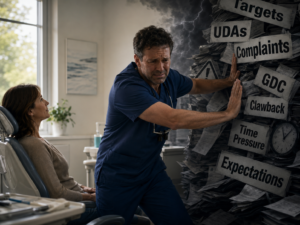
There is a name for this, Moral injury.
What is moral injury?
Moral injury can occur when you know what you believe is the right thing to do, but circumstances prevent you from doing it. For a dentist that might mean knowing a patient needs more time, a different treatment or a different approach, while working within a system that makes providing that care difficult. When this happens repeatedly, it can create guilt, anger, frustration, anxiety and a sense of being trapped or compromised.
There is an important difference between:
“I cannot cope.”
and
“I am struggling because I am repeatedly being asked to work in ways that conflict with my professional values.”
The first makes the problem entirely about you.
The second asks us to look at you and the system around you.
Burnout or moral injury?
They can feel very similar and often exist together.
Burnout says: “There is too much for me to carry.”
Moral injury says: “I am being prevented from doing what I believe is right.”
Burnout often brings exhaustion, reduced motivation, cynicism and a feeling that you have nothing left to give.
Moral injury may bring guilt, anger, frustration, loss of trust, fear of making mistakes and a growing sense that the clinician you want to be cannot exist within the environment in which you are working.
You can, of course, experience both.
| Burnout | Moral injury |
| Often associated with chronic workload and insufficient recovery | Often associated with conflict between what you believe is right and what you are able or required to do |
| Exhaustion | Guilt, shame, anger or betrayal |
| Reduced motivation | Loss of trust |
| Cynicism | Moral conflict |
| Reduced sense of achievement | Feeling compromised or powerless |
| Emotional depletion | Questioning your professional identity or values |
| May improve when demands reduce and recovery increases | May persist if the underlying ethical conflict remains |
This is not an absolute distinction.
Research increasingly suggests that burnout and moral injury can interact. Feeling trapped in an ethically uncomfortable system can eventually produce exhaustion, depersonalisation and feelings of ineffectiveness that look very much like burnout.

This distinction matters because you cannot necessarily self-care your way out of moral injury. Sleep, exercise, good food, holidays and relaxation are important, but they cannot fix a working environment that repeatedly conflicts with your values.
Why dentistry can create moral injury
There is no single cause, it is often the cumulative effect of many pressures.
- The NHS
You want to provide high-quality patient care, at the same time there are UDAs, targets, funding pressures, clawback, patient demand and the commercial realities of running a dental practice. When the care you believe a patient deserves and the care the system enables you to deliver repeatedly conflict, that can be deeply uncomfortable.
- Fear of regulation
Dentists absolutely need to be accountable and patients need protection and many clinicians describe practising with an ever-present fear of complaints, litigation or GDC involvement. Even where no wrongdoing has occurred, the possibility of a lengthy investigation can hang over somebody’s career, finances, family and wellbeing. This fear can leads to defensive dentistry rather than confident dentistry that you are proud to deliver.
- Complaints and litigation
A complaint should ideally begin a conversation. Increasingly, clinicians tell me they experience complaints as something to defend themselves against.
- What should I write?
- Should I apologise?
- Could this become a claim?
- Should I tell my indemnifier?
- Could this go to the GDC?
When every difficult patient interaction begins to feel potentially dangerous, relationships change.
- Patient expectations
Marketing, social media and digital technology have helped dentistry enormously, and they have also created extraordinary expectations. Software can create a perfect smile on a screen in seconds, Biology and clinical dentistry cannot. If patients expect perfection and clinicians feel responsible for producing it, the psychological pressure can become enormous.
- Social media comparison
You finish a difficult day and open Instagram.
- Perfect composites.
- Perfect implants.
- Perfect smiles.
What you rarely see are the decades of experience, the failed cases, the mentors, the training or the hundreds of cases that came before the one being displayed. You are comparing your everyday dentistry with somebody else’s carefully selected highlights.
Comparison really can be the thief of joy.
- The wrong practice environment
Sometimes the problem is much closer to home. A young clinician may be promised mentoring and support, only to discover that the mentoring disappears, appointment times are shortened and output becomes the priority. They may be working with inexperienced nurses while simultaneously being expected to train them, then criticised for running late or not producing enough.
That is a no-win situation.
Similarly, a practice may talk about putting patients first while its systems, targets and leadership communicate something very different, it often feels to you and the patients, it is all about the money.
A persistent values clash can take an enormous psychological toll.
- No space to recover
- The diary is full.
- The emergency gets squeezed in.
- Lunch becomes the time for notes, referrals and phone calls.
- The glass of water poured at 9am is still sitting untouched at 4pm.
Human beings need time to eat, drink, think and reset, These are not luxuries they are essential and human rights.
- Isolation
Dentistry can be surprisingly lonely.
Part-time working and busy diaries mean many practices have lost the informal conversations, peer review, team meetings, mentoring and shared lunches that once helped clinicians put difficult experiences into perspective. Sometimes what you most need after a bad morning is somebody experienced saying:
“That happened to me too.”

What can you do?
The first step is recognising what belongs where.
Ask yourself:
What is outside my control?
What can I influence?
What is mine to change?
If a particular working environment is repeatedly damaging you, it is reasonable to question whether you should remain in it.
- That might mean changing your NHS/private balance. It might mean developing your clinical or communication skills so you have more choices.
- It may mean changing practice.
- It may even mean changing direction within dentistry.
If the values of your practice and your own values fundamentally conflict, becoming more resilient may not solve the problem.
Sometimes you need a different environment. if you do choose to move, you must first understand what you need before choosing the next practice, otherwise you will bounce from practice to practice hoping to find the right one, and ending up more demoralised.
Take responsibility for what is yours
Moral injury does not mean every difficulty is caused by the system, we still need to look after ourselves.
- Your sleep matters.
- Food and hydration matter.
- Exercise and being outside matter.
- Connection, fun and a life beyond dentistry matter.
- Your communication skills matter.
- Your clinical development matters.
- Your boundaries matter.
These are within your control and influence.
Sometimes there are emotional wounds, beliefs or experiences that need appropriate psychological or therapeutic support. Emotional wounds may come from previous or current environments, our history, our habitual habits and thinking,
The answer is not to decide that everything is moral injury and neither should you assume that everything is you.

Maybe the question needs to change
If you are struggling at the moment, perhaps stop asking:
“What is wrong with me?”
and begin asking:
- “What is happening to me?”
- “What around me is contributing to this?”
- “What am I tolerating that needs to change?”
- “What can I influence?”
- “What kind of clinician and human being do I want to be from here?”
Consider for a moment
- Your anxiety does not automatically mean you are weak.
- Your Sunday-night dread does not mean you chose the wrong career.
- Your exhaustion does not automatically mean you lack resilience.
- And waking at 3 o’clock worrying about your patients does not mean you are a failure.
It may be that you are trying very hard to thrive in an environment that is making thriving incredibly difficult. Recognising the systemic impact could be the beginning of something much more useful.
If some of this feels uncomfortably familiar and you would like space to work out what belongs to you, what belongs to the system and what needs to change, please contact me at Jane@IODB.co.uk.
Sometimes the first step is simply having a truth-full conversation about what is really happening.