Overcoming Impostor Syndrome, the Valley of Despair, and More – Navigating the Journey as a Young Dentist.
As a dentist, your journey in the world of dental practice is both rewarding and challenging. Along this path, you may encounter various psychological and professional hurdles that can impact your confidence, competence, and ethical decision-making. In this blog, we’ll explore four concepts that dentists often face: Impostor Syndrome, the Valley of Despair in the Dunning-Kruger graph, Conscious Incompetence on the Mastery Cycle, and the importance of a pricking conscience.
Impostor Syndrome:
Impostor Syndrome is a common phenomenon where individuals doubt their abilities and fear being exposed as frauds, despite their qualifications and achievements. Dentists are not immune to this self-doubt, the nagging voice in your head that is constantly questioning your competence, so you feel like you don’t deserve your success. I have been enabling dentists to overcome imposter syndrome for years through therapeutic coaching sessions. One client recently had an insightful change in perspective, recognising what they had previously called their imposter syndrome, is instead that their identity as a dentist is like a set of clothes that are currently too big and they are growing into them. Acknowledging that undermining voice and addressing Impostor Syndrome through coaching is the first step to boosting your confidence, becoming a better dentist who provides great patient care.
The Valley of Despair
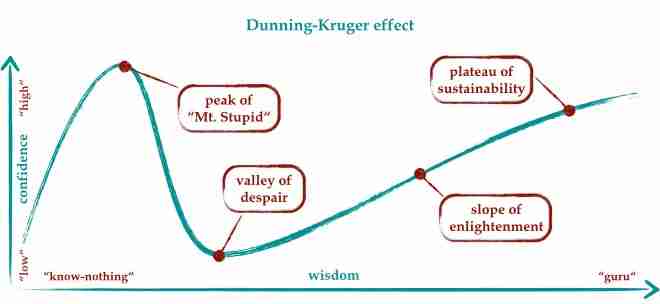
The Dunning-Kruger effect illustrates how individuals tend to overestimate their abilities when they’re in the early stages of learning or skill development. This can be particularly relevant for dentists who are just starting their careers. In the Valley of Despair, dentists may feel overwhelmed by the realisation of how much they have yet to learn. Within the first 5-10 years all young dentists will visit the valley of despair, some quickly get out, others get stuck and are there for months or years, others don’t see it for what it is, bouncing from practice to practice or even leaving the profession. However, it’s essential to view the valley of despair as a normal, predictable phase of your career development that holds the opportunity for growth. BDS is not the destination, it is your first step so that you can use your qualification to Begin the Development Sequence. You can see from the graph the only way out of the valley of despair is through training and skills development. a great approach is to sign up to Tipton Training events, they have a range of amazing clinical courses including the restorative course hands-on clinical skills. The Institute of Dental Business has lots of communication skills courses that will enable you to convert more of your treatment plans, reduce complaints and improve your confidence. Training is the bridge between overconfidence and true competence.
The Mastery Cycle
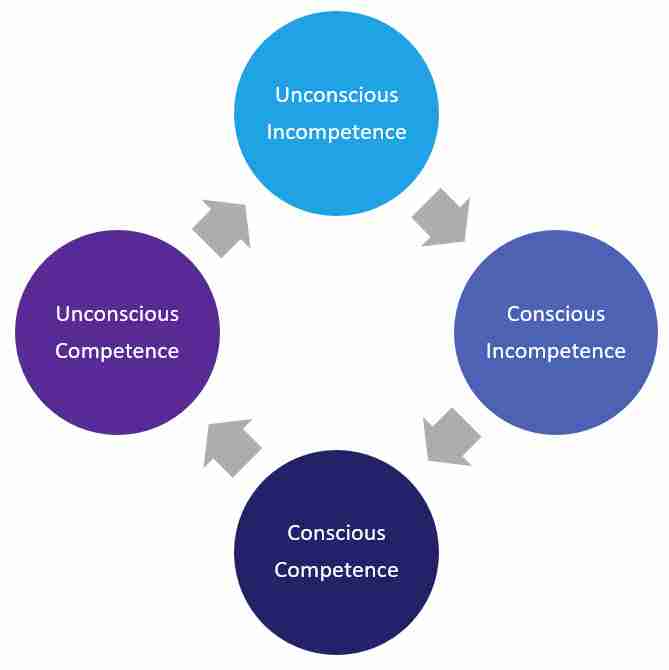
The mastery cycle is a 4-step process that once you have your BDS you will start and continue for the rest of your career. It is likely that you will be at different levels for various facets of your role as a dentist, clinical, non-clinical, communication at any one time.
Moving from unconscious incompetence to conscious incompetence is a stage of the Mastery Cycle where individuals become aware of their lack of skill or knowledge in a particular area, it is usually highly emotionally charged and often comes as a result of a mistake, complaint, or near miss. when we achieve BDS we often think we know all there is to know about dentistry, unfortunately this is not true. There is a commonly used expression that you only learn to drive once you have passed your test, the same is true of dentistry, you learn how to be a dentist and do dentistry only after you have qualified. It’s crucial for you to regularly map where you are on the mastery cycle and combining this with your personal development plan and your CPD. Embrace this phase as a stepping-stone toward conscious competence and unconscious competence before starting the cycle again. Engage in continuous education and professional development to enhance your skills and stay updated with the latest advancements in dentistry, work with a coach to manage the emotional, occasionally traumatic, and psychological elements of your professional development.
A Pricking Conscience:
Your conscience acts as a moral compass, guiding your decisions in your clinical dentistry. Professionalism is doing what is right when no-one is looking.
I have come across a small number of clinicians who think they are experiencing imposter syndrome when in truth it is a pricking conscience. These dentists experience constant internal conflict, feelings of low self-worth and may consider leaving the profession, because they are shutting down, downing out, or ignoring their internal wisdom. The most common situation is when young dentists are offering private dentistry, charging several times more than they were on the NHS without doing any additional training, clinically or in patient communication, they are offering the same treatment as they did under the NHS and charging significantly more. It is little wonder their consciences are pricking. It’s essential to maintain high ethical standards and priorities patient-centred care. Listen to your “pricking conscience” is it really telling you that you are an imposter and not good enough or is it telling you that you need to upskill? Uphold honesty, integrity, and transparency in your interactions with yourself, patients, and colleagues. Ethical behaviour not only strengthens your professional reputation but also fosters trust with your patients, reducing complaints building reputations.
Therapeutic coaching has simple quick interventions that enable you to listen and embrace your inner voices enabling you to tap into that wisdom, so you can practice private dentistry with confidence. If you are looking for places to develop your skills so you can step into private dentistry, I would encourage you to connect with all or some of the following,
Training Organisations
Tipton Training https://tiptontraining.co.uk/
British association of Private Dentistry (BAPD) https://bapd.org.uk/
British Association of Cosmetic Dentistry (BACD) https://bacd.com/
British Association of restorative dentistry (BARD) https://www.bard.uk.com/
Dentinal Tubules https://www.dentinaltubules.com/
The Institute of Dental Business https://www.IODB.co.uk
Specialist organisations
British Society of Periodontology https://www.bsperio.org.uk/
British Endodontic Society https://britishendodonticsociety.org.uk/
British Orthodontic Society https://www.bos.org.uk/
More besides
Conclusion:
As a dentist, you have a responsibility to provide quality dental care while maintaining the highest ethical standards. The journey to becoming a skilled and confident dentist may involve grappling with Impostor Syndrome, navigating the Valley of Despair, and recognising your Conscious Incompetence. However, these challenges are opportunities for growth and improvement.
Remember that your “pricking conscience” can guide you toward making ethical decisions that benefit both your patients and your practice. Embrace self-awareness, seek coaching, and prioritise ongoing education to excel in your field. By addressing these concepts head-on, you can continue to develop your skills, deliver exceptional patient care, and find fulfilment in your dental practice journey.