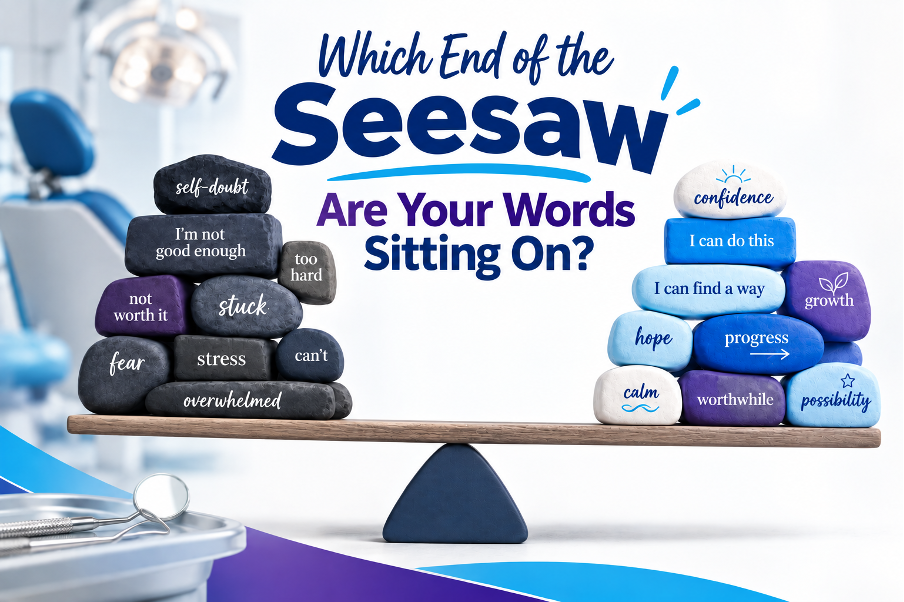
Which End of the Seesaw Are Your Words Sitting On?
Words are powerful.
The words we use influence what we notice, what we focus on, how we feel and, ultimately, how we behave.
Yet, much of the time, we are not particularly deliberate about the language we use.
We speak on autopilot, we repeat familiar phrases, we describe ourselves, our lives, our work, our relationships, and our circumstances using language that has become so habitual that we barely hear it anymore.
The problem is that habitual language can quietly become habitual thinking, and habitual thinking will influence what happens next.
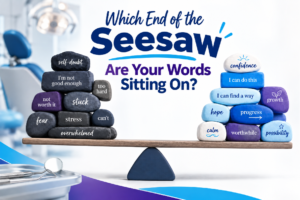
Imagine your words sitting on a seesaw
Imagine a seesaw, at one end is a collection of words and phrases associated with things you want to move away from, things that are negative, unpleasant, judgemental
Perhaps:
- “I’m not good enough, I always doubt myself.”
- “It’s too difficult, I can’t cope with this.”
- “There’s no point, It’s not worth it.”
- “I’m terrible at this.”
- “I’ll never get this right.”
- “Everything is stressful.”
- “I just need to get through today.”
These words may describe something that feels very real in that moment, they are not necessarily inaccurate, yet a question is how they direct your attention what the consequences are.
At the other end of the seesaw are words and phrases associated with possibility, movement, optimisms positivity, and things you would like to move towards.
Perhaps:
- “I can learn this; I can find a way.”
- “I’m getting better.”
- “This matters to me, it’s worth trying.”
- “What could I do differently?”
- “I have handled difficult things before.”
- “I don’t know how yet, I can ask for help.”
- “What is within my control?”
Neither end of the seesaw asks you to deny your reality. It is not about pretending that everything is wonderful when it is not. It is about noticing your language patterns and where they repeatedly direct your attention.
Which end are you sitting?
Listen carefully to yourself for the next few days, which end of the seesaw would you spend most of your time?
What do you say when something goes wrong?
What language do you use when you talk about yourself?
How do you describe your patients, your team, your workload or your future?
Do you regularly say:
“I have to…”
“I should…”
“I can’t…”
“I’m rubbish at…”
“They always…”
“It never…”
“There’s nothing I can do…”
Or does your language create a little more room for thought?
“I could…”
“I’d like to…”
“What if…”
“What can I influence?”
“What am I learning?”
“What would make this easier?”
“What is another way of looking at this?”
The difference may appear small, it could be one or two words, the tone, or emphasis, and those words determine the direction the conversation you are having with yourself.
We often cannot hear our own patterns
One of the interesting things about habitual language is that the person using it is often the person least likely to notice it. We hear what we mean rather than necessarily hearing the actual words coming out of our mouths. We may repeat a phrase hundreds of times and never hear it until someone else points it out, then we recognise how often we use it.
It is helpful to have a listening buddy, colleague, friend or coach who notices your patterns and can increase your awareness of the word patterns you use. Not to correct you, not to tell you that you must be more positive, simply to help you notice and bring your habits to conscious awareness.
“You’ve said ‘I have no choice’ three times.”
“I’ve noticed you describe yourself as struggling quite often.”
“Whenever you talk about that situation, you say, ‘I should’.”
“You keep saying you’re not ready. What would ready mean?”
Once a pattern becomes conscious, you have a choice about whether you want to keep using it.
This is not about positive thinking
Changing your language does not mean replacing every difficult thought with a cheerful one, if something is painful, frustrating, frightening or unfair, describing it honestly matters. The danger comes when a temporary experience becomes a permanent description.
“I’m finding this difficult” is different from “I’m useless at this.”
“I feel anxious about this conversation” is different from “I’m an anxious person.”
“I haven’t found the answer yet” is different from “There is no answer.”
“This hasn’t worked” is different from “Nothing works.”
One describes an experience.
The other risks turning that experience into an identity, a certainty or a prediction.
Usually, a very small linguistic shift creates enough space for a different thought to appear, that different thought may create a different action.
Try listening to yourself
For the next week, become curious about your language, don’t change anything initially, simply listen.
Notice the words you repeatedly use when you are under pressure.
Notice the words you use to describe yourself.
Notice whether your language closes possibilities down or opens them up.
Notice which end of the seesaw your words are weighing down.
You might even write down the phrases you hear yourself using most often.
Then ask yourself:
- Is this language helping me?
- Is it accurate?
- Is it the only way of describing what is happening?
- Where does this phrase direct my attention?
- How does it make me feel?
- What does it encourage me to do next?
And then
Is there another way I could say this that is still truthful, but more useful?
Your words do not have to be perfect
The aim is not to police every sentence you say, it is to become a little more conscious, because once you can hear your patterns, you can begin to choose. You can decide whether the words you have been using are supporting your confidence, your wellbeing, your relationships and your performance.
If you notice your words are quietly pulling the seesaw in a direction you no longer want to go, it puts you in the position of control.
I invite you, over the next few days, listen to yourself with curiosity.
Which end of the seesaw are your words sitting on?
If you would like to explore your linguistic patterns and the impacts they are having on your feelings and achievements, book a coaching session with Jane.
In the first instance you can choose either a SPEAK WITH JANE appointment or a FREE CALL FRIDAY session.
Book online www.iodb.co.uk