Open Loops: Could Unfinished Business Be Contributing to Your Stress and Overwhelm?
Do you ever have that nagging feeling that something isn’t quite right?
Perhaps you can’t put your finger on it. You’re getting through your working day, seeing patients, supporting colleagues, managing the demands of the practice, but something feels off.
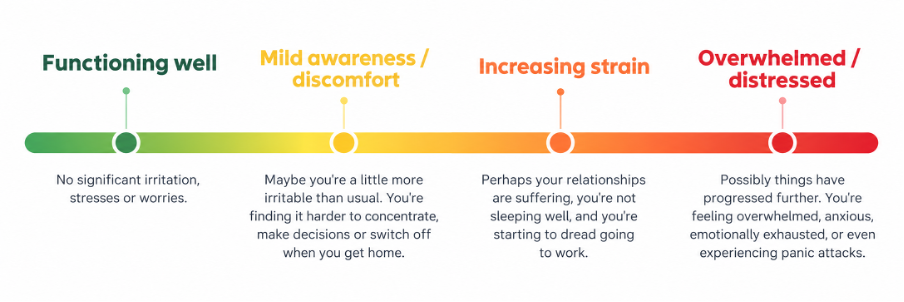
Maybe you’re a little more irritable than usual, you’re finding it harder to concentrate, make decisions or switch off when you get home, your relationships are suffering, you’re not sleeping well, you’re starting to dread going to work.
Possibly things have progressed further. You’re feeling overwhelmed, anxious, emotionally exhausted, or even experiencing panic attacks.
Wherever you are on that spectrum, it’s worth paying attention to what you’re experiencing.
How you’re feeling affects far more than your mood, it can influence your health, relationships, clinical decision-making, communication, confidence and enjoyment of life. Ignoring those early warning signs doesn’t make them disappear.
“If you don’t make time for your mental wellness, you will be forced to make time for and experience stress, anxiety, worry.
Your experience is unique to you
One of the things I’ve learnt through my years as a dentist, coach and therapeutic coach is that two people can experience what looks like the same problem, yet the underlying cause can be completely different.
That’s why understanding what’s really going on for you matters. Because, before you can make meaningful lasting improvements, it’s important to identify what is causing your particular experience – for the correct treatment, you must have the correct diagnosis.
While everyone’s experience is unique, there are some common patterns that can contribute to stress, anxiety and overwhelm.
One of those patterns is something I call incompletion and open loops.
What are open loops?
Open loops are unfinished tasks, unmade decisions, or unresolved commitments that your brain keeps active in working memory
Think about everything you’ve started but haven’t finished. Every decision you’ve been putting off. Every conversation you need to have but haven’t had.
In dentistry, it might be:
- Clinical notes waiting to be completed.
- Radiographs that need reviewing.
- A patient complaint that hasn’t been resolved.
- A difficult conversation with a colleague you’ve been avoiding.
- Decisions about your career, practice or finances that you keep postponing.
Then there’s everything happening outside work. The unanswered messages, unfinished jobs at home, relationship difficulties and decisions about your future.
Each unfinished task, unmade decision or unresolved commitment has the potential to become an open loop, something your mind keeps returning to, even when you’re trying to concentrate on something else.
Why do open loops matter?
Back in the 1920s, psychologist Bluma Zeigarnik investigated our tendency to remember unfinished or interrupted tasks. Her research gave rise to what is known as the Zeigarnik Effect, the idea that incomplete tasks can remain particularly prominent in our minds.
Imagine your brain has a limited amount of mental bandwidth, Every time an unfinished task or unresolved decision demands your attention, it’s competing for some of that capacity. One or two open loops might be manageable, but what happens when you have twenty, thirty or fifty? You probably find yourself constantly thinking about what you haven’t done, what you need to do, or what might happen if you make the wrong decision. Eventually, you may notice that your ability to concentrate, communicate, solve problems and make decisions begins to suffer, you become less effective, so tasks take longer or remain unfinished, and those unfinished tasks create even more mental clutter.
It’s a cycle that can leave you feeling increasingly overwhelmed, frustrated and exhausted.
I call this open loop fatigue.
So, what’s the answer?
The simple answer is to begin closing those loops.
Finish the unfinished tasks. Make the outstanding decisions. Resolve the commitments and have the conversations you’ve been avoiding. Of course, when you’re already overwhelmed, even deciding where to begin can feel impossible, sometimes what looks like procrastination or poor organisation is actually part of a much deeper pattern.
This is why it’s important not just to look at what’s happening, but to understand why it’s happening for you.

Don’t wait until you’re overwhelmed to make a change
Whether you’ve noticed a vague sense of dissatisfaction or you’re experiencing significant stress and anxiety, recognising that something needs to change is an important first step.
Working with an appropriately trained professional who can explore your thoughts, emotions, behaviours and thinking patterns can help you gain that understanding.
As a Master Certified Coach, therapeutic coach and NLP Master Practitioner, I work with people to explore their individual experiences, recognise patterns and identify opportunities for change.
Coaching can offer a valuable approach to understanding and changing unhelpful patterns, sometimes alongside other forms of professional support. If you’re experiencing significant anxiety or panic attacks, Therapeutic coaching can help too.
If something isn’t quite right for you, perhaps it’s time we had a conversation.
You don’t need to have all the answers, or even know exactly what the problem is, that’s something we can begin to explore together.
If you’d like to talk, visit www.iodb.co.uk and schedule a time for us to connect.
A problem can only be present in the absence of a truth-full conversation.