SUPER-vision: The Missing Piece in Dentistry’s Professional Support Network?
What if the key to becoming a better clinician isn’t more clinical training, but a deeper understanding of yourself?
Dentists spend years developing their clinical knowledge and technical skills. We attend courses, learn new techniques and invest in professional development.
Yet who is looking after the person behind the clinician?
Who helps you explore the impact of your thoughts, emotions, beliefs, relationships and working environment on your ability to perform, make decisions, communicate and thrive?
This is where SUPER-vision for dentists comes in.
What is SUPER-vision?
Firstly, forget the wagging finger. This isn’t about someone checking up on you, criticising your decisions or telling you what you’ve done wrong.
SUPER-vision is a supportive, confidential and collaborative process of guided reflective practice, designed to help you remain professionally effective, develop and flourish.
This is not a new concept outside dentistry – Is it time we caught up?
Clinical supervision has long been an established part of mental health and psychiatric services, where practitioners regularly work with emotionally demanding situations. Within professional coaching, supervision is also well established and supported by three leading professional bodies:
As you read through these definitions of what supervision is, I invite you to swap out the word coach / Supervisee and insert dentist or clinician. What would dentistry be like if we embraced and created this culture in our profession?
International Coaching Federation (ICF):
“Coaching supervision is a powerful path to continuous growth and professional excellence. Research shows it can:
- Increase your self-awareness and confidence.
- Boost your objectivity and resourcefulness.
- Combat isolation and foster a greater sense of belonging.
It’s a collaborative process where you engage in reflective dialogue with a trained supervisor to explore your practice, enhance your skills, and deepen your self-awareness. Through this partnership, you gain valuable support and guidance.
Unlike mentor coaching, which focuses on refining your technical skills, supervision takes a more holistic approach. It focuses not only on what you do as a coach, but on who you are and how you show up in your practice. Coaching supervision creates a safe space to reflect on both your successes and challenges, helping you become a more impactful coach.”
Association for Coaching (AC)
“Coaching supervision is a formal and protected time for facilitating a coach’s in-depth reflection on their practice with a Coaching Supervisor. Supervision offers a confidential framework within a collaborative working relationship in which the practice, tasks, process and challenges of the coaching work can be explored. The primary aim of supervision is to enable the coach to gain in ethical competency, confidence and creativity so as to ensure best possible service to the coaching client, both coachees and coaching sponsors. Supervision is not a ‘policing’ role, but rather a trusting and collegial professional relationship.”
https://www.associationforcoaching.com/page/WhatisCoachingSupervision
European Mentoring and Coaching Council (EMCC):
“A safe space for reflective dialogue with a practicing supervisor, supporting the supervisee’s practice, development and well-being.
The purpose of supervision is
- To ensure the supervisee maintains appropriate professional standards
- To facilitate the development of the supervisee’s professional practice
- To provide support for the supervisee’s well-being”
Three governing bodies, one underlying principle: looking after the practitioner is essential to supporting the people they serve. Does this sound like protecting patients?
Having been involved in supervision as a coach for over 20 years, I have experienced and witnessed first-hand its extraordinary impact on coaches, their professional development and the quality of their work.
I believe this is a vital missing piece in dentistry’s professional support network, and I am committed to introducing SUPER-vision into dentistry.
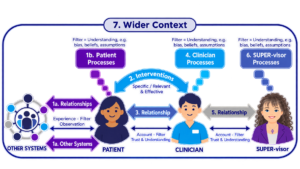
Introducing the Seven-Eyed Model of SUPER-vision
The Seven-Eyed Model, developed by Peter Hawkins and Robin Shohet, it provides a framework for exploring professional practice from seven different perspectives.
Using the model illustrated above, we can explore a specific incident that happens in surgery, an adverse outcome, a tense or angry patient interaction, a complaint and much more besides.
Using the seven-eyed model we could explore
- Patient processes, relationships and other systems – What’s happening for the patient, and how are their relationships, circumstances and the larger system, maybe your practice, the NHS, their workplace etc influencing the situation?
- Interventions – Clinically, what are you doing/ have you done, why, and what impact is it having?
- Clinician–patient relationship – What is happening between you and your patient, at a human to human level,
- Clinician processes – How are your own thoughts, emotions, beliefs and assumptions influencing your clinical practice, emotional intelligence, and patient interactions?
- Clinician–SUPER-visor relationship – What can we learn from the dynamics emerging within our reflective conversations?
- SUPER-visor processes – What is the SUPER-visor noticing, experiencing and understanding?
- Wider context – How are practice culture, team relationships, organisational systems such as the NHS, GDC, CQC etc and other external pressures influencing what’s happening?
Rather than simply asking, “What should you have done differently?”, SUPER-vision encourages a much more powerful question:
“What is happening within you, between you and others, and around you that is influencing how you practise?”
How is SUPER-vision for Dentists -different from coaching or mentoring?
Mentoring generally focuses on developing knowledge, experience and specific skills.
Coaching helps you achieve goals, overcome challenges and move towards a desired future.
SUPER-vision provides a reflective space to explore your professional experiences, responsibilities, relationships and wellbeing.SUPER-vision goes beyond what you do, exploring who you are, how you show up and how this influences everyone around you.
The purpose is threefold: to support your wellbeing, facilitate your professional development and help you maintain safe, effective and ethical practice.
What does SUPER-Vision mean?
SUPER-vision
S – Self What is happening within me?
U – Understanding What is happening around me?
P – Perspectives and Patterns Whose perspective have I not considered?
E – Expansion How can I expand my thinking and options?
R – Resolution What action creates progress?
This leads naturally to the idea that SUPER-vision helps you develop your performance by moving from:
- Reacting towards Reflecting
- Judging towards Understanding
- Certainty towards Curiosity
- Isolation towards Support
- Action Towards Intentional Action.
Could SUPER-vision be what you’ve been missing?
Perhaps you’ve experienced an unexpected clinical event, are struggling with difficult patient or team relationships, feel stuck in your career, or are experiencing stress, self-doubt or emotional exhaustion.
You don’t need to be struggling to benefit from SUPER-vision. It is equally valuable when things are going well and you want to develop greater self-awareness, confidence and professional mastery.
Because thriving as a clinician isn’t simply about what you know or what you do. It’s about who you are and how you show up.
Are you a dental professional with a coaching qualification?
If you’ve completed an ILM Level 3, 5 or 6 coaching qualification, or hold another recognised coaching qualification, In addition to offering SUPER-vision to clinicians, I also offer coach supervision to support your practice, reflective development and professional growth as a coach.
Let’s have a conversation
If you’re curious about how SUPER-vision could help you become a more effective, confident and fulfilled clinician, I’d be delighted to explore it with you.
DM me
A problem can only be present in the absence of a truth-full conversation.