The Curve You Are Living Every Day
There is a curve that quietly shapes everything you do in practice.
You feel it when your diary is empty.
You feel it when it is full.
And you feel it most when it is overflowing.
The Yerkes–Dodson Law describes the relationship between stress (or arousal) and performance.
At low levels of stress, performance is poor.
At moderate levels, performance peaks.
At high levels, performance declines.
Simple.
And profoundly important.

When There Is Not Enough Pressure
At the far left of the curve sits under-stimulation.
This is the clinician with:
- Gappy appointment books
- Long breaks between patients
- A sense of drift
It looks comfortable from the outside.
It feels anything but.
Motivation drops.
Focus softens.
Energy disappears.
You may even begin to question yourself:
- “Am I losing my edge?”
- “Why aren’t patients saying yes?”
The issue is not your clinical ability.
It is that you are operating below the level of stimulation required for peak performance.
When It Tips Too Far
Keep pushing, and the curve turns.
What once sharpened you begins to blunt you.
You start to feel:
- Rushed
- Irritated
- Mentally fatigued
Decision-making becomes harder.
Communication becomes shorter.
Listening becomes selective.
Then comes:
- Stress overload
- Exhaustion
- Anxiety
And eventually:
- Burnout
- Emotional withdrawal
- Loss of joy in the work
This is not a resilience issue.
It is a load issue.
No one performs well in chronic overload.

The Sweet Spot: Where Dentistry Feels Effortless
Think of Goldilocks and the three bears.
One bowl of porridge was too cold.
One was too hot.
One was just right.
Performance works in exactly the same way.
Too little pressure… and you drift.
Too much pressure… and you struggle.
But somewhere in the middle, there is a sweet spot.
Move along the curve and something shifts.
You are:
• Engaged
• Focused
• Present
There is a healthy tension.
You are running to time.
Patients are saying yes.
You are thinking clearly, communicating well, and delivering excellent care.
This is not “too little pressure”.
This is not “too much pressure”.
This is just right.
This is optimum stress.
Not relaxed.
Not overwhelmed.
Alert, purposeful, and in control.
This is where:
• Case acceptance improves
• Patient relationships deepen
• Clinical outcomes shine
This is where dentistry becomes deeply satisfying.

Why This Matters More Than You Think
Most dentists try to solve performance problems in one of two ways:
- Work harder
- Learn more clinical skills
Neither addresses the curve.
Because performance is not just about skill.
It is about state.
And your state is directly influenced by where you are sitting on this stress curve.
The Hidden Role of Communication
Here is where this becomes even more relevant.
When stress rises:
- You explain less clearly
- You rush conversations
- You assume understanding
- You default to familiar patterns
And patients feel it.
They hesitate.
They defer.
They say “I’ll think about it”.
Which creates:
- More pressure
- More stress
- Lower performance
A loop begins.
The Real Skill: Managing Your Position on the Curve
High performers are not those who eliminate stress.
They are those who regulate it.
That means:
- Recognising where you are
Are you:
- Under-stimulated
- In the zone
- Overloaded
Most people do not pause long enough to notice.
Making the appropriate changes
- Adjusting the environment
Sometimes the issue is not you, it is the system.
- Appointment spacing
- Diary design
- Time to eat and hydrate
- Time to think
- Team support
- Workflow
- Communication framework
These either support optimal performance or push you off the curve.
- Strengthening your communication under pressure
Because when pressure rises, communication is the first thing to deteriorate.
And yet, it is the very thing that:
- Builds trust
- Improves acceptance
- Reduces future stress
- Building reproducibility
Peak performance should not be accidental.
It should be structured.
A framework allows you to:
- Stay consistent
- Reduce cognitive load
- Perform well even under pressure
A Different Way to Think About Pressure
Pressure is not the enemy.
Too little, and you drift.
Too much, and you break.
The goal is not to remove pressure.
It is to calibrate it.
Because somewhere in the middle is a version of you that is:
- Clear
- Confident
- In control
And that version of you creates:
- Better patient experiences
- Better outcomes
- A far more enjoyable working life
Take a Moment to Locate Yourself on the Scale.
Not where you think you should be.
Not where you were yesterday.
Where you actually are, right now.
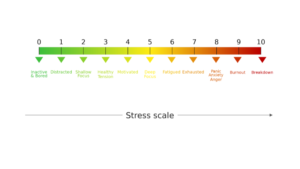
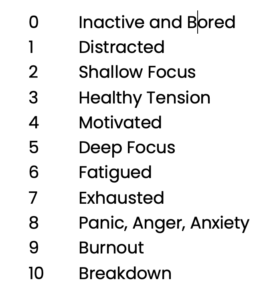
Are you in that space of healthy tension, motivated energy, deep focus?
Or have you drifted… or tipped?
If you are not where you want to be, something is driving that.
It may be:
• Your workload
• Your diary structure
• Your communication
• Your systems
• Or simply the way you are thinking about the day ahead
And this is important.
You are not expected to see everything from inside your own situation.
Sometimes the shift comes from a different perspective.
A conversation.
A question you have not yet asked yourself.
A colleague.
Your team.
A coach.
Support is not a weakness.
It is a strategy.
Now widen your view.
Where is your team sitting on this scale?
Imagine starting your morning stand-up with one simple question:
“Where are you today, 0 to 10?”
No judgement.
Just awareness.
Because awareness changes behaviour.
It opens conversations early.
It allows you to respond before problems escalate.
It replaces reaction with intention.
And then consider your patients.
They are on this scale too.
A patient who is distracted, fatigued, or anxious will not:
• Listen in the same way
• Process information clearly
• Make decisions confidently
Whereas a patient who is calm and focused can engage, understand, and choose.
When you begin to see this, something shifts.
You stop expecting people to meet you where you are.
You start meeting them where they are.
And that is where communication improves.
Where trust builds.
Where outcomes change.
This is where dentistry becomes more effective.
More human.
And ultimately, more successful.
A Final Thought
If your days currently feel:
- Flat and uninspiring
or - Overwhelming and exhausting
It is not random.
It is the curve.
And once you see it, you can start to work with it rather than against it.
If you would like to explore this concept further, so that you can live on the hill of peak performance rather than the foothills of boredom or anxiety, do book a call with me through my online booking system
www.iodb.co.uk