
What Thought Loop Are You Stuck In?
Have you ever noticed yourself having the same conversation with yourself, over and over again?
You revisit the problem.
You analyse what happened.
You think about what you should have said.
You decide what you will do differently next time.
And yet, somehow, you end up back in the same place, this is what I think of as a thought loop.
A thought loop is not simply thinking about something more than once. It is a repetitive pattern of thinking in which the same assumptions, interpretations, emotions and responses keep circling around one another.
It can feel as though you are thinking deeply about the problem, yet you are simply travelling around the same track. The more times you travel around it, the more familiar the thinking become, therefore more believable and then even more habitual that version of your reality become?
- Is it reality?
- Is it a comfortable perspective?
- Is it a story that you repeatedly tell yourself and others?
- Is it True?
A thought loop can feel completely true
This morning I was working with a client who is also a coach.
In a short, 12-minute coaching conversation, we explored a thought loop connected with communication in a close family relationship.
The essence of the loop was:
“Whichever way I communicate — whether as a parent, a friend or a coach — I always seem to get it wrong.”
Notice the certainty in that statement.
However. Always. Wrong.
Once you become caught in that type of loop, every new interaction can begin to provide further evidence that our existing conclusion is correct. We notice the things that reinforce it, what we think, we prove. Consequently, you are overlooking the things that contradict your thought loop.
Many then attempt to resolve the problem by our behaviour in response to the thinking loop rather than responding to what is happening.
Rather than trying to decide whether the belief was right or wrong, as the coach I guided my client and gave her the space to explore the shape of the thinking loop, as if it were a real thing.
“If this thought loop had a shape, what would it look like?” – A long-stretched circle.
Interestingly, this awareness created greater insight into how the disconnected communication took on the form of “lobbing” words from one time zone into another.
One person here.
The other person over there.
Words travelling backwards and forwards across the space, but with very little real proximity or connection.
Coaching is an emergent process, which led us to exploring what the shape of the thinking loop was like when communication was working.
It was very different, there was proximity, there was connection, there was a sense of being alongside rather than communicating across a divide.
As a coach, nothing had been prescribed, I had not told my client what to say, what to do or how to repair the relationship.
Instead, the process of coaching created enough space for something that had previously been invisible to become visible and for the client to discover their own truth, their own answers.
Once you can see your repetitive thinking loop, you no longer can remain inside it.

What are your thought loops?
Dentistry provides fertile ground for thought loops.
You are working in an environment that involves responsibility, people, uncertainty, financial pressure, regulation, clinical risk and often very high personal expectations.
It would be usual to develop some familiar patterns of thinking.
An interesting question could be, which of your patterns of thinking are helping you, and which are quietly keeping you stuck?
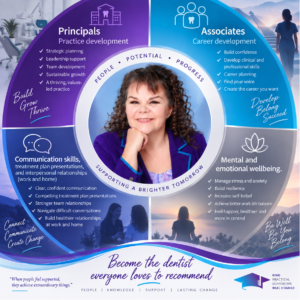
There are three main areas of my work, and I regularly see people like you getting caught in loops.
My three main areas
- Principals – Practice development
- Associates – Career development
- Communication skills, treatment plan presentations, and interpersonal relationships (work and home)
- Mental and emotional wellbeing.
- Your role as a principal and the way your practice operates
Perhaps your loop sounds something like:
- “If I don’t do it myself, it won’t get done properly.”
- “My team never take responsibility.”
- “There simply isn’t enough time.”
- “Nobody understands how much pressure I’m under.”
- “We’ve tried changing this before and it didn’t work.”
- “This is just what running a practice is like.”
You may then behave in ways that unintentionally strengthen the loop, if you believe nobody takes responsibility, perhaps you step in more quickly, because you step in, other people have less opportunity to take responsibility, you then look around and see a team that is not taking responsibility.
So, the loop perpetuates.
The obvious question could be, “How do I make my team take more responsibility?”
A more helpful coaching question could be, “What am I doing, thinking or assuming that helps to keep this particular pattern in place?”
A very different thinking will emerge
- Your career development as an associate
Associates can become caught in thought loops about where their career is going and what they believe is possible for them.
Perhaps your loop sounds something like:
- “I’m not experienced enough yet.”
- “I need to do another course before I can take the next step.”
- “There aren’t enough opportunities in this practice.”
- “Everyone else seems to be progressing faster than me.”
- “Maybe I need to leave.”
- “I’m not sure what I want next.”
You may then behave in ways that unintentionally strengthen the loop.
If you believe you are not experienced enough, perhaps you avoid attending events meeting colleagues face to face, because you do not meet colleagues you don’t build relationships with people who can support, guide or mentor you, because you don’t know them you avoid attending courses or peer review events, so you gain less experience and so you don’t attend events, join groups or apply for roles that will stretch you.
So, the loop begins to cycle again and again.
The obvious question might be:
“Why do I lack confidence?”
A more supportive coaching question might be:
“What opportunities are already be available to me that I am not currently noticing, asking for or allowing myself to take?”
This creates a very different place from which to think.
Perhaps in your thinking loop are comparing your career and work with another clinician who has 20 years more experience than you
The obvious question might be:
“Why is my work not as good as theirs?”
A coaching question might instead be:
“If I stopped measuring my career against somebody else’s, what would meaningful progress look like for me?”
The aim is not for a coach to tell you whether you should stay, leave, specialise, buy a practice or take another qualification.
It is to help you step outside the loop; notice the assumptions influencing your thinking and explore possibilities that may currently be sitting outside your awareness.
- Your communication and interpersonal relationships
Dentistry is built on conversations.
- Conversations with patients.
- Conversations with clinician colleagues
- Conversations with nurse and receptionists
Conversations about performance, money, treatment, mistakes, expectations, boundaries and difficult behaviour. Our communication is rarely based only on what the other person has just said it also involves responding to our interpretation of what they have said.
Perhaps your loop sounds like:
“Patients only care about price.”
So, you anticipate resistance, you change the way you talk about treatment, only offering something you perceive the patient will value and pay for based on your assumptions, your patient senses your discomfort or caution and that you are not confident in what you are offering and ask for the NHS option as it is the cheapest.
Their response reinforces your original belief.
The obvious question maybe “How do I offer my private work more cheaply?”
A more useful question maybe, “What do patients value about the broader service of dentistry?”
“Whenever I give feedback, people become defensive.”
You approach the conversation anticipating defensiveness, you over-explain, downplay the message, hint about the subject, delay the conversation or inadvertently sound tense. The other person senses that something difficult is coming and they may be about to be reprimanded. They become scared because they don’t really know what you are trying to say, and think whatever it is, it is going to be bad. You interpret this as defensive and once again, the loop completes itself.
- The words may change.
- The people may change.
- The situations may change.
The underlying thinking pattern remains remarkably familiar.
An obvious question maybe “Why do I make people defensive?”
A more useful question maybe, “When giving feedback, what is important that the other person feels?”
- Your mental and physical wellbeing
Some of the most powerful loops are the ones we have about ourselves.
- “I should be able to cope.”
- “Everyone else seems to manage.”
- “I just need to work harder.”
- “I’ll slow down once things become quieter.”
- “I don’t have time to exercise.”
- “I can’t let anybody down.”
- “I should be able to sort this out myself.”
So, you keep going.
- Working harder.
- Carrying more.
- Thinking more.
- Sleeping less.
- Postponing the very things that might help you function differently.
- Until exhaustion itself becomes further evidence that something is wrong.
An apparently obvious questions may appear to be, “How do I think more positively?”, or “How do I become better?”
More helpful questions asked by your coach could be, “Whose expectation am I trying to live up to?” or “How will you know that you have become better?”
The challenge is that much of the loop is in your blind spot
This is the important part. If every element of the problem were already within your awareness, there is a reasonable chance you would have solved it.
- You are intelligent.
- You are resourceful.
- You have probably spent years developing your ability to solve complex problems.
The difficulty is that we cannot see our own blind spots.
A thought loop may contain:
- ❓ Assumptions we no longer question
- 💬 Words we barely notice ourselves using
- ❤️ Emotional responses
- 🖼️ Past experiences
- 🔮 Predictions about what will happen
- 🧠 Beliefs about ourselves or other people
- 🛡️ Protective behaviours
- 🔎 Interpretations that feel like facts
From inside the thought loop, all these things can appear perfectly logical, which is why telling yourself to “think differently” won’t work. Thinking differently only becomes possible when you first notice the how, the structure of your current thinking loop.

This is why coaching is so powerful
Coaching is not about your coach being more knowledgeable, sitting opposite you and telling you what to do. It is certainly not about your coach providing you with their answer to your problem.
Good coaching creates a thinking space. A space in which your coach listens; listens to what you are saying, how you are saying it, and what you are not saying.
Your coach will notice the patterns in
- The words you use and those you repeat.
- The tonality and emphasis
- The things you avoid.
- The assumptions hidden inside a sentence.
- The contradictions.
- The shift in energy.
- The metaphor you use without consciously noticing it.
- The things you dismiss quickly.
- The places where your thinking suddenly becomes rigid.
- The things you can see.
- The things in your blind spot
Your coach will notice, hear and sense elements of your thinking loop that remain outside your own awareness, and bringing those elements into awareness will be the first step from being stuck inside the loop to being able to stand outside it and look at it.
Usually when working with a trained coach, that shift happens surprisingly quickly, not because your coach has provided a clever answer, because they have created the environment for a new perspective to emerge that makes a different solution possible for you.
You do not need to think harder
When you become stuck, your instinct is often to think about the problem even more, thinking harder from inside the same thought loop will simply mean travelling around it more quickly.
What is needed, is not more thought, it is to develop a different thought.
- A different perspective.
- A different question.
- A different interpretation.
- A different understanding of what is happening.
- A different space to notice something that you could not previously see.
I invite you to consider three areas of your professional life:
Your role as a principal or clinician
Where are you repeatedly experiencing the same frustrations, challenges or problems?
Your role as an associate
Where is your thinking about your career cyclical?
Your communication and relationships
Which conversations seem to follow the same familiar pattern, regardless of how hard you try to change them?
Your mental and physical wellbeing
What are you repeatedly telling yourself about pressure, responsibility, coping, rest, health or what you “should” be able to manage?
Ask yourself one more question:
What if the problem is not simply the problem?
What if problem is a thought loop that has become so familiar that you can no longer see it? You do not need and should not want someone to give you the answer. What is likely to serve you best is to find a coach, someone who can create the space for you to think, ask questions so you think, keep you company as you think, creating an arena in which your answer becomes easier to see.
For me, is part of the magic of coaching.
Creating for you, the opportunity to see what has been sitting in your blind spot, so you explore new perspectives and find approaches that were previously unavailable while you were travelling around the old loop.
Because once you can see the loop, you have a choice, you can keep travelling around your habitual track or you can choose a new path.
If you want to discover more about coaching, and why it can be so impactful you can e mail me at Jane@IODB.co.uk