When Bonuses Breed Rats: What Dentists Can Learn from the Cobra Effect

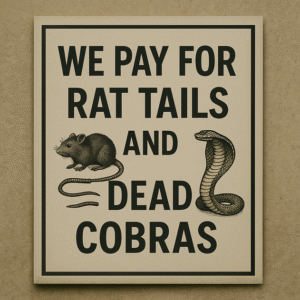
The phrase “Cobra Effect” comes from British-ruled Delhi, India, in the late 1800s. To curb the city’s dangerous cobra population, colonial officials offered a bounty for every dead cobra. At first, the scheme appeared to work. But soon, some locals began breeding cobras simply to kill them and claim the reward.
When the government discovered the manipulation, they scrapped the programme. Cobra breeders, now unable to profit, released their snakes. The result? More cobras than before.
This is the essence of the Cobra Effect: a well-intentioned incentive that backfires and makes the original problem worse.
Hanoi, 1902: When Rat Tails Paid Better than Rats
A few years later, another classic example occurred in Hanoi, Vietnam, around 1902. The French colonial government faced a severe rat infestation, fuelled by the city’s new sewer system.
- The Problem: Rats were spreading disease and thriving underground.
- The Solution: Officials offered a bounty for every rat tail turned in.
- The Backfire: Locals began trapping rats, cutting off their tails, and releasing them so they could breed more rats – producing an endless supply of tails. Others even bred rats for profit.
- The Outcome: The rat population exploded, leaving Hanoi worse off than before.
Both Delhi’s cobras and Hanoi’s rats show us how perverse incentives can create exactly the problem they were meant to solve.
Dentistry’s Rat Tails and Cobras
It’s easy to dismiss these colonial stories as oddities from history. But dentistry is full of the same traps when it comes to bonuses and incentive schemes.
- Bonuses for signing patients up to plans.
- Extra payments for whitening or Invisalign consents.
- Percentages paid to treatment coordinators for securing high-value cases.
At first, these schemes can boost numbers. But then the focus shifts:
- Away from patient relationships.
- Away from health care.
- Towards the transaction.
Patients start to feel sold to rather than cared for. The relationship becomes a commodity. The unintended consequences?
- Patients leave because they feel pressured.
- Complaints increase from people pushed into choices that weren’t right for them.
- Team culture suffers, with competition overtaking collaboration.
Short-term carrots can breed long-term cobras.

Asking Better Questions Before You Incentivise
To avoid these perverse outcomes, pause before introducing a new incentive. Use Jane’s 5 Magic Questions to take a holistic view. Ask them from the perspective of every stakeholder – patients, the practice, the team as a whole, individual contributors, and emotional stakeholders (including you as the owner).
- What does a bonus mean?
- For what purpose is a bonus?
- What is essential in a bonus?
- What is important in a bonus?
- What is the value or usefulness of a bonus?
These questions uncover whether an incentive genuinely adds value – or risks breeding cobras.
So, What’s the Solution?
Instead of building growth on short-term carrots, the strongest practices focus on:
- Recruiting well – bringing in people who share your values and naturally want to do the right thing.
- Building culture – creating an environment where genuine care, collaboration, and excellence are the norm.
- Rewarding well – paying people fairly and generously, and recognising their contribution in ways that go beyond money: trust, respect, professional development, flexibility, and a sense of belonging.
This way, your team isn’t working for a carrot. They’re working because they believe in your practice, your patients, and your shared purpose.
Beyond Carrots and Sticks
The real power in dentistry isn’t in dangling rewards. It’s in creating a culture where:
- Patients feel respected and supported in making the right decisions for themselves.
- The team takes pride in service and collaboration.
- The practice grows through trust, reputation, and intrinsic motivation.
Before you roll out your next bonus scheme, remember Delhi’s cobras and Hanoi’s rats. Incentives can be useful tools – but only when designed with care. Otherwise, you may find your solution breeding more problems than it solves.