Why Some Dental Practices Become Toxic: How the Graves Drives Reveal Culture, Compatibility, and Long-Term Fit
Dental practices rarely become toxic because of one person or one problem. More often, they become difficult places to work because different value systems collide.
When your values don’t match your environment, you feel it in your body long before it shows up in your diary, your mood, or your sleep.
The Graves Drives, originally developed by Clare W Graves and forming the foundation of Spiral Dynamics, Don Beck, give us a clear, practical way to understand why:
- some practices feel chaotic,
- some feel rigid and suffocating,
- some burn people out,
- and some feel like a family you never want to leave.
They also give you a powerful lens to recruit the right people, build healthy teams, and choose a practice where you can settle long term.
Let’s walk through each Graves Drive and explore how they shape culture, create toxicity when misaligned, and guide you in making better hiring and career decisions.
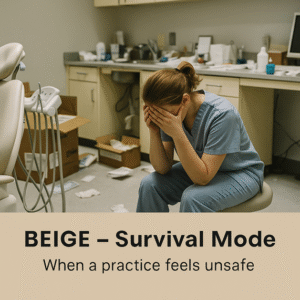
BEIGE – Survival Mode
When a practice feels unsafe**
Beige represents people operating in pure survival: overwhelmed, burnt out, or unable to think beyond the next five minutes.
Toxic behaviours appear when:
- individuals are exhausted
- new or unsupported team members are thrown in with no guidance
- locums are expected to “just cope” with unfamiliar systems
In a Beige-dominant environment:
- no one plans ahead
- everyone is firefighting
- people shut down rather than communicate
The recruitment insight:
If your practice culture pushes people into Beige, it isn’t a recruitment issue.
It’s a wellbeing, workload, and leadership issue.
If you’re job searching:
Avoid practices where everyone looks drained. Their culture will pull you into survival mode too.

PURPLE – Tribe and Belonging
The comfort of family… and the danger of cliques
Purple builds warm, loyal, family-style teams.
Patients love them. Team members stay for years.
But toxicity appears when:
- the practice becomes suspicious of new people
- long-term staff resist needed change
- “this is how we’ve always done it” overrides improvement
- cliques form
Recruitment insight:
If you want longevity, hire people who value belonging, routine, and relationships. They stay for years.
Pair Purple with a strong change-leadership style or innovation stalls.
If you’re job searching:
A Purple practice is wonderful if you value community.
It becomes suffocating if you want autonomy, new ideas, or innovation.

RED – Power and Action
The energy that drives progress… or dominates others
Red brings confidence, action, and momentum.
It is the drive you want when the practice needs to get things done.
Toxicity appears when:
- strong personalities bulldoze quieter team members
- boundaries are ignored
- conflict is normalised
- people shout or dominate meetings
Recruitment insight:
Red energy is helpful in emergencies and leadership roles, but when unmanaged it creates fear.
Only hire strong Red personalities when you also have Blue structure to hold them.
If you’re job searching:
Avoid practices where aggression is framed as “just how we do things here.”

BLUE – Order, Duty, Structure
The backbone of safety… and the birthplace of rigidity
Blue keeps dentistry safe: compliance, Infection Prevention and Control.(IPC) audits, protocols, consistent notes.
Toxicity appears when:
- rules matter more than people
- change is blocked by bureaucracy
- the practice becomes inflexible
- there is constant criticism or micromanagement
Recruitment insight:
A healthy practice needs some Blue, but too much becomes sterile and demoralising.
Hire people who appreciate structure but can also adapt.
If you’re job searching:
If you crave stability, Blue is comforting.
If you are innovative or creative, you will feel suffocated.

ORANGE – Achievement and Results
The engine of growth… until burnout takes over
Orange practices are ambitious, modern, and commercially sharp.
They systemise, innovate, market well, and grow.
Toxicity appears when:
- productivity overtakes wellbeing
- KPIs become pressure rather than insight
- Clinicians feel pushed
- competition becomes unhealthy
- burnout rises
Recruitment insight:
Hire Orange team members when you want growth.
But balance them with Green to protect people and culture.
If you’re job searching:
These practices are stimulating and well organised.
But if you’re already tired, they can drain you quickly.

GREEN – Harmony and Empathy
The heart-centred culture… that avoids tough decisions
Green creates warm, supportive, connected teams.
Patients adore them.
Toxicity appears when:
- conflict is avoided
- poor performance is tolerated
- consensus slows decisions
- emotions overload the team
- boundaries are unclear
Recruitment insight:
Hire Green when you want compassion and collaboration.
But ensure you have some Blue or Yellow to maintain accountability.
If you’re job searching:
Wonderful for wellbeing.
But if you thrive on clarity, direction, or progress, you may feel lost.

YELLOW – Systems Thinking
The integrator… that others may not understand
Yellow thinkers see how everything connects: clinical, financial, team culture, patient experience.
Toxicity appears when:
- they seem aloof or overly complex
- others feel confused or inferior
- leaders stay “in their head” and forget the emotional side
- constantly learn new things with no integration
Recruitment insight:
Yellow is ideal for senior leadership, strategic roles, and transformation work.
But only if the team is ready for this level of thinking and learning.
If you’re job searching:
Look for practices that value autonomy, flexibility, and innovation.
Avoid those where “that’s just how we do it” rules the day.
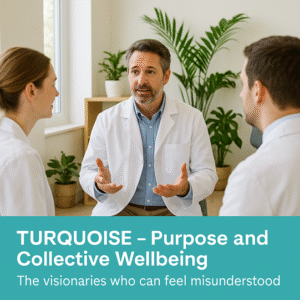
TURQUOISE – Purpose and Collective Wellbeing
The visionaries… who can feel misunderstood**
Turquoise brings meaning, ethics, and sustainability.
They think about legacy and long-term impact.
Toxicity appears when:
- ideas remain abstract
- the team feels lost or unable to keep up
- vision is not grounded into action
Recruitment insight:
Turquoise is ideal for shaping practice culture and long-term purpose.
But it must be translated into practical steps or it becomes unreachable.
If you’re job searching:
You’ll thrive here if you want purpose-driven dentistry.
Avoid if you prefer clear step-by-step direction.

How Toxicity Really Forms: Value Mismatch
A practice becomes toxic when the dominant drive of the practice clashes with the drives of its people.
Examples:
- A Blue practice hires a Red associate. Conflict erupts.
- An Orange principal leads a Green team. Burnout and resentment grow.
- A Purple practice brings in an Orange Patient Care Coordinator, both feel frustrated.
- A Yellow owner tries to innovate but the Blue team blocks everything.
This isn’t personal.
It’s values ecology.
Using Graves Drives to Recruit Better
For Practice Owners
- Start by identifying your practice’s dominant drives
- Recruit for cultural fit first, skills second
- Balance the drives so the culture stays healthy
- Train leaders to understand their own dominant value system
For Associates, Hygienists, and Nurses
- Identify the culture where you thrive
- Ask interview questions that reveal the practice’s value system
- Choose a practice whose values match your long-term goals
- Avoid environments that trigger your stress response
The Goal: Healthy, Values-Aligned Practices Where People Stay
Graves Drives give you a practical, evidence-based way to diagnose cultural problems, reduce toxicity, and create teams who genuinely fit — and stay.
When you understand the values that drive behaviour, dentistry becomes easier, safer, calmer, and far more fulfilling.
If you are a principal or clinician ready to explore your own motivational drivers and how they shape your practice, contact me and I will arrange your individual profile, guide you through the assessment, and support you in applying the results to enhance your practice culture.
If you want to recruit people who fit, retain people who stay, and build a practice culture where challenges become learning rather than friction, a whole practice Graves Drive profile is the place to begin. It gives your team the insight you all need to understand yourselves more deeply, strengthen your team, and create a practice where everyone can win, learn and evolve together.
E mail me Jane@IODB.co.uk for more details.