In recent years, there has been a growing trend among dentists to delegate patient communication and relationship-building to software. With automated systems handling everything from appointment reminders to treatment plan presentations, it’s easy to see the appeal. After all, many dentists would much rather focus on clinical care than worry about “selling” treatments. However, by entrusting these crucial touchpoints to software companies, dentists risk losing control over how they connect with patients, ultimately leading to a more transactional approach to care.
The Paradox of Technology and Trust
Would you agree that ultimately all decisions, including those about dental care, are ultimately based on feelings and trust? Patients will only proceed with treatment when they know, like, and trust you. When knowing, liking or trust are absent for either the patient or you, the clinician, red flags appear when ignored, the complaints will follow soon after. It follows that when the process is managed primarily by software rather than a conversation, the essential personal connection is reduced and potentially lost completely, the patient feels like they’re just another customer in a pushy sales process.
Psychologist Roger Bailey’s work shows that 52% of people make decisions only after seeing a proposal multiple times. The number of times needed varies by individual and could represent a treatment plan or a series of examination appointments. This means that treatment recommendations may need to be communicated by different team members—perhaps the dentist, hygienist, or a patient care coordinator—to resonate fully. Additionally, 25% of people need time to consider their options, while 15% are perpetually undecided, evaluating the proposal anew each time they hear it. Only 8% of people decide immediately and rarely change their minds.
This data highlights the importance of patience and understanding each patient’s unique decision-making process, something that software alone cannot replicate.
The Influence of Clinical Authority
Research by Stanley Milgram shows that people are more likely to follow recommendations when they come from someone in a position of perceived authority—in this case, you in a clinical uniform.
Building Trust: Beyond Online Forms
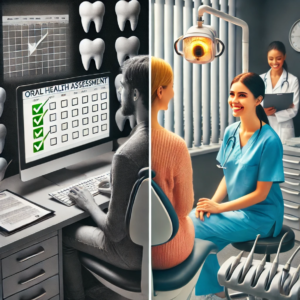
While digital medical history forms completed in advance can save time, there’s something to be said for the value of reviewing them with patients in person. Observing subtle cues—pauses, changes in breathing, or facial expressions—can reveal important details that patients may not have thought to mention in an online form. This process not only ensures more accurate information but also establishes rapport and demonstrates to the patient that their wellbeing is the dentist’s priority.
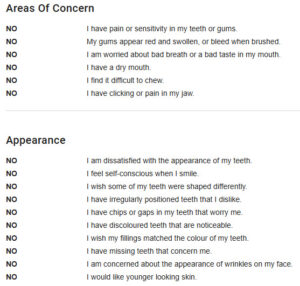
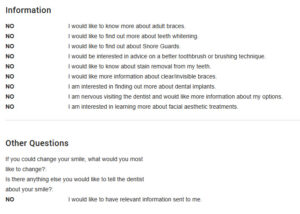
Similarly, online oral health assessment forms designed by software technicians, reduce complex treatment outcomes to single-word products.
These forms inadvertently commoditise dental care, leading patients to view treatments as interchangeable products rather than personalised health services. Dental treatments, unlike a smartphone, are non-returnable, customised services that require trust. Abdicating the design of these interactions to software companies risks further commoditising your care, reinforcing the perception of dentistry as a transactional service, and ultimately increasing the potential for complaints and stress.
Essence of Patient Relationships
Most patients don’t come to your practice for whitening or implants; they come for peace of mind, knowing that someone is looking after their health. What they value most is regular check-ups and the reassurance that their oral health is in good hands. Yet, many practices fail to convey this through software-driven assessment forms that lack options for patients to express these simple, health-focused goals. In the example below, notice how standardised health assessments reduce your role to a list of commoditised items.
Interestingly, high-end restaurants—particularly Michelin-starred venues.— 20 years ago the concepts of dental menus, modelled on restaurants, were introduced so facilitate a conversation with patients about their wants needs and preferences for outcomes to their dental care and treatments, There is now a movement where restaurants have recently begun moving away from fixed menus. Instead of relying on pre-determined lists, they engage directly with diners to tailor meals to individual preferences, aiming to create a memorable experience. Just as these establishments prioritise hospitality over the food itself, what if you, too, focused more on patient experience than on the dental treatments alone? You may ask a patient to pay a similar price to a meal at an award winning restaurant, the meal will last for a few hours, the memory a life-time and the price forgotten almost immediately. While in many clinics an implant might last 20 years, the price is always recalled often with horror at the magnitude. What must you do so that the warmth, hospitality and service that accompanies the treatment leaves a life-long good memory and the price is forgotten.
A Balanced Approach
There’s no question that running a modern dental practice is expensive, and patient fees are essential for sustainability. However, by focusing on relationship-building and trust, rather than reducing interactions to transactions, you can foster loyalty and satisfaction that will drive your practice’s growth more naturally, with fewer complaints and less stress.
As technology and AI continue to evolve, I invite you to consider how they can serve as supportive tools rather than replacements for human interaction. The secret to reducing complaints and the fear of GDC involvement is to spend more time, not less, getting to know your patients, understanding their concerns ,values, wants needs and preferences, how do you use technology to complement—rather than overshadow your efforts? By following this approach, you can create a practice that patients remember not just for the quality of treatment, but for the warmth, respect, and trust they feel every time they visit.
If you would like to learn more about building strong patient centred relationships and increasing hospitality in your practice, book a SPEAK WITH JANE conversation www.iodb.co.uk