For many dentists, there comes a point a few years into practice when the questions start to change.
It is no longer simply, How do I get through the day and become clinically competent?
It becomes,
Where is my career going?
What kind of dentist do I want to become?
How do I move into private dentistry?
What should I invest in next?
Do I need another diploma, an MSc, implants, endodontics, orthodontics, restorative dentistry or more aesthetic training?
Who do I train with?
Will another qualification really give me greater confidence, better cases, more income and the career I want?
These are sensible questions, but they can also lead dentists into believing that the answer to career progression must be another clinical course. So they invest more money, collect more qualifications and become increasingly clinically capable, while still wondering why their diary is still empty, income still stagnant, confidence and professional satisfaction lower than before they did the course, and now more debt.
Most people enter dentistry with an idea of the dentist they hope they will become.
Then clinical life happens.
- Targets
- UDAs
- Bills
- Patients
- Courses
- Staff
- Compliance
- Audits
- Complaints
- Inspections
- Responsibilities
Somewhere amongst all that activity, that original passion and vision disappears.
It does not have to.
- You can rediscover it.
- You can refine it.
- You can create a new version of it.
- You can do more of the dentistry you enjoy.
- Work with patients you value.
- Build stronger relationships.
- Create greater financial freedom.
- Have more confidence in your decisions.
Together we can build you a life in which dentistry is an important and fulfilling part of who you are, rather than something that consumes everything else.
The reality is that there can be a considerable chasm between where you are now and the successful private dentist you want to become. Clinical knowledge alone will not bridge it. To become a truly successful clinician you need all three Cs of dental SuCCCes
You can become the dentist you dreamed of being when you bring together the 3 Cs of succcess:

The route to the career you want may therefore be less about asking, Which clinical course should I do next? and more about asking, Which of my three Cs needs developing next?
What makes a successful dentist?
For many clinicians, the obvious answer is clinical skill.
Of course, clinical skill matters enormously. You need to be able to diagnose accurately, relieve pain, treat disease and understand the foundations of dentistry. You need a sound understanding of anatomy, disease process, occlusion, function, restorative principles and how the mouth works as a whole.
These are not optional extras. They are the foundations upon which everything else is built, yet clinical skills alone does not create success.
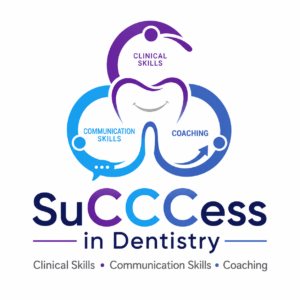
The 3 Cs of Dental Success: Clinical Skills, Communication and Coaching
You can be the most technically gifted clinician in the room and still struggle to build a diary full of the dentistry you enjoy, create loyal patient relationships, gain acceptance of treatment plans or build the career you imagined when you first entered dentistry.
Because being a successful dental clinician requires three things.
Clinical Skills.
Communication Skills.
Coaching.
The 3 Cs of Dental Success.
C1: Clinical Skills
Dentistry begins with good dentistry.
Before we talk about communication, business, growth or success, you have to be able to do the fundamentals well.
Diagnosis.
Pain relief.
Treatment of disease.
Understanding anatomy.
Understanding occlusion.
Restoring health and function.
These are the foundations of our profession.
There is something else I believe passionately. All dentistry should be beautiful.
Beautiful dentistry is not the exclusive domain of people who describe themselves as cosmetic or aesthetic dentists.
- A well-shaped restoration is beautiful.
- A comfortable denture is beautiful.
- A thoughtfully designed treatment plan is beautiful.
- Removing pain is beautiful.
- Restoring function is beautiful.
- Helping somebody eat, smile, speak or live more confidently is beautiful.
Good dentistry should respect biology, function, psychology, general health, and lifestyle of the individual patient.
Clinical skill therefore matters. It gives you the ability to deliver excellent care.
But it is only the first C.
Because being able to provide treatment does not automatically mean your patients will choose to have it.
C2: Communication Skills
This is where many talented clinicians become stuck.
They invest thousands of pounds and hundreds of hours developing their clinical skills, yet spend comparatively little time developing the skill that determines whether patients actually understand, value and accept their recommendations.
Communication.
Without communication there is no relationship.
Without relationship there is no trust.
Without trust there is rarely a confident yes to your treatment plan.
You and your patient may both speak English. That does not necessarily mean you are communicating. Because communication is not simply about what you say.
Communication is about what the other person understands.
Great communication goes further, You understand what your patient understands you said. They understand that you understand them
When you understand what matters to them, you can make recommendations appropriate to their wants and needs in a way they understand why your recommendations matter.
Then and only then, you both know that the message has been received in the way it was intended.
Communication is not a straight line.
It is not:
Dentist speaks → Patient listens.
Nor is it simply:
Dentist speaks → Patient replies.
True communication is an infinity loop.
- You speak.
- They interpret.
- They respond.
- You listen.
- You clarify.
- They refine.
- You check.
- They understand.
And the loop continues until both people genuinely understand one another.

That is where trust develops.
That is where meaningful relationships are created.
And that is where patient-centred treatment acceptance becomes possible.
The money you need is already in your network
There is a belief that growing a successful dental career means constantly finding new patients.
- More marketing.
- More leads.
- More social media.
- More advertising.
Consider this.
All the money you need for the rest of your career is already in the bank accounts of the people who know you, like you and trust you, and the people they can introduce you to.
Your existing patients know people.
- Their families.
- Their friends.
- Their colleagues.
- Their neighbours.
When patients genuinely know you, like you and trust you they value the care you provide and they are far more than the one person sitting in your dental chair, they are a community of excited advocates for you.
- They talk about you.
- They return.
- They accept appropriate treatment.
- They introduce other people.
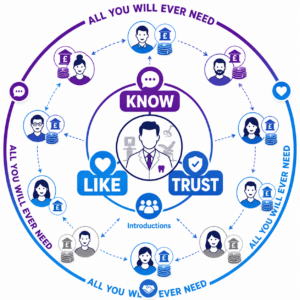
This is why communication skills can have such a profound impact on a dental career.
Clinical skills qualify you to do the dentistry.
Communication skills create the relationships and opportunities so you can provide it.
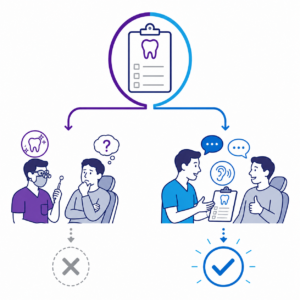
Clinical skills don’t convert treatment plans, communication skills do.
Dentists sometimes assume that if they explain something clearly enough, patients will understand why they should proceed.
But patients do not make decisions purely because something is clinically correct, they make decisions through the lens of their own priorities, fears, beliefs, experiences, circumstances and emotions.
- One patient wants reassurance.
- Another wants detail.
- One wants to know how quickly something can be completed.
- Another needs time to think.
- One wants to understand the science.
- Another simply wants to know:
- Will it hurt?
- Will it last?
- Will I be able to eat normally?
- Will anybody notice?
- Can I afford it?
The clinician who can recognise these differences has an enormous advantage., not because they are learning how to “sell” treatment, because they are learning how to understand people.
when patients feel understood, they are much more able to make confident, informed decisions about their care.
C3: Coaching
And then there is the third C.
The one that is so often missing.
Coaching.
You can have excellent clinical skills, You can develop outstanding communication skills and without somewhere to stop, think, reflect and challenge your own assumptions, it is very easy to continue doing what you have always done.
That is why I see coaching as the full stop in your week.

- A deliberate pause.
- A safe place to think.
- A place to reflect.
- A place to plan.
- A place to ask questions you rarely have the time or space to ask yourself during a busy clinical day.
A good coach does not simply tell you what to do, I create the environment in which you can see things differently.
- Coaching sessions are where the magic happens.
- Because suddenly you no longer have to accept the status quo.
- You no longer have to follow the crowd.
- You no longer have to build your career according to somebody else’s definition of success.
- You can begin to create your own path.
- You can get off the dental treadmill and career conveyor belt and become the dentist everyone loves to recommend.
There is a remarkably well-trodden path in dentistry.
- Find a job.
- Do more clinical courses.
- Work harder and faster
- Buy more equipment.
- Increase your clinical skills.
- Perhaps buy a practice.
- Perhaps specialise.
- Perhaps add even more days.
- Perhaps earn more.
For most people who follow this path, they end up burnt-out, demoralised and unfulfilled, wondering is all life has to offer?
The danger comes when we follow the well trod path without ever asking: Is this actually what I want?
Coaching gives you the opportunity to ask different questions.
- What kind of dentist do I want to be?
- What dentistry do I enjoy?
- Who are the patients I most enjoy helping?
- How many days do I actually want to work?
- What do I want my life outside dentistry to look like?
- What am I tolerating that I no longer want to tolerate?
- What would I attempt if I stopped comparing myself with everybody else?
- What does success actually mean to me?
- Those questions can change a career.

Coaching creates choice, direction and accountability
The greatest gift of coaching is not advice.
It is choice.
When you are rushing from patient to patient, solving problems, managing a diary, dealing with staff, answering emails and carrying all the responsibilies that come with being a clinician, it can become difficult to see beyond the immediate demands of the day.
- Coaching creates space.
- Space creates thinking.
- Thinking creates choices.
- Choices create change.
- Coaching enables you to be intentional
When you have the space and insights to be intentional then you can begin creating your career and life you really desire.
- When you become intentional,
- You can become more confident.
- More intentional.
- More resilient.
- More commercially aware.
- More fulfilled.
- And perhaps most importantly, more yourself.
- More suCCCesful
The three Cs work together
Clinical skills without communication can leave brilliant dentistry sitting on an unaccepted treatment plan.
Communication skills without clinical skills cannot deliver the outcome the patient deserves.
Clinical and communication skills without reflection can leave you busy, successful on paper and wondering why your career does not feel the way you thought it would.
That is why the three Cs belong together.
Clinical Skills
Give you the ability to deliver excellent dentistry.
Communication Skills
Give your patients the understanding and confidence to choose appropriate treatment.
Coaching
Gives you the thinking space to shape your career, challenge your limitations and decide what success looks like for you.
Together they create something far more powerful.
A dentist who is clinically capable.
A communicator who builds genuine relationships.
And a professional who is consciously creating their own future.
Become the dentist you dreamed of being
Clinical skills matter.
Communication skills create opportunity.
Coaching creates the space in which you decide what to do with that opportunity.
What is missing and where do you need to invest?