Anxiety, Overwhelm and Burnout: What If the Words are Hiding the Solution?
Spend a few minutes in a dental Facebook group or WhatsApp forum and three words appear again and again:
Anxiety. Overwhelm. Burnout.
Dentists, clinicians, practice managers, dental nurses and other members of the dental team use these words to describe how they are feeling, often accompanied by a plea for help.
“My anxiety is through the roof.”
“I’m completely overwhelmed.”
“I think I’m burntout.”
These feelings are real.
The emotional and physical sensations people are experiencing can be intense, frightening, exhausting and deeply uncomfortable. Wanting those feelings to stop is completely understandable.
But there is a problem.
Anxiety, overwhelm and burnout are very big words.
They are umbrella terms. They describe an overall experience without necessarily identifying what is creating it.
And if we cannot clearly identify the problem, finding the right solution becomes much more difficult.
What do you mean by ‘anxiety’?
Anyone who has worked with me will probably recognise one of the questions I ask repeatedly:
“What do you mean by that?”
It can sound ridiculously simple.
Yet it is one of the most powerful questions we can ask.
A client might initially tell me:
“I need help with my anxiety.”
But ‘anxiety’ does not tell us what is actually happening.
So we explore it., questions could include
- And what kind of anxiety is that anxiety?
- And is there anything else about anxiety?
- And whereabouts is anxiety?
- And that’s anxiety like what?
- When do those sensations happen?
- What are you thinking about immediately before you notice the feeling?
Or
- What colour, size, shape location, is anxiety?
- What sounds, tempo, volume, pitch, direction does anxiety have?
- What temperature, texture, structure is anxiety?
And this is where things become interesting. Because the problem we eventually uncover is very rarely simply ‘anxiety’.
- For one dentist, what they called anxiety was actually loneliness.
- For another, it was feeling ill-prepared for a particular clinical procedure.
- For someone else, it was inexperience.
- Another was frightened that their fees were too high and that patients would think they were overcharging.
- Another felt unsupported by their colleagues
- Someone else was carrying the responsibility for a practice and believed that everything depended upon them.
- Another was terrified of making a mistake.
- Another it was dread dealing with a particular patient who reminded them of an ex.
- Another simply did not know how to say no.
All of them could quite reasonably have said:
“I feel anxious.”
But each required a completely different solution.
You cannot solve an umbrella
Imagine trying to solve ‘overwhelm’.
Where would you begin?
Compare that with:
“I have 47 unfinished tasks and I don’t know which one to do first.”
Now we have something we can work with.
Or compare:
“I’m burnt out.”
with:
“I am working five clinical days every week, regularly running through lunch, taking notes home in the evening and answering team messages at weekends.”
Now there are identifiable behaviours, boundaries and circumstances that can be explored.
Or:
“Dentistry is making me anxious.”
compared with:
“Every time I prepare a crown I am frightened I will remove too much tooth tissue because I don’t trust my clinical judgement.”
Those are very different conversations.
The more precisely we can describe the problem, the more possibilities we create for solving it.
Clarity creates choice.
The danger of accepting the first label
Human beings naturally simplify information.
We delete information, generalise experiences and create labels that help us make sense of an extraordinarily complicated world.
That ability is useful.
But sometimes the label becomes so broad that it obscures the very information we need.
- “I’m anxious.”
- “I’m stressed.”
- “I’m overwhelmed.”
- “I’m burnt out.”
- “I’m depressed.”
- “I can’t cope.”
These statements may accurately communicate that someone is struggling, but they are the beginning of the exploration, not necessarily the conclusion.
The question becomes:
What does that mean for you, specifically?
Because your anxiety is not necessarily somebody else’s anxiety.
Your overwhelm is not necessarily somebody else’s overwhelm.
And what someone else did to feel better may therefore have very little relevance to what will help you.
Why social media advice always misses the mark
This is one of the difficulties with asking for help in Facebook or WhatsApp groups.
Someone posts:
“I’m feeling completely overwhelmed with dentistry. What should I do?”
Within minutes there may be dozens of responses.
- Reduce your days.
- Leave NHS dentistry.
- Move practice.
- Take a holiday.
- Exercise more.
- Meditate.
- Change associates.
- Change principals.
- Sell the practice.
- Take time off.
- Try a particular app.
- Do a course.
- Speak to your GP.
Everyone offering advice is usually trying to help.
But they are offering solutions before the problem has been clearly defined.
They are often answering from their own experience rather than understanding yours.
We end up talking at one another rather than communicating with one another.
Before asking:
“What should I do?”
there may be a much more useful question:
“What, specifically, is happening?”
Treatment and understanding are not competitors
For some people experiencing anxiety, depression, burnout or other psychological distress, you may visit your GP or another healthcare professional. Are they trained to help you unpick the feelings and get to the real issue or are they trained to write a script?
Medication can be helpful and appropriate for some people. For many it does not address the real underlying problem so the feelings return when the drugs are stopped. Sometimes the medication can be a useful adjunct to the work identifying and resolving the cause of the feelings.
These approaches do not have to compete with one another.
But whatever support you choose, precision matters.
- If loneliness is contributing to how you feel, loneliness deserves attention.
- If you feel clinically underprepared, additional training, mentoring or supervision may be needed.
- If you feel unsupported, the solution may involve relationships, communication or changing your environment.
- If you are frightened of patient complaints, we can explore what you believe a complaint would mean about you and whether your systems, consent processes or communication could be strengthened.
- If you are exhausted because you have constructed a working life without boundaries, those boundaries can be examined.
The emotional experience is important, so is understanding what is generating it.
This is personal for me
My interest in emotional and psychological wellbeing is not purely academic or professional.
I first saw a therapist when I was five years old following self-harm.
For many years of my life I experienced significant psychological distress, including periods of severe depression and suicidal thoughts.
Eventually, I found approaches that helped me understand my thinking differently and changed the way I responded to myself, other people and the situations around me.
My experience is not proof that one particular method will work for everybody, because there is no single answer that fits every human being.
But it created a lifelong fascination for me:
What makes one person struggle in a situation where another does not?
What meaning has someone given to what is happening?
What are they noticing?
What are they deleting?
What assumptions are they making?
What are they telling themselves?
And, perhaps most importantly:
What would need to become different?
That fascination has influenced the way I have worked with clients for many years.
Chunk the problem down
If you are currently telling yourself:
“I’m anxious.”
Try not to stop there.
Ask:
Anxious about what, specifically?
Then ask again.
Suppose your answer is:
“I’m anxious about work.”
What about work?
“My patients.”
What about your patients?
“I’m worried they will complain.”
What specifically are you worried they will complain about?
“My treatment.”
What about your treatment?
“I’m worried I’m not good enough.”
Now we are somewhere very different from: “I have anxiety.”
We have moved towards something that can be explored.
- What makes you believe you are not good enough?
- Is there evidence that supports that belief?
- Is there evidence that contradicts it?
- Is this a clinical skills issue?
- A confidence issue?
- A perfectionism issue?
- A comparison issue?
- A previous complaint?
- A lack of supervision?
- An unrealistic expectation of yourself?
Each possibility points towards a different intervention.
This is why the quality of the question influences the quality of the solution.
Use feelings as information
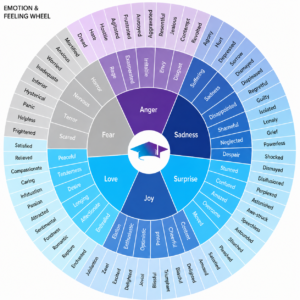
A feelings wheel can be useful here.
Not because every emotion fits neatly into a coloured segment of a diagram, but because it encourages us to move beyond:
“Bad.”
“Stressed.”
“Anxious.”
When I use a feelings wheel with clients, something interesting often happens.
They look at the words and start thinking.
- “I’m not actually frightened.”
- “It’s more frustration.”
- “No, it’s disappointment.”
- “Actually, I think I feel trapped.”
- “I feel embarrassed.”
- “I think it’s loneliness.”
- “That’s it. I feel powerless.”
That refinement matters.
Because frustration requires a different response from fear.
Loneliness requires a different response from inadequacy.
Exhaustion requires a different response from uncertainty.
Feeling trapped requires a different response from being clinically inexperienced.
The more accurately we can describe our internal experience, the more intelligently we can respond to it.
From ‘What is wrong with me?’ to ‘What is happening?’
There is another reason I believe this distinction is important.
When someone adopts a very large psychological label, the problem can begin to feel as though it is them.
“I am anxious.”
“I am burnt out.”
“I can’t cope.”
Instead, try becoming curious.
What is happening that results in me feeling this way?
That small change creates distance between you and the problem.
And once the problem becomes something that can be examined, rather than something you simply are, possibilities begin to appear.
- You might not need to fix yourself.
- You might need to change something.
- Learn something.
- Say something.
- Ask for something.
- Stop something.
- Start something.
- Clarify something.
- Set a boundary.
- Have a conversation.
- Develop a skill.
- Get support.
Or understand something about yourself that you have never understood before.
Start with one question
So, if you are struggling with anxiety, overwhelm or burnout, I invite you to begin somewhere deceptively simple.
Take the word you are currently using to describe how you feel and ask yourself:
“What do I mean by that?”
Then keep going.
- What specifically?
- When specifically?
- With whom?
- About what?
- What happens immediately beforehand?
- What am I frightened might happen?
- What do I believe this means?
- What would need to change?
You do not need to have all the answers immediately.
The objective is to move away from one enormous, frightening, apparently insoluble problem and towards smaller, clearer problems that can be understood.
Because when we understand what is actually happening, we have a much better chance of finding a solution that fits the person rather than simply treating the label.
Anxiety, overwhelm and burnout may describe how you feel.
They do not necessarily explain why you feel it.
And sometimes, discovering the why is the beginning of finding your way forward.
Useful tools
A useful tool for beginning this process is the Emotions and Feelings Wheel. It can help you move away from broad, umbrella terms ( found in the centre) and begin to refine what you are actually experiencing. The aim is not necessarily to find the ‘right’ word on the wheel, but to use the words as prompts for deeper thinking. When I use this tool with clients, it almost always starts a process of exploration: Is it really anxiety, or is it fear, loneliness, frustration, inadequacy, disappointment or something else entirely? Interestingly, the feeling they eventually identify often does not fit neatly into one of the labels on the wheel, and that is absolutely fine. The purpose is to create greater clarity.
Working with a coach who is trained in linguistics can take this exploration further, helping you uncover what is actually driving the anxiety, overwhelm or burnout and then identify solutions that fit you. There is no one-size-fits-all answer to emotional and psychological difficulties. Finding the individual cause and the individual solution is the key to creating lasting change in mental and emotional wellbeing.
If you are experiencing severe psychological distress, are concerned about your safety, or are having thoughts of harming yourself, please seek appropriate professional or urgent medical support. Coaching can complement healthcare and psychological treatment, but it is not a substitute for medical assessment or treatment where these are needed.