When You Do Not Like How You Feel: Using Emotional Precision to Create Change
Much of the coaching I do begins in the same place: someone does not like how they feel.
The details are different for every client, but within dentistry there are some familiar themes. Fear. Anxiety. Burnout. Depression. Overwhelm. Frustration. Exhaustion. A sense of being trapped or unable to cope.
These feelings can become so intense that they start to feel unmanageable. People know they want to feel differently, but they cannot see how to shift from where they are to somewhere more supportive.
This is not limited to dentists. Dental nurses, hygienists, therapists, practice managers, receptionists and other members of the dental team can experience the same emotional strain. The ideas in this article are also relevant far beyond dentistry.
Words matter when we are trying to change how we feel
After more than 25 years of coaching, one thing I have learnt is that words are powerful.
When we do not use words accurately, we are more likely to misunderstand ourselves and one another. When we cannot describe what we are experiencing, it becomes much harder to decide what needs to change.
“I feel awful” may be true, but it does not tell us very much.
Do you feel anxious, ashamed, frustrated, disappointed, overwhelmed, frightened, exhausted, resentful or helpless?
Each emotion points towards something different. Each may require a different response.
Emotional precision does not make the feeling disappear. It does, however, give us a clearer starting point.
The past can still shape the way we respond today
I recently took part in an exceptional coaching supervision session hosted by Jenny Bird and The Coach Continuum.
Supervision gives coaches an opportunity to step back and notice the wider systems, relationships and influences that affect how we coach.
During the session, one participant shared how difficult she sometimes finds it to communicate with her four siblings. As a child, her parents had placed her in the role of the “lieutenant”. It had been her responsibility to control and discipline the younger children.
Seventy years later, she can still find it almost impossible to answer a sibling’s question without them responding , “Stop telling me what to do.”
It is fascinating how roles given to us in childhood can continue to shape the way we relate to people as adults, particularly within families.
The same patterns can appear at work.
A dentist who learnt early in life that mistakes were unacceptable may experience intense fear when receiving feedback.
A team member who learnt that conflict was dangerous may avoid raising concerns until resentment builds.
A practice owner who was expected to take responsibility for everyone may struggle to delegate, rest or allow others to solve problems.
We may be reacting to what is happening now, but the intensity of the reaction can be connected to something much older.
A practical way to explore what you are feeling
During the supervision conversation, we explored the relationship between childhood experiences, memories and our present-day emotional responses.
One of the ideas we considered was the work of psychologist and emotional intelligence researcher Marc Brackett.
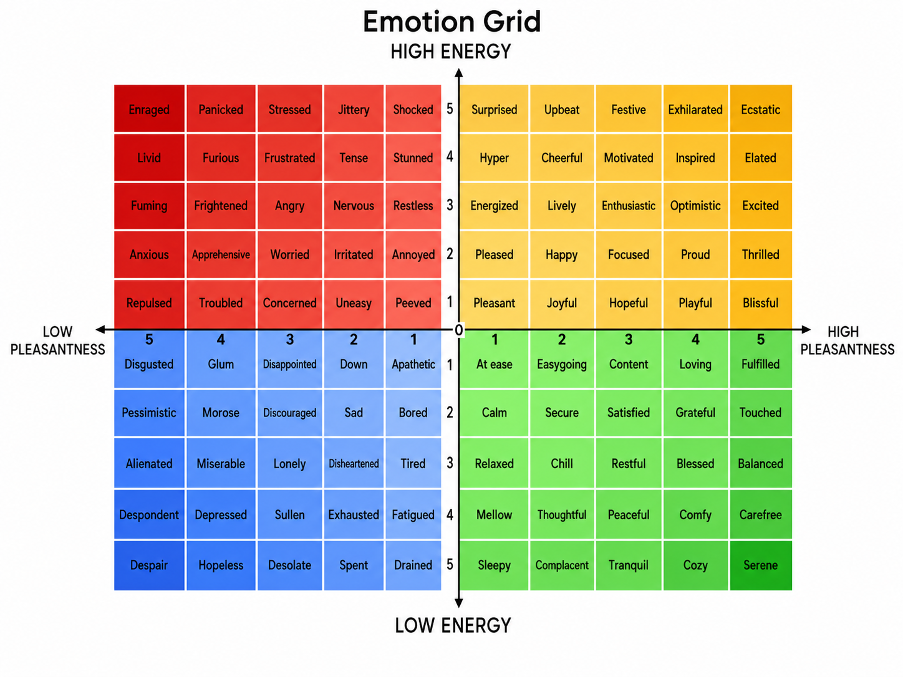
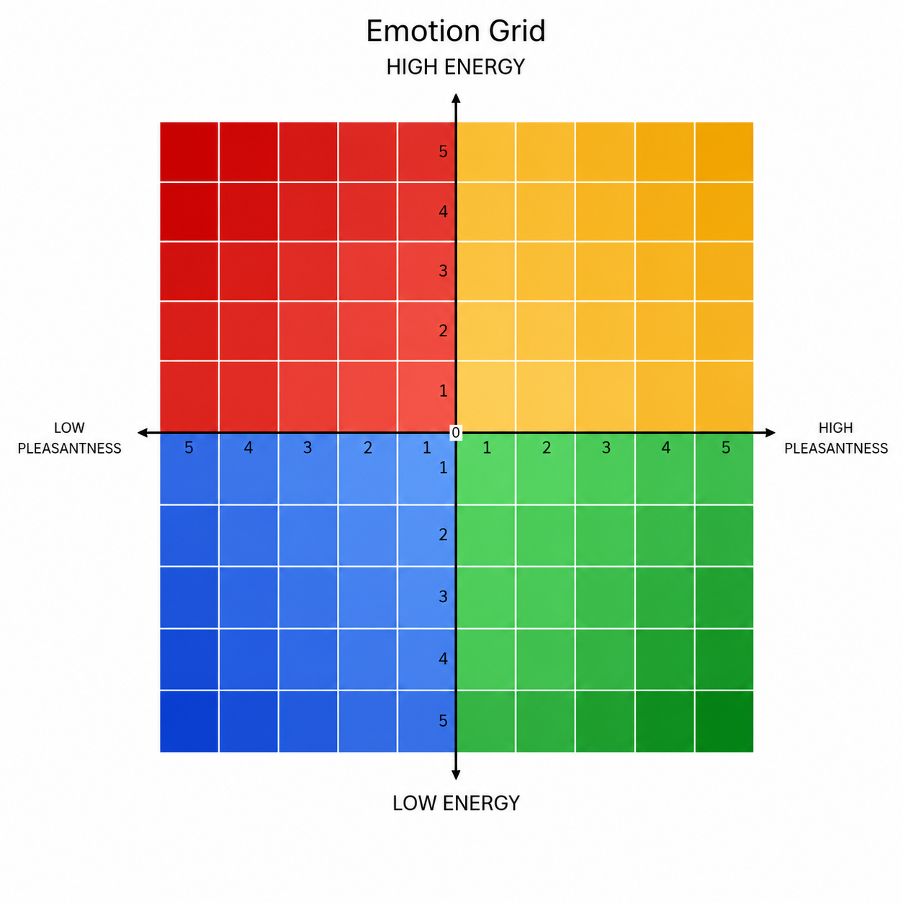
Brackett’s approach encourages us to explore emotions through two dimensions:
- pleasantness
- energy
Rather than immediately trying to label an emotion, begin by noticing its qualities.
Think about an emotion you are experiencing now. Alternatively, bring to mind a recent moment when you felt triggered by a patient, colleague, practice owner, employee, friend or family member.
There is no need to name the emotion yet.
Simply notice it.
Where do you experience it in your body? In your head, your chest your belly, your back arms, legs etc
What are the qualities of the emotion?
Does it feel tight, heavy, restless, hot, hollow, numb or unsettled?
Then ask yourself two questions.
- How pleasant is this feeling?
Using a scale from zero to five, decide whether the emotion sits towards low pleasantness or high pleasantness.
A feeling of fear, irritation or despair may sit towards the low-pleasantness side.
A feeling of contentment, hope or excitement may sit towards the high-pleasantness side.
- How much energy does this feeling contain?
Again, use a scale from zero to five.
Does the emotion have high energy or low energy?
You may notice that you are experiencing more than one emotion. That is normal. Emotions often arrive in groups rather than appearing alone.
Plot each emotion separately on the grid. Click here for a grid
For example, you may notice an emotion that is:
- five towards low pleasantness and two towards high energy
- four towards high pleasantness and five towards high energy
- three towards low pleasantness and four towards low energy
The numbers do not need to be perfect. Their purpose is to help you slow down, observe and become more precise.

Naming the emotion
Once you have identified the level of pleasantness and energy, look at the corresponding area of the emotion grid.
The word you find may not describe your experience perfectly. It may, however, be close enough to open the door.
You may have believed you were angry, but realise you are frightened.
You may have called yourself stressed, but discover that you feel disappointed, trapped or unsupported.
You may have assumed you were tired, when the more accurate word is discouraged.
That difference matters.
You will respond differently to fear than to anger.
You can act differently to grief than to irritation.
You could choose differently to exhaustion than to boredom.
The clearer the description, the more useful your choices can become. Click here for a grid with emotions
Questions to help you explore the emotion
Once you have named the emotion, allow yourself to remain curious rather than rushing to fix it.
You might ask:
- What do I notice now that I have named this emotion?
- How does identifying it more precisely help me?
- What would I prefer to feel?
- What can I alter?
- What needs to be acknowledged?
- What might need to be forgiven or healed?
- What belongs in the past and no longer needs to influence my present?
- What can I choose to do differently now that I could not do before?
- How might this emotion be serving, protecting or teaching me?
- What insight do I have now that I did not have before?
- Who might I need to speak with to help me process what I am feeling?
- What support do I need?
Not every emotion needs to be removed.
Some emotions need to be listened to.
Anxiety may be drawing attention to uncertainty.
Frustration may be signalling a boundary that has been repeatedly crossed.
Sadness may reflect something that matters deeply.
Anger may be protecting hurt.
Overwhelm may be revealing that the current expectations are unrealistic.
The aim is not to judge the emotion as good or bad. The aim is to understand it well enough to decide what to do next.
What happens when you repeat the exercise?
Some people find it useful to repeat this exercise over several days or weeks.
As you do, you may begin to notice patterns.
Ask yourself:
- Which quadrant do I spend most of my time in?
- Is there an emotion that feels especially familiar?
- Is there a quadrant I rarely experience?
- Are there emotions I find difficult to recognise or express?
- What becomes possible when I expand my emotional vocabulary?
- What changes when I become more specific about how I feel?
You may discover that high-energy, low-pleasantness emotions dominate your working day.
You may notice that you move between anxiety and exhaustion.
You may recognise that calm, satisfaction or contentment feel unfamiliar.
You may also realise that some of the emotions you experience at work are not entirely about the situation in front of you. They may be connected to earlier experiences, expectations or roles that you have carried for many years.
That awareness creates choice.
Why this matters in dentistry
Dentistry places significant emotional demands on people.
Clinicians are expected to remain calm while making complex decisions, managing risk, meeting regulatory requirements and caring for anxious patients.
Practice owners may carry responsibility for finances, recruitment, performance, complaints and the wellbeing of the whole team.
Dental nurses, receptionists, managers, hygienists and therapists may absorb the emotions of patients and colleagues while trying to manage their own.
When these feelings remain unnamed, they can influence communication, decision-making and relationships.
A clinician who feels frightened may become overly defensive.
A manager who feels overwhelmed may sound abrupt.
A team member who feels undervalued may withdraw.
A practice owner who feels out of control may become more controlling.
Emotional precision helps us separate the person from the behaviour and the present situation from the history behind it.
It gives us the opportunity to pause and ask:
“What am I actually feeling, and what does this feeling need from me?”
You do not have to stay where you are
Recognising an emotion is not the end of the process. It is the beginning.
Once you can identify where you are, you are better able to decide where you want to go.
You may not be able to move directly from despair to joy, or from panic to calm.
You may, however, be able to move from panic to concern.
From despair to tiredness.
From anger to disappointment.
From overwhelm to clarity.
Small shifts matter.
The more accurately you understand your emotional experience, the less likely it is to control you without your awareness.
You begin to create space between the feeling and the response.
Within that space, different choices become possible.
And sometimes, naming what you feel is the first step towards no longer feeling trapped by it.
If you recognise that your emotions are controlling and debilitating you rather than you honouring them so they can serve you, you will probably find coaching a valuable approach.
To learn more about how I work with my clients, you may choose to book a speak with Jane conversation through my website, www.IODB.co.uk