Do You and Your Patients Really Speak the Same Language?
🦷 You speak English. Your patients speak English.
So why does it sometimes feel like you’re talking at cross purposes?
If you’ve ever felt disheartened by:
- Patients who don’t book,
- Patients who say yes… and then disappear,
- Or the sting of a complaint when you genuinely tried your best,
…it’s easy to assume the problem lies with the patient, the system, or even the treatment options you’re offering.
But what if the issue isn’t what you’re saying…
…it’s how you’re saying it?
The Truth About “Speaking English”
Most of us were taught English at school – grammar, reading comprehension, spelling, maybe even a bit of creative writing. But we weren’t taught how to really communicate. We weren’t shown how to listen with curiosity, or how to adapt our words to suit the person in front of us.
And yet, dentistry – particularly in the private sector – depends on exactly that.
Success in dentistry doesn’t just come from your clinical skills. It comes from the relationships you build.
And those relationships begin with communication.
But here’s the rub:
Just because someone speaks English doesn’t mean they speak it like you do.
What Is a Dialect, Really?
We’re not talking about accents or slang.
When I say every patient has their own “dialect,” I mean:
- The way they make sense of the world
- How they structure information
- What kind of language helps them feel safe, seen, and understood
If we want patients to trust us – to say yes to treatment, to come back regularly, to recommend us – we need to learn how to speak their dialect, not just our own.
Why Miscommunication Is Costing You
Most miscommunication is accidental. It happens when we assume that others interpret words and tone the same way we do. But they don’t.
And when that gap opens up between what you meant and what they heard, it creates confusion, anxiety, and frustration – for them and for you.
It’s often the silent cause of:
- Complaints
- No-shows
- Patients not going ahead with treatment
- Fractured trust within the team
- And eventually, financial pressure on the practice
Think of it like this:
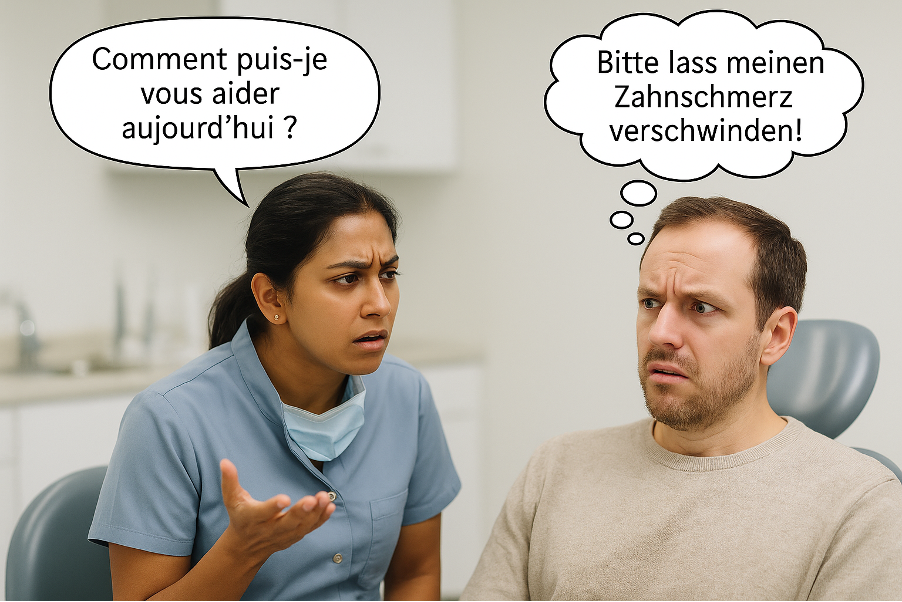
If you’re speaking French and your patient only understands German, it doesn’t matter how clear you think you’re being. They won’t get it. They can’t.
Dentistry Is a Relationship Business
Yes, some practices operate like a transaction-based service – in and out, single treatments, little long-term engagement.
But building a business on one-off treatments is like building your social life on one-night stands. It’s fleeting. Unpredictable. Unsatisfying in the long term.
If you want to build a practice that:
- Has loyal patients who return year after year,
- Enjoys consistent referrals,
- And has fewer gaps in the diary,
…then you need a different approach.
You need trusted relationships – built not just on competence, but on connection.
And connection comes from being able to speak the same language as your patients.
Understanding Your Patient’s Unique Dialect
Every patient has preferences for how they:
- Receive information
- Some need to see it – show them diagrams, visual aids, models.
- Others need to feel it – connect to the emotional benefit of treatment.
- Some want to hear stories – case studies, patient journeys, relatable experiences.
- Others need data – the percentages, the risks, the clinical rationale.
- Make decisions
- Some decide quickly and stick with it.
- Others need time, space, or repetition.
- Some will only commit when they’ve heard it from multiple angles.
- And a few will never make a permanent decision – that’s their process.
A quick way to identify your patient’s dialect?
Ask: “What’s it like outside today?”
You’re not interested in the weather forecast.
You’re tuning in to how they answer:
Do they say “It looks cloudy”?
“It feels close today”?
“My son forgot his coat again – typical”?
Or “Met Office says 60% chance of rain by 3pm”?
Their answer gives you a glimpse into how they process the world – and how you might best reach them.
Why This Matters (Clinically and Commercially)
When you and your team can identify and adapt to your patient’s dialect:
✅ Trust goes up
✅ Complaints go down
✅ Appointment white space disappears
✅ Treatment plan uptake increases
✅ The value of your treatment plans improves
✅ And yes – your income rises
Not because you’re pushing harder.
But because your patients understand you.
And feel understood in return.
And here’s something worth remembering:
Your income is a direct reflection of how much your patients know you, like you, and trust you.
That trust starts with speaking their language.
We Can Teach You How
Our training isn’t about sales scripts or clever phrasing.
It’s about helping your whole team develop communication fluency – the ability to listen deeply, respond intelligently, and adapt naturally to the person in front of you.
We help you and your team:
- Decode your own communication preferences
- Understand how to identify your patient’s unique dialect
- Learn how to structure language and treatment presentations that land
And when you do that, everything else improves: team morale, patient satisfaction, and your bottom line.
Next Step: Let’s Have a Conversation
Would you like to explore how communication training could benefit your team, your patients, and your practice?
🗨️ Book your complimentary ‘Speak with Jane’ call via www.iodb.co.uk
We’ll talk about where the communication breakdowns might be happening in your practice – and how we can fix them, together.