Why Change Fails – And What to Do Instead
Have you ever introduced a change in your dental practice only for it to quietly fall flat?
Maybe you’ve brought in a new IT system to streamline operations. Or you’ve created a new role to help manage patient flow. Or perhaps you’ve announced the shift from NHS to private. You might even have attended a brilliant course, bought the equipment, felt inspired – only to return to practice and carry on as before.
If this sounds familiar, you’re not alone. Many principals and practice managers feel frustrated, even demoralised, when change doesn’t stick. And dental team members, too, often find themselves stuck in situations they’re unhappy with, but unsure how to change. The intention is there, but change doesn’t happen.
So what’s going wrong?
“You just need to change your mindset…”
We’ve all heard this. Maybe even said it ourselves.
But here’s the truth: change doesn’t happen by willpower alone.
Being told to “just change your attitude” or “just be more positive” is like being told to “just fix your tooth” without being given any tools, materials, or training.
Lasting change – whether personal or professional – requires two things:
- Understanding how people think about change.
- Knowing how the process of change actually works.
The Psychology of Change: Why People Resist It
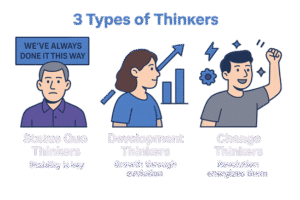
We all process change differently – and that’s not just personality, it’s how our thinking patterns are wired. Just like fingerprints, no two are the same, but broadly, people fall into three styles:
- Status Quo Thinkers – Stability is key.
They prefer predictability and routine. Change, even if beneficial, feels like disruption. You’ll often hear “We’ve always done it this way.”
- Development Thinkers – Growth through evolution.
These individuals embrace change when it’s gradual and has a clear purpose. Sudden shifts unsettle them, but well-paced development is welcomed.
- Change Thinkers – Revolution energises them.
They thrive on variety and may even push for change before it’s needed. Routine bores them. These are your early adopters.
Knowing which type of thinkers are in your team is essential if you want change to take root. Otherwise, you risk pushing too fast or too slow – and losing the team along the way.
These patterns are not right or wrong, any one of them can be helpful or a hinderance depending on the situation.
The 6 Stages of Change – Why Timing is Everything
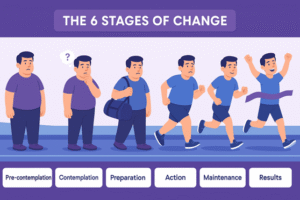
Psychologists James Prochaska and Carlo DiClemente developed the Transtheoretical Model of Behaviour Change. They discovered that successful change follows six distinct stages. Problems arise when leaders are at one stage – often “Action” – while the team is still at “Pre-contemplation”.
It’s like starting a running race while your team is still tying their shoelaces.
The 6 Stages of Change:
- Pre-contemplation – “There’s no problem.”
- Contemplation – “Maybe something needs to change.”
- Preparation – “I’m getting ready.”
- Action – “I’m doing it.”
- Maintenance – “I’m keeping it going.”
- Results or Release – “This is now my new normal.”
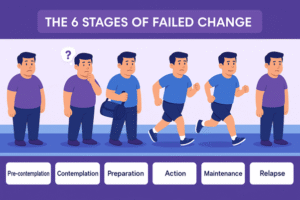
If the cycle is broken, and people are pushed too fast or not supported properly, we don’t get to stage six. Instead, we loop back into:
Relapse – “Let’s just go back to how it was.”
This is why changes don’t stick. It’s not because people are lazy or resistant. It’s because they’re being asked to take action before they’re ready – or without support through the other stages.
So what do you do instead?
If you’re introducing change in your practice – whether systems, staffing, culture, or clinical – here’s what works:
- Understand your own and your team’s thinking patterns around change.
- Identify where each person is in the cycle of change.
- Go back if needed – and bring people with you.
- Create a structured, resourced plan that supports progress through all six stages.
This isn’t a slow process – in fact, done right, it’s far quicker than fighting resistance and relapsing again and again.
Change Doesn’t Have to Be a Struggle
As dentists, we’re trained in clinical excellence – but not always in the psychology of change. That’s where I come in. With a background in dentistry, applied psychology, and coaching, I help practices and individuals understand their thinking, lead through change, and build the kind of workplace where everyone can thrive.
If you’re ready to make a change – in your practice, your mindset, your team, or your career – and want to know how to do it successfully, I’d love to support you.
📧 Contact me at Jane@IODB.co.uk
Let’s have a conversation.