The Tale of Two Houses
On the edge of a small, sunlit town stood two plots of land, side by side. Each belonged to someone with a dream.
Eleanor was a woman who carried her dreams carefully, like fine crystal. She had a vision of a home that would cradle her life—a place to work, to laugh, to share meals, to grow old gracefully. When she walked the empty plot, she could already imagine the golden light spilling across polished floors, the murmur of family voices at the dinner table, the quiet hum of peace.
Eleanor sought out an architect. A quiet man with sharp eyes, ink-stained fingers, and the kind of calm that comes from knowing the weight of his craft. His studio smelled faintly of cedar and coffee. Rolls of blueprints lined the walls like scrolls in an ancient library. They spent long hours together, voices low and thoughtful. He asked questions Eleanor had never considered:
“Where will the sun rise when you drink your morning tea?”
“When the children run through the halls, how will their laughter travel?”
“When you are old, will the stairs still welcome you?”
Each answer shaped the lines on his paper. Every curve, every wall, every beam spoke of foresight. When Eleanor saw the final plans, she pressed them to her chest like a love letter. She understood that this paper—this thinking—was the foundation of everything.
She paid for those plans without hesitation. Not because they were ink on parchment, but because they held wisdom. They would save her time, money, and heartbreak in years to come.
Next door lived Martin. Martin liked things fast. Martin liked things cheap. He saw Eleanor poring over papers and shook his head with a chuckle.
“All that talk, all that money for some scribbles? I’ve got AI, CAD-CAM, and a good eye. Why would I pay someone else?”
And so, Martin sketched his dream in a weekend frenzy—rooms here, stairs there, windows wherever they fit. It’ll do, he thought, grinning at his own cleverness.
The builders came.
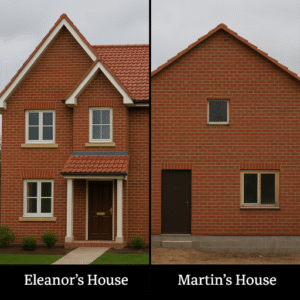
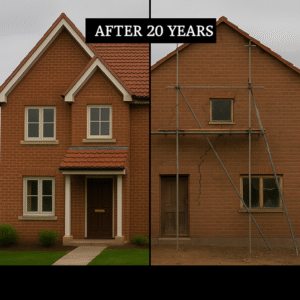
For Eleanor, the build was a symphony. Every nail struck its note on time. Every beam fit as if the earth had been waiting for it. The staircase curved like a ribbon, doors opened without a whisper of resistance, light danced where it was meant to. When the house stood complete, Eleanor stepped inside and felt it breathe with her. It wasn’t just a house; it was home. Through the years, it embraced birthdays, quiet dawns, laughter, and late-night talks. Every corner told her: You were wise to plan.
She told anyone who visited, “The secret is the architect. I paid for his thinking, not just his lines.”
Martin’s build was chaos wrapped in dust. Walls fought for space. The staircase began boldly but ended awkwardly, like a sentence without a full stop. Doors clashed with wardrobes. When rain came, water sought weaknesses Martin hadn’t imagined. His house became a battlefield of repairs—pipes leaking, beams groaning under strain. Every month, another bill, another regret.
Late one night, as he patched yet another crack, Martin muttered into the silence:
“If only I’d spent the money on someone who knew how to think.”
The Moral
Houses aren’t just bricks and timber. They’re thought, foresight, wisdom. Without those, the walls crumble long before the years do.
What This Means for Dentistry
Dentistry is no different. Every time you plan a treatment, you’re not just a builder—you are the architect of your patient’s future. You are designing something that should last not for a season, but for decades.
Just like the architect, you must study, think, and understand:
- How will this treatment fail?
- When will it fail?
- What do I need to do now to make sure it lasts 30 years?
That thinking takes time. It takes training and expertise. It cannot—and must not—be done at 10 o’clock on a Sunday night at your dining table. It should be scheduled in your diary. It should have its own treatment item code. And yes, you should charge for it, because your mind is the most valuable tool you own.
So let me ask you:
Are you making sure you charge for your expertise as a dental architect? Or are you giving it away for free?
If you’d like help learning how to zone your diary, set your prices, and communicate this to patients so they understand its value, get in touch with me. Together, we’ll ensure your patients live in the dental equivalent of Eleanor’s house, not Martin’s.
Because being a dentist isn’t just about drilling and filling. It’s about design. It’s about building smiles and structures that last a lifetime.