Understanding What You Are (and Are Not) Expected to Provide Under the NHS
Many dentists, therapists, and team members are overwhelmed, drowning in UDAs, chasing their tails, and feeling unhappy, demoralised, and underpaid by the UDA system. You may also have noticed how providing predominantly NHS care can lead to deskilling. For many, this has become so disheartening that they are now leaving the profession altogether.
I understand that frustration deeply. I have been where you are — anxious, exhausted, and fearful of complaints, wanting to do the right thing but unsure where the boundaries truly lie. My purpose in this article is to offer clarity and stepping stones to help you move towards a simpler, less stressful, and more rewarding professional life.
Why So Many Clinicians Feel Confused
In my conversations with dentists and therapists who feel anxious and overwhelmed, I have discovered that even those who have worked within the NHS for years often have little or no understanding of what is actually expected of them under the contract.
Very few have read:
-
the General Dental Services (GDS) Contract,
-
the wording on the FP17 DC, or
-
documents such as Avoidance of Doubt: Clinical Policy for Self-Funded Dental Treatment Requiring NHS Intervention or the Restorative Dentistry Index of Treatment Need Complexity Assessment (produced by the NHS and the Royal College of Surgeons, Faculty of Dental Surgery).
As a result, many clinicians feel compelled to provide treatments that should not be carried out under the NHS.
Because they are uncertain about the rules and how to make accurate assessments, they often lack confidence in communicating clearly with patients. This uncertainty breeds fear and worry — and can result in dentists feeling pressured to perform treatments outside their NHS remit or beyond their level of competence, simply because patients expect the treatment to be provided under the NHS.
What This Blog Aims to Do
The purpose of this blog is to:
-
clarify what you are and are not expected to provide under the NHS,
-
show you where to find the supporting documents, and
-
help you align patient expectations with what is contractually and clinically appropriate.
If, after reading, you would like to discuss how to communicate these boundaries clearly and confidently with your patients, please do get in touch.
Why Complaints Happen
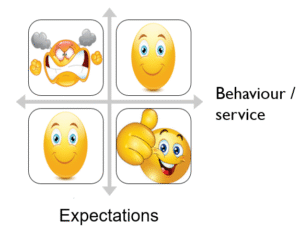
Most patient complaints are not about clinical treatment. They arise because of a mismatch between what patients expect and what is delivered.
By understanding exactly what you are contracted to provide, and learning how to communicate that clearly, you can eliminate the confusion and tension that lead to complaints — for both you and your patients.
Go to the Source, Not the Gossip
Please be cautious about relying on what you hear through dental gossip, Facebook or WhatsApp groups, or corridor conversations. These snippets of “advice” are often quick, simplified, and sometimes entirely inaccurate.
The wisdom is in the detail — and the only way to be sure of your obligations is to refer back to the primary documents. Unfortunately, in many online spaces, those who shout the loudest often lack the facts to substantiate their opinions.
Always take guidance only from people who can reference and verify what they share.

What the NHS Contract Actually Says
The General Dental Services (GDS) Contract defines what you are required to provide.
Standard General Dental Services (GDS) Contract
Revised: May 2025
https://www.england.nhs.uk/wp-content/uploads/2018/08/D145-standard-general-dental-services-contract.pdf
MANDATORY SERVICES
Mandatory services
74.Subject to clause 74A, the Contractor must provide to its patients, during the
period specified in clause 75, all proper and necessary dental care and treatment
which includes—
74.1. the care which a dental practitioner usually undertakes for a patient and
which the patient is willing to undergo;
74.2. treatment, including urgent treatment; and
74.3. where appropriate, the referral of the patient for advanced mandatory
services, domiciliary services, sedation services or other relevant services
provided under Part [5] of the 2006 Act.
74A. The services described in clause 74 are not required to be provided by the
Contractor during any period in respect of which the Care Quality Commission has
suspended the Contractor as a service provider under section 18 of the Health and
Social Care Act 2008 (suspension of registration)75.The Contractor must provide—
75.1.1. urgent treatment, and
75.1.2. all other services described in clause 76,
that are necessary to meet the reasonable needs of its patients during normal
surgery hours. Normal surgery hours are [ ] to [ ] [every working day]
28.
76.The dental care and treatment referred to in clause 74 includes—
76.1. examination;
76.2. diagnosis;
76.3. advice and planning of treatment;
76.4. preventative care and treatment;
76.5. periodontal treatment;
76.6. conservative treatment;
76.7. surgical treatment;
76.8. supply and repair of dental appliances;
76.9. the taking of radiographs;
76.10. the supply of listed drugs and listed appliances; and
76.11. the issue of prescriptions,
but it does not include additional services.
Unless you have an advanced mandatory services contract, you are not expected to provide advanced mandatory services under the NHS unless you have been formally commissioned to do so.
“advanced mandatory services” means any primary dental service that would fall within the services described in clauses 74 to 76, but by virtue of the high level of facilities, experience or expertise required in respect of a particular patient, the service is provided as a referral service;
““additional services” means one or more of—
(a) advanced mandatory services;
(b) dental public health services;
(c) domiciliary services;
(d) orthodontic services; and
(e) sedation services;
Levels of Care and Complexity
Clinical Guide for Dentistry Version 2, 28 October 2022
https://www.england.nhs.uk/wp-content/uploads/2015/09/B1639-cinical-guide-to-dentistry-september-2023.pdf
Clinical Standard for Restorative Dentistry Version 2, 28 October 2022
https://www.england.nhs.uk/wp-content/uploads/2022/10/B1640-clinical-standard-restorative-dentistry.pdf
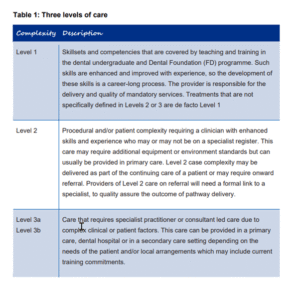
The NHS defines three levels of care based on complexity and expertise:
“2.2.1 Level 1 Level 1 care complexity requires the skill set and competencies for performers on the NHS performer list and delivered within a primary care NHS mandatory contract.
2.2.2 Level 2 Level 2 care complexity is defined by procedural and/or patient complexity requiring a clinician with enhanced skills and experience who may or may not be on a specialist register. Providers of Level 2 care on referral will need a formal link to a consultant-led MCN to quality assure the outcome of pathway delivery.
2.2.3 Level 3 Procedures to be performed or conditions to be managed by a clinician recognised as a specialist and on a GDC specialist list OR by a suitably registered consultant.”
Only Level 1 is covered by mandatory services — and this is the only level of complexity that you are expected to provide under your GDS contract.
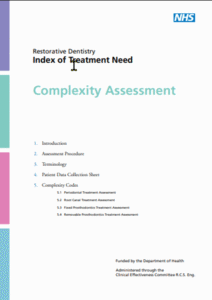
If you are not confident at evaluating case complexity, the NHS and the Royal College, Faculty of Dental Surgery, have made this easier through the Restorative Dentistry Index of Treatment Need Complexity Assessment:
https://www.rcseng.ac.uk/-/media/files/rcs/fds/publications/complexityassessment.pdf
This invaluable resource guides you through assessing Level 1, 2, and 3 complexity for:
-
Periodontal treatment
-
Root canal treatment
-
Fixed prosthodontics
-
Removable prosthodontics
Understanding these distinctions will help you be confident about what you can and should provide, and what lies outside your NHS remit.
Navigating Complex Cases
Sadly, very few areas have clinicians commissioned to provide advanced mandatory care. Yet that does not mean you should feel pressured to deliver Level 2 or 3 treatment within your NHS commitment — especially if it is beyond your competence.
If you find yourself in this position, you have options:
Molar Endo Decision Tree
-
Evaluate the level of complexity using the Restorative Dentistry Index of Treatment Need Complexity Assessment.
-
If Level 1, it falls under mandatory services and should be provided by the GDP under the NHS.
-
If Level 2 or 3, do you have a mandatory service contract?
-
Yes: treatment may be provided under the NHS through your advanced mandatory service contract.
-
No: you have four routes available:
-
Refer to another provider with an advanced mandatory services contract.
-
If none exist, refer to your local Clinical Commissioning Group for guidance on what may be commissioned under the NHS.
-
Refer to a private specialist or GDP with a special interest.
-
If you have undertaken additional training and possess the equipment, experience, and confidence, provide the treatment privately.
-
-


Bringing It All Together
I hope this article has given you greater clarity about what you can and cannot do under the NHS — and the confidence to make those decisions from a place of knowledge rather than fear.
Knowing what to do is one part of the journey. Knowing how to communicate it to patients — clearly, confidently, and compassionately — is another. Many dentists tell me they end up performing non-mandatory NHS treatments simply because they fear a complaint or don’t know how to have that conversation.
That’s where I can help.
If you would like to improve your communication skills, build strong patient relationships, and reduce your anxiety about complaints, I invite you to join our Patient Centred Communication – BEST CHOICES training or to contact me directly for a conversation. Together, we can make your working life calmer, clearer, and more rewarding