Should I Take This Job? Why the Best Answer Starts With You
“Should I take this job or that one?” “Should I specialise in endodontics or implants?” “I’ve been offered more money, but I’ll have to travel further. What would you do?”
These are the sorts of questions I regularly see dental clinicians asking in Facebook groups, and whilst there’s nothing wrong with seeking advice, I do find myself wondering whether people are asking others to help them make a decision or actually handing over responsibility for making that decision to somebody else.
The interesting thing about these questions is that they’re almost always presented as binary choices, either this or that, when in reality important career and life decisions are rarely that simple.
They’re multifactorial, influenced by your values, beliefs, priorities, responsibilities, preferences, financial circumstances, relationships, aspirations and what you want your life to look like.
Here’s the problem. The people you’re asking don’t know you.
With the very best intentions, they’ll offer you their opinions about what they would do, based upon the limited information you’ve provided and influenced by their own values, beliefs, priorities and personal circumstances.
Their perspectives may be interesting, even useful, but please don’t confuse somebody else’s opinion with what’s right for you.

Internal Referencing – Do you know what’s right for you?
In my coaching practice, I use MindSonar thinking pattern profiles to explore 13 different factors that influence how we think, make decisions and ultimately behave. None of these thinking patterns is inherently right or wrong; the more important question is whether, in a particular context, they’re serving you or sabotaging you.
Two patterns are particularly relevant when it comes to making decisions: referencing and locus of control.
People can be internally or externally reference and have internal or external locus of control. There is not a right or wrong way to be, the question is more does your level serve you or sabotage you?
Internal referencing is about knowing your own criteria for success, understanding what’s important to you and being able to recognise whether something is right for you or not.
External referencing, on the other hand, is when you look towards other people for their opinions, approval or judgement to tell you what is right or wrong.
Think about that familiar question when trying on clothes: “Does my bum look big in this?”
That’s external referencing. You’re asking somebody else to make the judgement.
Internal referencing would be looking in the mirror and thinking, “Yes, I look great”, or perhaps deciding that the outfit really doesn’t do me justice. Either way, you know what you’re looking for and you’re making the judgement against your own criteria.
Interestingly, our education system has spent years conditioning us to externally reference. From school through GCSEs, A levels and dental school, we’ve been taught what we need to know, what answers are expected and how our performance will be judged by somebody else. Google and latterly AI develop an external reference thinking pattern looking to the outside for answers.
Then we qualify, step into the wider world and suddenly find ourselves faced with decisions for which there isn’t a predetermined correct answer and we need to think about the best approach for the patient. For some this is hard because, they have become dependant on an externally referencing approach of being told what to do, and so we see lots of Facebook messages and WhatsApp messages seeking advice.
How much time have we spent learning how to define our own criteria for success and how to think and make our own decisions?
Shakespeare wrote in Hamlet, “To thine own self be true.”
To be true to yourself, you first need to know yourself.
That means understanding:
- Your values and their hierarchy. What really matters to you?
- Your beliefs, including those that support you and those that might limit you.
- Your priorities, preferences, talents and responsibilities.
- Your thinking patterns and how they influence your choices.
- Your sense of identity, purpose and what you want from your career and life.
The better you understand yourself, the easier it becomes to establish your own criteria for making decisions that genuinely fit you.

Internal Locus of Control – Who’s in the driving seat?
The second pattern I’d like to explore is internal versus external locus of control, which is about where you perceive the responsibility and power to influence what happens in your life.
Someone operating with a strong internal locus of control recognises their ability to influence outcomes and takes responsibility for making things happen. If they decide they want to improve their fitness, they might research gyms, organise a personal trainer and put a plan into action.
Someone adopting a more external locus of control might wait for a friend to suggest joining a gym together and rely upon them to make the arrangements and get things started.
There are circumstances we can’t control, and there are times when relying upon others is entirely appropriate. As with our other thinking patterns, the question isn’t whether one is right and the other wrong, but whether the approach you’re using is helping you achieve the results you want.
So, when you’re making decisions about your career, who’s in the driving seat?
Are you taking responsibility for exploring your options, establishing your priorities and making things happen, or are you handing over that responsibility to somebody else?
If you’re allowing somebody else to make the decisions, how confident can you be that they’re making the best decisions for you?

This is where coaching and supervision can be so powerful
One of the things I particularly value about coaching and SUPERvision is that they provide opportunities to get to know yourself better, to explore your thinking patterns, understand your beliefs and values, and recognise what might be influencing your decisions, sometimes without you even realising it.
If you attended t a coaching session asking, “Should I take this job or that one?”, I wouldn’t tell you which job to take, instead, I would invite you to explore all the different factors influencing your decision, what each opportunity might mean for you, how it fits with your values, priorities, identity and purpose, and what the potential consequences might be for your career, relationships, wellbeing and happiness.
We could explore whether your habitual thinking patterns are serving you or sabotaging you, helping you become more internally referenced and more confident about taking responsibility for your choices.

The purpose of coaching and supervision isn’t to tell you what to do. It’s to help you develop the self-awareness, clarity and confidence so you have more choice and capacity to decide what’s right for you.
The next time you’re tempted to ask a group of strangers what you should do with your career, a clinical situation, or purchase, perhaps pause and consider whether you are looking for specific useful information to inform your decision or hoping somebody else will make that decision for you.
I believe there’s a rather wise Yoda inside each of us, waiting for us to stop asking everybody else for the answers and start asking consulting with our inner wisdom to find a better answer, because we have learned how to ask ourselves better questions.
After all, it’s your life, your career and your decision.
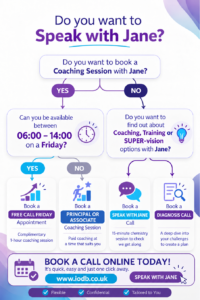
If you’d like to understand your own thinking patterns, explore what really matters to you, shed light on your blind spots and develop greater confidence in making decisions that serve you, I’d be delighted to help.
E mail Jane@IODB.co.uk