You Said It. But Did They Catch It?
How to improve communication within your dental practice
Many people go through their working day feeling unheard, ignored, misunderstood or misrepresented.
This can be particularly damaging within a dental practice, where effective communication affects almost everything: patient care, teamwork, clinical safety, diary management, leadership, morale and profitability.
We have more ways to communicate than ever before. We can send emails, text messages, WhatsApp messages, voice notes, practice-management notifications and team announcements within seconds.
Yet communication does not necessarily become more effective simply because it becomes faster.
In fact, the more communication channels we have, the easier it can become to mistake sending a message for having a conversation.

Communication is like a game of catch
I like to think of a conversation as being like a game of catch.
You can throw the ball perfectly, but that does not mean the other person caught it.
In the same way, just because you have said, written or sent something does not mean it was received, understood or interpreted in the way you intended.
You may believe your message was clear. The other person may have heard something entirely different.
That is because communication is not simply what was said.

Communication is what was understood.
This means that responsibility for communication does not end when you press send, finish speaking or walk away.
Before assuming that communication has taken place, ask yourself:
- How do I know they heard or read it?
- How do I know they understood it?
- How do I know their interpretation of my words is the same as mine?
- Have we agreed what needs to happen next?
- Do we have the same understanding of what success looks like?
- Have we agreed who is responsible and by when?
Until these questions have been answered, you may have transmitted information, but you have not necessarily created shared understanding.
When you communicate, how do you ensure the ball is caught and not dropped?
Text and email are useful, but limited
Text messages and emails are excellent vehicles for sending data.
They are useful for confirming:
- Dates and times
- Addresses
- Instructions
- Meeting agendas
- Factual information
- Agreed actions
- Written records
They are often a poor vehicle for conversation especially one that may be emotionally charged, complicated or sensitive.
When you send an email or message, are you speaking with someone or simply talking at them?
Are you creating a conversation, or are you talking into a void?
Without facial expression, tone of voice, pauses and immediate clarification, the recipient fills in the missing information for themselves. They may read frustration where none was intended, criticism where you meant to offer guidance, or indifference where you were simply busy.
The words may be yours, but the tone can be created entirely inside the reader’s mind.
This is why messages involving performance, conflict, disappointment, patient complaints, misunderstandings or changes in responsibility are usually better handled through a conversation.
A useful principle is:
Use written communication to transfer information. Use conversation to create understanding.
Once the conversation has taken place, the agreed actions can then be confirmed in writing.
Are you communicating at people or with them?
Communication at someone is usually one-directional.
You tell them what you think, what you want or what they have done wrong. You may then assume the matter has been dealt with.
Communication with someone is different.
It creates space for both people to contribute. It allows questions, clarification and reflection. It recognises that the other person may have information, concerns or perspectives that you do not yet know.
Communicating with someone does not mean avoiding leadership, difficult messages or clear expectations.
It means making sure the message has been understood and giving the other person an opportunity to respond.
For example, compare:
“From now on, you need to make sure the surgery is fully stocked before the morning session.”
with:
“I would like every surgery to be fully stocked before the morning session. Talk me through what you understand that to mean and what might prevent it from happening consistently.”
The first statement gives an instruction.
The second begins a conversation.
Ask for playback, not agreement
One of the least reliable ways to check understanding is to ask:
“Do you understand?”
Most people will say yes.
They may believe they understand. They may not want to look foolish. They may want to end an uncomfortable conversation. They may understand the words but not the standard you expect.
A more useful question is:
“Please talk me through what you have understood.”
You could also ask:
- “What are you taking away from this conversation?”
- “What do you understand the next steps to be?”
- “How would you explain this to someone else?”
- “What do you understand success to look like?”
- “What do you need from me to complete this?”
- “Is there anything you have understood differently?”
These questions are not a test designed to catch someone out.
They are an opportunity to discover whether your message was clear.
The response may reveal that information has been deleted, distorted or generalised.
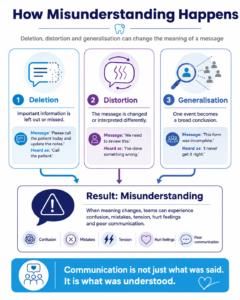
Deletion
Part of the message has been missed.
You said, “Please complete the stock check every Friday and send it to the practice manager.”
They heard, “Complete the stock check.”
Distortion
The message has been interpreted differently.
You said, “We need to review how these calls are being handled.”
They heard, “You think I am bad at my job.”
Generalisation
One event has been turned into a much broader conclusion.
You said, “The laboratory form was incomplete on this occasion.”
They heard, “I never do anything properly.”
Playback allows these differences to be identified before they become mistakes, resentment or conflict.

Learn from the talking circle
Some Indigenous talking-circle traditions use a talking stick, feather or another significant object to indicate whose turn it is to speak. The other participants listen and reflect before responding. Practices vary between communities, so the idea should be approached with respect rather than treated as a single tradition shared by every Indigenous nation.
There is something valuable dental teams can learn from this approach.
When one person is speaking, everyone else listens to understand rather than preparing their defence or planning what they will say next.
The listener can then play back what they believe they heard:
“What I heard you say was…”
The speaker can confirm, correct or add to the listener’s interpretation.
The conversation continues until both people have clarity.
You do not need a physical talking stick in every meeting. You need the discipline that it represents:
- One person speaks at a time.
- Others listen without interrupting.
- The listener reflects back what they heard.
- The speaker clarifies any misunderstandings.
- Both people confirm the agreed meaning and next steps.
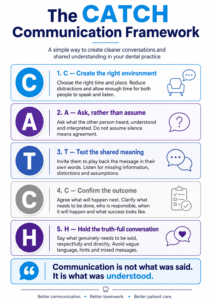
The CATCH communication framework
To create clearer conversations in your practice, remember to CATCH the message.
C — Create the right environment
Choose an appropriate time and place.
A rushed conversation between patients, a message sent late at night or feedback delivered in front of colleagues is unlikely to produce careful listening.
Reduce distractions and allow enough time for both people to speak.
A — Ask, rather than assume
Ask what the other person heard, understood and interpreted.
Do not assume silence means agreement or that a quick “yes” means the message is clear.
T — Test the shared meaning
Invite the other person to play the message back in their own words.
Listen for missing information, different interpretations and assumptions.
C — Confirm the outcome
Agree exactly what will happen next.
Clarify:
- What needs to be done
- Who will do it
- What standard is expected
- What support is required
- When it will be completed
- How you will know it has been successful
H — Hold the truth-full conversation
Say what genuinely needs to be said, respectfully and directly.
Do not hide the real issue inside vague language, hints, passive-aggressive messages or lengthy emails.
A truth-full conversation allows people to understand what is happening, why it matters and what needs to change.
Does this take too much time?
Playing messages back, asking questions and checking understanding can feel slow.
It may seem unnecessary when everyone is busy and the next patient is waiting.
But how much time is lost resolving the consequences of poor communication?
Consider the time spent:
- Correcting avoidable mistakes
- Repeating instructions
- Managing complaints
- Repairing damaged relationships
- Dealing with hurt feelings
- Rebooking patients
- Investigating who said what
- Replacing team members who felt unheard
- Having the difficult conversation that was avoided weeks earlier
Taking an extra two minutes to create shared understanding can prevent hours of confusion and frustration.
Checking understanding is not wasted time.
It is an investment in clarity, trust and consistency.
In the rush to save a few minutes, clarity, understanding and relationships become the collateral damage.
Start with your next conversation
The next time you give an instruction, make a request or raise a concern, do not finish the conversation by asking:
“Is that clear?”
Instead, ask:
“What have you understood from what I have said?”
Then listen carefully to the answer.
You may discover that the ball you thought you had thrown clearly was never caught.
Effective communication is not about speaking more, sending more messages or finding another communication channel.
It is about slowing down long enough to make sure meaning has travelled successfully from one person to another.
A problem can only be present in the absence of a truth-full conversation.

If you would like to improve the communication and understanding within your practice, contact us for more information about our team training days and 1-2-1 bespoke coaching.