Self-employed, Worker or Employee? The Conversation Every Dental Practice Needs to Have
There are daily posts in dental forums from associates, hygienists and therapists asking questions about their self-employed contracts.
- Can my practice tell me how much holiday time I take and when I take it?
- Do I have to find and pay for my own locum?
- Can I / they change my days?
- Why am I being asked to sign this clause?
- Am I actually self-employed?
These are not insignificant questions.
For decades, self-employment has been commonplace within dentistry, particularly for dental associates. The BDA continues to describe associates as traditionally working on a self-employed basis. However, the assumption that someone is self-employed simply because they are called an “associate”, “self-employed hygienist” or “self-employed therapist” is increasingly unsafe.
Some employment-law specialists aver that many working relationships described as self-employed may, when examined more closely, have characteristics of worker or even employee status. That does not mean that dental clinicians cannot genuinely be self-employed, it means that the label is not enough.
For both the practice engaging the clinician and the clinician being engaged, the important question is:
What is the reality of the working relationship?
Current Government guidance could hardly be clearer. An engager cannot simply choose whether somebody is an employee, worker or self-employed. The correct classification flows from the reality of the relationship, and it should be kept under review as that relationship changes.
That is why the conversation you have before signing the contract matters so much.
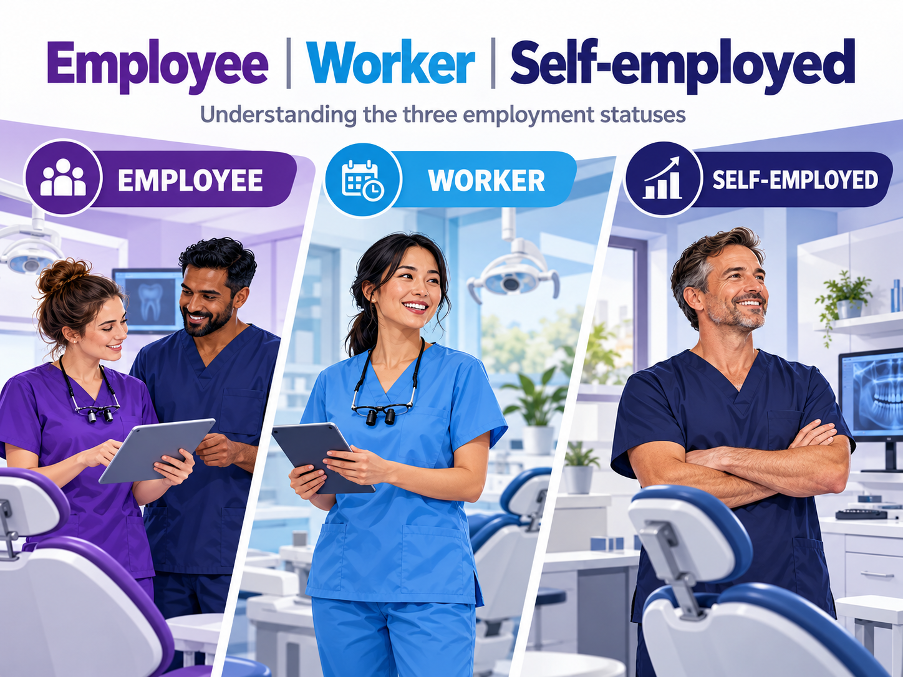
There are three main employment statuses
For employment-rights purposes in Great Britain, there are three main categories: employee, worker and self-employed.
Broadly, there are three main employment statuses to understand: employee, worker and self-employed. The distinction matters because each status brings different responsibilities, protections and employment rights.
An employee works under a contract of employment. The organisation they work for will generally have a significant degree of control over when, where and how their work is carried out. Employees have the widest range of statutory employment rights and protections.
Someone who is genuinely self-employed, however, is running a business on their own account and providing services to clients or customers. They generally have greater commercial independence and take greater responsibility for how their business operates, including its financial risks. In return for that independence, genuinely self-employed people usually have far fewer statutory employment rights than workers or employees.
A worker sits somewhere between an employee and someone who is genuinely self-employed. A worker will normally be expected to carry out the work personally, but may have more flexibility than an employee. Importantly, they are not genuinely providing their services to the organisation as an independent business with that organisation as their client or customer. Workers have a number of important statutory rights, including entitlement to the National Minimum Wage, paid holiday and protection against unlawful deductions from wages, discrimination and whistleblowing.
The difficulty is that these categories are not determined simply by the title given to someone or by writing “self-employed” into their contract. The whole nature of the working relationship needs to be considered.
Workers have rights that genuinely self-employed contractors do not have. Current ACAS guidance includes paid holiday, minimum wage, payslips, discrimination protection and whistleblowing protection among workers’ rights. Workers do not normally have all the additional protections available to employees, such as ordinary unfair dismissal protection or statutory redundancy pay.
There is another complication.
Employment status and tax status are not the same thing
This is an important distinction that is often missed.
There is a separate system for determining employment status for tax and for determining employment status for employment rights.
For tax purposes, HMRC is essentially deciding whether the engagement is employed or self-employed. There is not a separate tax category of “worker” equivalent to the worker category in employment law.
It is therefore possible for somebody’s position for employment-rights purposes and tax purposes not to be identical. GOV.UK specifically warns that being regarded as self-employed for tax does not necessarily make somebody self-employed for employment-law purposes.
For dentists there has also been an important change.
HMRC’s specific guidance relating to the employment status of dentists was withdrawn from 6 April 2023. HMRC now directs practices and clinicians to its general employment-status guidance and the Check Employment Status for Tax, or CEST, tool.
In other words, being a dentist does not automatically determine the answer.
What does HMRC look at?
There is no single magic clause that creates self-employment.
The whole relationship has to be considered.
Factors pointing towards genuine self-employment can include having significant control over when, where and how you work; genuinely operating a business on your own account; being able to work for different clients; negotiating your fees; taking financial risk; having the possibility of making a profit or loss; and having a genuine ability to arrange for somebody else to undertake the work.
Conversely, greater control by the practice, a requirement for the clinician to provide the service personally, integration into the business, little financial risk and restrictions on the individual’s ability to operate independently may point towards worker or employee status.
Government guidance specifically says that someone is more likely to be self-employed when they have significant freedom over how they work, bear genuine financial risk, can provide a substitute without restriction, negotiate prices and are not integrated into the client’s organisation.
HMRC looks at specific working arrangements to decide if you are self-employed rather than an employee:
- Control: You decide how, where, and when you do your work.
- Multiple clients: You have several customers or clients at the same time.
- Invoicing: You submit invoices for your pay instead of receiving a PAYE wage.
- Equipment: You provide the main tools and equipment needed to do your job.
- Substitution: You can hire other people or send someone else at your own expense to do the work.
- Financial risk: You charge a fixed price and bear the financial risk of fixing unsatisfactory work in your own time.
For tax purposes, HMRC categorizes individuals strictly as either employed (paying tax via PAYE) or self-employed (filing through Self Assessment)—the employment law category of a “worker” does not exist separately for tax
None of those points should be considered in isolation. For example, submitting an invoice does not automatically make somebody self-employed, paying your own tax does not automatically make you self-employed, working in more than one practice does not automatically make you self-employed, writing SELF-EMPLOYED ASSOCIATE AGREEMENT across the front of the contract certainly does not settle the question.
HMRC itself states that two people carrying out apparently similar work could have different employment statuses because the actual terms and circumstances of their engagements are different.
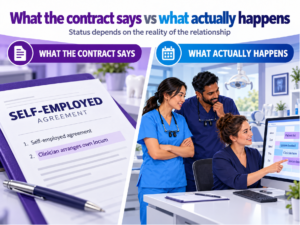
The contract matters, but what actually happens matters too
Imagine an associate agreement states:
The associate is responsible for finding and engaging a suitable locum if they are unable to work for more than a specified period and on paper, that may appear to support self-employment.
What happens in reality?
If every time the associate is away the practice automatically arranges the locum, chooses the locum, negotiates with them and organises payment, the reality may not reflect the contractual wording.
That matters.
The Supreme Court has established that tribunals can look beyond what a contract says and examine the actual agreement and working relationship between the parties.
In Autoclenz Ltd v Belcher [2011], car valeters had written agreements describing them as self-employed and containing provisions including substitution rights. The Supreme Court upheld the tribunal’s ability to consider what the parties had actually agreed and how the relationship operated, rather than accepting the written description at face value.
This principle reaches far beyond car valeting.
It reaches dentistry too.
Dentistry does not operate in a legal bubble
The rules determining employment status are not dental rules.
They are employment and tax rules.
These principles have been tested repeatedly in the courts, often in industries far removed from dentistry, but the judgments still matter because the same employment-status tests can apply. That means decisions involving taxi drivers, plumbers, car valeters, professional panel members and people working in many other industries can influence how a dental working relationship is considered.
Other Landmark “Self-Employment” Cases
To understand the broader landscape, it is useful to look at some of the key cases in which the courts have considered the boundary between genuine self-employment and worker or employee status.
In Uber BV v Aslam [2021], Uber argued that its drivers were self-employed individuals running their own micro-businesses and simply using the Uber app to connect with customers. The Supreme Court disagreed and found that the drivers were workers. A significant factor was the degree of control Uber exercised over fares, ratings and the allocation of work, which limited the drivers’ ability to operate with genuine entrepreneurial freedom.
In Autoclenz Ltd v Belcher [2011], car valeters had signed contracts which expressly described them as self-employed and included substitution provisions. However, the courts looked beyond the wording of the written agreement and considered the true reality of the working relationship. The case established an important principle: if the written contract does not accurately reflect how the relationship actually operates, a tribunal is not necessarily bound by the words on the page.
In Pimlico Plumbers Ltd v Smith [2018], the company argued that Mr Smith was an independent contractor. He dealt with his own tax affairs and supplied some of his own tools, which on the face of it appeared to support self-employment. However, the Supreme Court concluded that he was a worker. Of particular importance was the requirement for him to perform the work personally, together with the highly restricted right of substitution and the operational controls imposed on him, including the use of a company-branded van and uniform.
In Somerville v Nursing & Midwifery Council [2022], the individual concerned had no overarching obligation to accept a minimum amount of work and the organisation was not required to provide him with ongoing work. Nevertheless, the Court of Appeal confirmed that an individual can still have worker status for individual engagements, even where there is no continuous mutual obligation between those engagements.
In Independent Workers Union of Great Britain (IWGB) v CAC & Roofoods Ltd (Deliveroo) [2023], the issue moved in the opposite direction. A union sought recognition for Deliveroo riders on the basis that they were workers and should therefore have collective bargaining rights. The Supreme Court concluded that the riders were genuinely self-employed. A central feature of the decision was their “virtually unfettered” right of substitution. Riders could allow someone else to carry out deliveries without needing Deliveroo’s prior approval, which meant there was no sufficient obligation for them to provide the service personally.
More recently, in PGMOL v HMRC [2024 / 2026], HMRC argued that part-time football referees should be treated as employees for tax purposes on a match-by-match basis. Following consideration of issues including mutuality of obligation and the wider economic reality of the relationship, the First-tier Tribunal ultimately concluded that the referees were independent contractors. Factors included their freedom to withdraw from matches and the extent to which they were not integrated into the organisation as employees.
Taken together, these cases reinforce an important point: there is no single clause, label or factor that automatically determines employment status. The courts look at the relationship as a whole, including personal service, substitution, control, mutuality of obligation, financial risk, integration into the organisation and, critically, what actually happens in practice.
Then we have a case directly involving dentistry.
Sejpal v Rodericks Dental Ltd
This is particularly relevant to dental practice owners and associates.
Mrs Sejpal worked as an associate dentist under an agreement describing the relationship in terms of self-employment.
Her agreement included arrangements concerning a locum if she was unable to work for a continuous period. The Employment Appeal Tribunal (EAT) considered whether the substitution arrangements genuinely meant she was not obliged to provide the service personally.
In Sejpal v Rodericks Dental Ltd [2022], an Employment Tribunal initially decided that an associate dentist was not a worker. The Employment Appeal Tribunal overturned that decision, finding that the tribunal had applied the worker-status test incorrectly. In particular, the associate’s locum clause did not amount to an unrestricted right of substitution, because any locum had to be acceptable to the practice. The case was sent back to a fresh tribunal to determine the remaining question of whether the practice was genuinely a client or customer of a business operated by the dentist. GOV.UK
Sejpal v Rodericks does not establish that dental associates are workers. What it does establish very usefully is that having a locum or substitution clause in a “self-employed” associate agreement does not, by itself, prove that the clinician is self-employed. The tribunal has to examine how restricted that right actually is and consider the wider reality of the relationship. The important lesson for dentistry is not that every associate is therefore a worker and that a substitution or locum clause by itself does not provide a magic shield around self-employed status.
The wording and the reality both matter.
“But our contract says they are responsible”
Another development I am seeing discussed is the inclusion of clauses along these lines:
“The Contractor warrants that they are an independent contractor and shall be solely responsible for all Income Tax, National Insurance contributions, and any other tax liabilities arising from remuneration paid under this Agreement. The Contractor agrees to indemnify and keep indemnified the Client against any claims, demands, tax assessments, penalties, or legal costs incurred by the Client resulting from any determination by HMRC or an Employment Tribunal that the Contractor is an employee, worker, or otherwise deemed to be employed by the Client for tax or statutory employment purposes.”
If you are being asked to sign wording like this, whether as the practice or the clinician, understand exactly what you are agreeing to.
An indemnity clause may attempt to allocate financial responsibility between the parties, but it cannot make someone self-employed simply by declaring that they are self-employed. Nor does a self-employed agreement between two parties prevent HMRC, a court or an employment tribunal from examining the true legal relationship. This clause may act as a deterrent for clinicians to challenge their status, yet the key is to get it right in the first place
The potential enforceability and financial consequences of an individual clause are precisely the sort of matters on which both parties should obtain their own appropriately qualified and indemnified legal advice.
Is it a “sham” self-employed agreement?
The phrase “sham self-employment” is increasingly appearing in public discussion.
BBC Radio 4’s File on 4 Investigates devoted a programme in March 2026 to “Bogus self-employment – who pays the price?”, looking at workers in several sectors who were allegedly being classified as self-employed despite questions about the true nature of their working arrangements. https://www.bbc.co.uk/sounds/play/m002s4f0
That does not mean that self-employment itself is somehow suspicious. Genuine self-employment remains a perfectly legitimate way to work. It does mean that the distinction matters rather than deciding for yourself that somebody else’s agreement is a “sham”, it is much more useful to ask: Does the contract accurately describe the relationship that actually exists?

The conversation practices and clinicians should have before signing
Whether you are the principal or practice manager engaging the clinician, or the clinician considering joining the practice, have an open and transparent conversation before anybody signs.
Talk specifically about:
- who decides the clinician’s working days and hours?
- How frequently are days, hours reviewed and re-contracted?
- Is either party is obliged to offer or accept work?
- Who is responsible for generating a patient list and filling the books?
- how much freedom the clinician has over their diary and workload?
- how fees and remuneration are determined?
- Who raises invoices / payslips?
- what happens when the clinician wants to take holiday, how long, how much notice etc?
- what happens when the clinician is ill, short-term, medium-term, long-term
- What happens if the clinician wants to take extended study leave, holiday, maternity/paternity/ adoption leave or a sabbatical?
- How the clinician will genuinely arrange a substitute or locum and how that works in practice
- whether the clinician can work elsewhere?
- who carries financial risk if the wrong employment status is specified / challenged?
- who is responsible for correcting unsatisfactory work and any associated cost, and what does financially responsible mean- does this include reimbursing the practice surgery expenses for remakes?
- what equipment, materials, staff and facilities are provided, what does the clinician need to provide?
- how integrated the clinician is into the practice?
- which practice policies and procedures apply
- how notice and termination work?
- what happens if the working relationship evolves over time?
and, crucially,
- whether what you are agreeing verbally, in the written contract is an accurate reflection of what really happens?
You cannot sign a document describing something, and then operate the relationship in a quite different way
This is not a one conversation process. In dentistry we are often too quick to hire and sign contracts. Both parties must understand the different types of engagement, what they mean for themselves and the other party, risks and benefits, and both parties should take qualified, indemnified advice.
Sign in haste – repent at leisure.
Clarity protects both sides.
Review the relationship, not just the contract
This is not a once-only exercise.
A clinician might join a practice with considerable independence, initially working one day each week and running a substantial independent business elsewhere.
Three years later, they may be working four days a week, with virtually all their income coming from that practice, working fixed hours and under considerably more operational control.
Or the opposite may happen.
Government guidance specifically recommends that engagers keep employment status under review so that it continues to reflect the ongoing reality of the relationship. Be mindful, your working relationship can change even when nobody has changed the contract.
Get advice before there is a dispute
Facebook groups can be useful places to hear other people’s opinions and experiences; however, they are not a substitute for personalised legal and indemnified advice.
Practice owners, practice managers and clinicians should consider obtaining advice from an appropriately qualified and insured employment-law specialist who understands dentistry. Support available through a professional or membership organisation. Such as, the BDA provides associate advice and contract-review services for members. BADT provides members with access to legal and accountancy advice, while BSDHT offers member support that includes access to specialist legal assistance for certain contractual and employment disputes. The Federation of Small Businesses also provides members with employment and legal support.
ACAS provides guidance on employment status and HMRC’s CEST tool can be used by the clinician, hirer or intermediary to obtain HMRC’s view on tax status, provided the information entered accurately reflects the engagement. Alternatively, you may choose an independently instructed specialist dental lawyer, such as Julia Furley and the team at JFH Law, or
The most important question is not “What does the contract call me?”
For principals and practice managers, this is not about finding cleverer wording that ensures every clinician remains self-employed, for clinicians, it is not about assuming that every restriction within an associate agreement automatically makes you a worker or employee.This is about making sure that everybody understands the relationship they are entering.
Before signing, sit down together and ask:
How do we genuinely intend this relationship to work?
Then make sure the agreement accurately reflects that conversation. Once the relationship begins, make sure what happens on an ordinary Monday morning reflects it too.
Because ultimately, if employment status is ever challenged, the question may not simply be:
“What did the contract say?”
It may also be:
“What actually happened?”
That is why an open, honest and transparent conversation at the beginning of the relationship may be one of the most valuable conversations a principal, practice manager or clinician ever has.
This article provides general information and is not legal, employment or tax advice. Employment status is fact-specific. Practices and clinicians should obtain advice about their individual
Dr Jane Lelean is a coach who works in the best interest of principals, practices, associates, clinicians. As a coach my role is to create awareness, provide time and the environment to think so you can make the best decisions for you.
If you would like to explore any of the issues raised in this blog and how they relate to you specifically please schedule an appointment through my website www.IODB.co.uk