Why You’re Running Late… And What to Do About It
On the surface, your day might look well planned.
The diary is full.
Patients are booked in.
The team is busy.
And yet… you are running behind.
Not once. Not occasionally.
But habitually.
By mid-morning, you are already chasing time.
By lunchtime, you feel the pressure building.
By the end of the day, you are exhausted, frustrated, and wondering how it happened again.
And you still have notes to write
This is not a time management problem.
It is a thinking problem.
The Hidden Assumption That Keeps You Late
When you look at your diary, what are you actually scheduling?
For many dentists, the answer is simple:
“How long will the treatment take?”
So a filling becomes 30 minutes.
A crown prep becomes 60 minutes.
A new patient exam becomes 45 minutes.
And everything looks neat, tidy, and efficient.
But this is only one part of the appointment.
And it is not even the whole story.
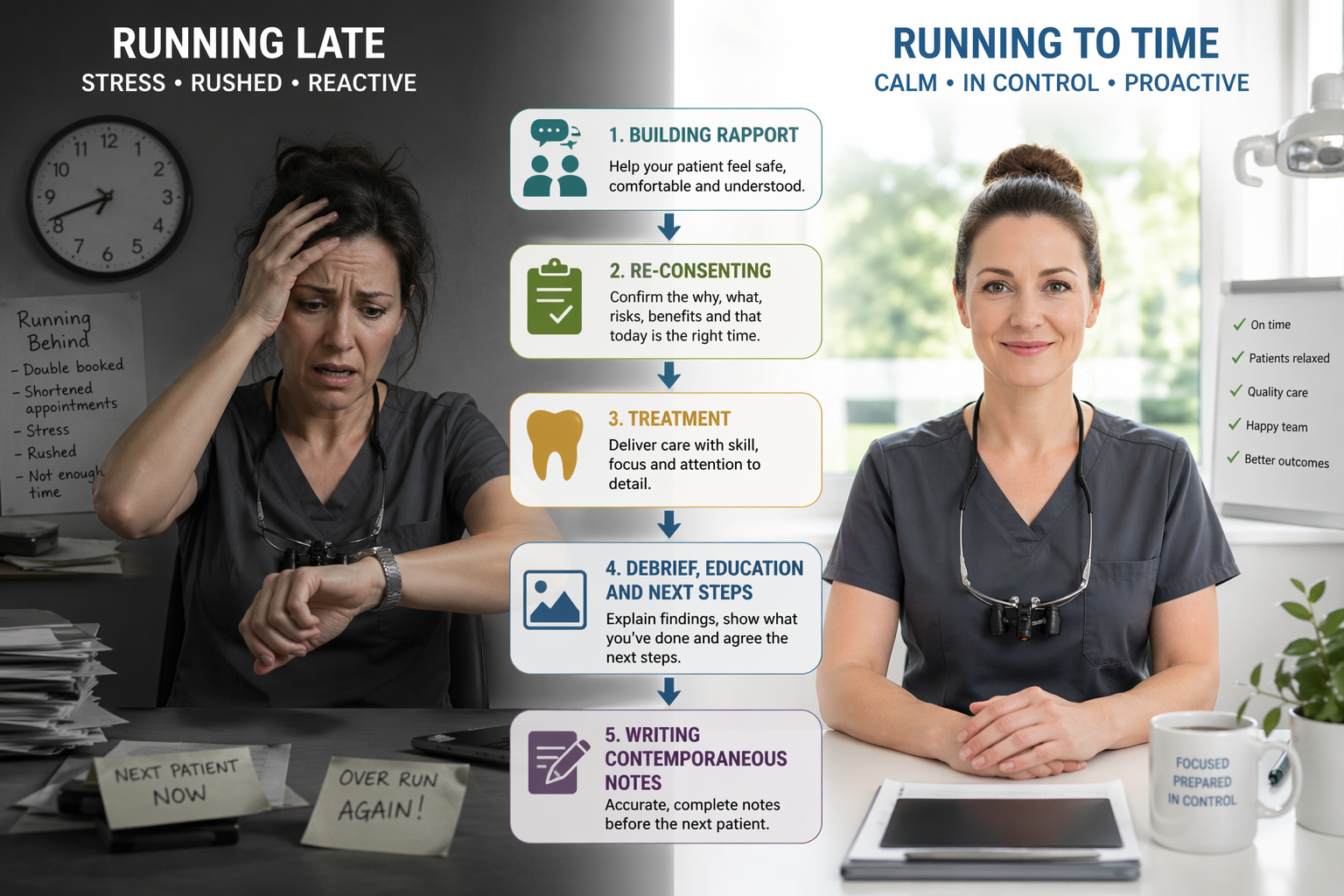
The Reality: Every Appointment Has Five Stages
If you want to run to time, you need to start seeing your appointments differently.
Every single patient interaction is made up of five distinct elements:
- Building Rapport
Before you even pick up an instrument, something important is happening.
You are helping your patient feel:
- Safe
- Comfortable
- Understood
Some patients settle quickly.
Others arrive anxious, guarded, or overwhelmed.
This stage cannot be rushed without consequence.
- Re-Consenting and Re-Contracting
Even if the treatment has been planned before, today matters.
You need to confirm:
- Why this treatment is being done
- What it involves
- Risks and benefits
- Whether today is still the right time
Life happens between appointments.
What was right two weeks ago may not feel right today.
- The Treatment Itself
This is the part most dentists plan for.
And yet, even here, variation is the norm:
- Easy access vs limited opening
- Straightforward anatomy vs complexity
- Calm patient vs highly reactive patient
No two procedures are truly identical.
- Debrief, Education, and Next Steps
Once the treatment is complete, your work is not finished.
You need to:
- Explain what you found
- Share what you have done
- Use photos or video where appropriate
- Give post-operative instructions
- Discuss what happens next
This is where understanding is built.
This is where trust deepens.
This is where future treatment is accepted.
- Writing Contemporaneous Notes
And finally, the part that is often squeezed… or delayed.
Your notes need to be:
- Accurate
- Complete
- Written before the next patient
Not later.
Not at the end of the day.
Not reconstructed from memory.
Written before you bring your next patient in.
This is part of the appointment.
Not an optional extra.
The Real Length of an Appointment
When you add these five elements together, something becomes clear:
Your appointment is not the treatment time.
Your appointment is the total of all five stages.
And if you only schedule for one of them…
You will always run late.
Why This Matters More Than You Think
Running late is not just inconvenient.
It has consequences.
For you:
- Rising stress and anxiety
- Decision fatigue
- Compromised clinical thinking
- End-of-day exhaustion
For your patients:
- Feeling rushed
- Reduced trust
- Lower acceptance of treatment
- A poorer overall experience
Because patients will forget what you said.
They will forget what you did.
But they will remember how they felt.
The Compromises You May Not Realise You’re Making
If you are working within:
- NHS constraints
- Capitation schemes
- Fixed fee structures
There is often a ceiling on what you can charge.
Which means something has to give.
The question is:
What are you compromising?
- Time with your patient?
- Quality of communication?
- Accuracy of records?
- Your own wellbeing?
And perhaps the more important question:
Are you making these compromises consciously… or by default?
A Different Way to Think About Your Diary
What if, instead of asking:
“How long will the treatment take?”
You asked:
“How long does this whole appointment need to be for this patient, today?”
That shift changes everything.
Because now you are considering:
- The person in front of you
- Their emotional state
- Their understanding
- The clinical complexity
- The communication required
And suddenly, your diary becomes more realistic.
More human.
And far more likely to run on time.
A Simple Reflection
Maybe everything is working well for you.
Possibly, you only run late occasionally.
Perhaps it is certain types of patients or procedures that create pressure.
Potentially, this is a daily source of stress that is quietly building.
Wherever you are, take a moment to reflect:
- Where are you losing time in your appointments?
- Which of the five stages is being underestimated?
- What would change if you planned for the whole appointment, not just the treatment?
Final Thought
Running to time is not about rushing.
It is about respecting the full reality of what you do.
Because dentistry is not just clinical.
It is relational.
It is communicative.
It is human.
And when your diary reflects that…
Everything starts to feel different.
Calmer.
Clearer.
More in control.