SUPER-vision: Another Petal on the Flower of Growth?
Are we using different words to describe the same thing?
SUPER-Vision, Training, Mentoring, coaching, therapy, facilitation, mentor coaching and coaching Supervision; here is a cluster of words within the world of personal and professional development that are frequently used alongside one another and, sometimes, almost interchangeably.
This is understandable, because each can involve
- a conversation,
- learning
- encourages reflection
- supports change
- will help somebody understand themselves differently, develop their capability or find a way forward.
Despite their surface similarities, they are not the same, they have their own unique qualities.
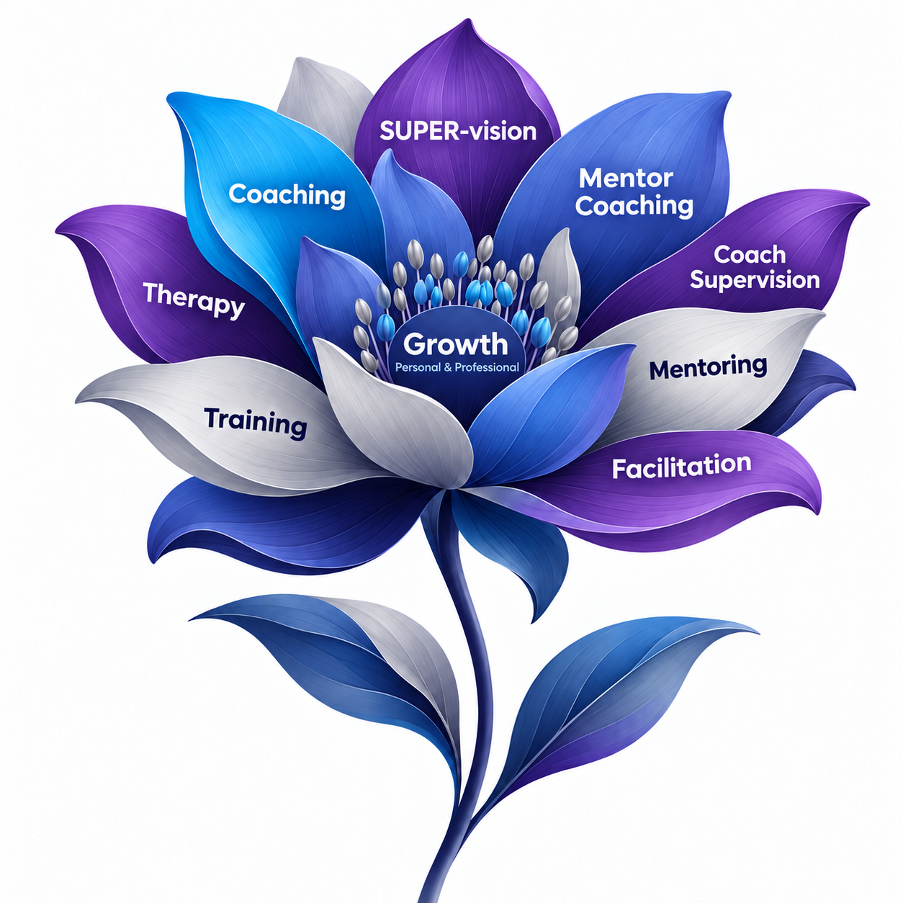
I think of this cluster of skills as petals on the same flower.
The flower represents growth – personal growth, professional growth, or frequently both. Each petal contributes something different and is unique, there are often areas where the petals overlap, similarly, a practitioner may sometimes draw skills from one discipline a pollinate another, to assist the client in achieving their desired outcome. To avoid confusion or dissatisfaction, it is essential that we establish expectations, clarify and define the difference between the terms, shedding light on how each conversation and the relationship may be similar and different. This allows clients to s access the correct skill set for their personal and current circumstances.
Understanding these differences matters, particularly when defining SUPER-vision.
The European Mentoring and Coaching Council (EMCC Global) describes supervision as:
“A safe space for reflective dialogue with a practising supervisor, supporting the supervisee’s practice, development and well-being.”
It identifies three purposes: maintaining appropriate professional standards, developing professional practice and supporting the supervisee’s wellbeing.
The International Coaching Federation (ICF) similarly describes coaching supervision as a reflective and collaborative process through which coaches develop their personal, professional and ethical capacity and maturity.
Association for Coaching (AC)
“Coaching supervision is a formal and protected time for facilitating a coach’s in-depth reflection on their practice with a Coaching Supervisor. Supervision offers a confidential framework within a collaborative working relationship in which the practice, tasks, process and challenges of the coaching work can be explored. The primary aim of supervision is to enable the coach to gain in ethical competency, confidence and creativity to ensure best possible service to the coaching client, both coachees and coaching sponsors. Supervision is not a ‘policing’ role, but rather a trusting and collegial professional relationship.”
The definitions reveal something important.
SUPER-vision is not about becoming better at what you do.
SUPER-vision is about exploring how you do what you do, who you are while doing it, the relationship between you and others, the impact of the wider system in which you are working all of which which determines what you do.
The petals on the flower
1) Training: developing what I know and can do
Training is perhaps the easiest petal to differentiate.
Training is about disseminating knowledge, competence or skills that learner wants or needs to acquire. The trainer knows something that the student does not know.
When choosing training, a fundamental question might be:
“What do I need to learn, understand or be able to do?”
2) Mentoring: learning from somebody else’s experience
Mentoring is also developmental, but the source of learning is different.
EMCC Global defines mentoring as a learning relationship involving the sharing of skills, knowledge and expertise between mentor and mentee through developmental conversations, experience sharing and role modelling.
Similarly, the CIPD describes workplace mentoring as a relationship in which a more experienced person shares their greater knowledge to support another individual’s development.
A mentor will help you grow and develop by virtue of what they have learned, their experiences personal or vicariously. The value of a mentor is their experience, knowledge, wisdom, because they have made mistakes, they can help you avoid them.
A mentor can therefore legitimately say:
“This is what I have learnt.”
“This is what worked for me.”
“Have you considered trying this?”
If you are considering a mentor, the fundamental question could be:
“What can I learn from your experience?”
3) Coaching: where do I want to go?
Coaching creates another area of overlap.
Coaching and supervision are like fraternal twins, they are both be non-directive, both use powerful questions, active listening, challenge, reflection, contracting and curiosity and will both result in increased self-awareness and generate decisions or actions.
The three leading bodies that set and maintain training standards, competency and ethics describe coaching as.
International Coaching Federation (ICF)
“Partnering with clients in a thought-provoking and creative process that inspires them to maximize their personal and professional potential”
European Mentoring and Coaching Council (EMCC)
“A professionally guided process that inspires clients to maximize their personal and professional potential through a structured, purposeful, and transformational experience”
Association for Coaching (AC)
“A facilitated, dialogic, and reflective learning process that aims to grow an individual’s or team’s awareness, responsibility, and choice (in both thinking and behaviour)”
Coaching conversations are different from other conversations, they have a structure and these include these qualities
- Face forward
- Are optimistic
- Are rigorous
- Give you space and company as you think
- Give you new insights and understanding
- Provide clarity and decisiveness
- Presuppose improvement
A key question to ask when considering engaging a coach could be
“What do I want?”
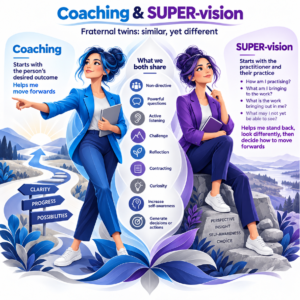
4) Therapy: what requires healing or deeper psychological understanding?
Therapy is another neighbouring petal, particularly because a meaningful supervisory conversation can sometimes involve thoughts, emotions, beliefs, past experiences and behavioural patterns.
That does not make supervision therapy.
British Association for Counselling and Psychotherapy (BACP) describes therapy as providing a safe and confidential relationship in which a person can explore thoughts, feelings and behaviours and develop greater understanding of themselves and others. Therapy may include relationships, childhood experiences, emotions, behaviours, past events and situations the client finds difficult.
There is clearly overlap with the reflective nature of coaching and supervision, and difference lies substantially in the direction of focus; in therapy the focus for the client is generally looking backwards to the past for insight and understanding, coaching and SUPER-vision the focus is future facing.
A key question to ask when considering therapy could be
“Why do I behave / think like this?”
5) Facilitation: helping people think together
Facilitation is perhaps the petal that describes how a process is enabled, particularly within groups.
The International Association of Facilitators describes facilitation as helping groups think together, explore options and make decisions, with the facilitator designing and guiding the process while participants focus on their ideas, relationships and outcomes.
A facilitator does not necessarily provide the answers, instead, they create the environment and the process through which a group can think for themselves and discover their own answers. A facilitator holds the space, create the framework, highlight patterns and dynamics and keep you on track in a way that many others cannot do.
A key question to ask when considering engaging a facilitator could be
“How could we work more effectively as a team?”
The defined career pathway of coaches, requires us to engage in Mentor coaching and Coaching supervision. If you are choosing to work with a coach it is a valuable question to ask them, are they involved in mentor coaching and coaching supervision, and how frequently? These questions will help you differentiate skilled and hight calibre coaches in an unregulated profession that often resembles the wild west. Great coaches choose to align and gain accreditation from one of the three professional bodies, International Coaching Federation (ICF), The Association of Coaching (AC) or The European Mentoring and Coaching Council (EMCC), reaccreditation will be require participating in CPD that will include mentor coaching and coaching supervision. Let us explore what they are.
6) Mentor Coaching and Coaching Supervision: First cousins
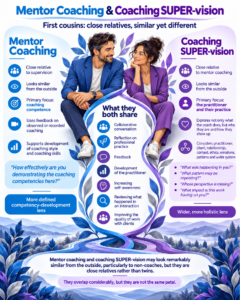
This is perhaps the distinction that requires the greatest clarity because mentor coaching and coaching supervision can look remarkably similar from the outside, particularly to non-coaches.
Both may involve:
- a collaborative conversation;
- reflection on professional practice;
- feedback;
- development of the practitioner;
- increasing self-awareness;
- consideration of what happened in an interaction;
- improving the quality of work provided to clients.
There is therefore genuine overlap, yet their primary focus is different.
The ICF defines mentor coaching
“ICF mentor coaching is a collaborative journey designed to enhance your coaching capabilities. By partnering with a mentor coach, you receive tailored feedback on your coaching sessions, allowing for deep reflection and growth in alignment with ICF Core Competencies.”
Importantly, the ICF explicitly states that mentor coaching develops coaching skills, rather than addressing wider subjects such as life balance or other areas outside the development of coaching competence.
Coaching supervision has a wider lens.
The ICF describes Coaching supervision as
“Harnessing your way of being as a coach is the key to unlocking your full potential. Coaching supervision is the compass that guides you, revealing deeper insights into your presence and impact to help you navigate your path to true coaching mastery.”
This distinction is significant.
Mentor coaching has a more defined competency-development lens, focusing on what you are doing in relation to the competency framework. When listening to a coaching recording the mentor may ask:
“How effectively are you demonstrating the coaching competencies here?”
Whereas, in coach supervision you may be asked,
“What was happening in you when the client said that?”
“What might you have been noticing but not responding to?”
“What pattern may be repeating between you and this client?”
“What belongs to you, what belongs to your client, and what might belong to the system?”
“Whose perspective is missing?”
“What ethical tension is present here?”
“What impact is this work having on you?”
7) SUPER-vision – discovering who you are.
My understanding of SUPER-vision is a contracted, psychologically safe, reflective partnership that enables a coach to stand back from their work and examine themselves, their practice, their relationships and the wider systems around them from multiple perspectives. Its purpose is to support professional development, ethical and effective practice, wellbeing and intentional action, for the benefit of the client.
It is not someone teaching you what to do- Training
It is not someone sharing their experience. – Mentoring
It is not somebody assisting you in reaching your goals-coaching
It is not someone helping you look to the past for answers- Therapy
It is not someone guiding group thinking – facilitation
It is certainly not the wagging finger that the word supervision can sometimes recall, SUPER-vision: the opportunity to see more than we can see alone.
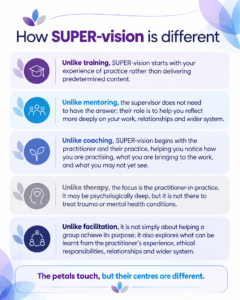
What does SUPER-Vision mean to me?
I have developed SUPER-Vision as a way of describing the journey through that reflective space:
S – Self
What is happening within me?
Before analysing everybody else, I need to notice myself. What am I thinking, feeling, sensing or assuming? What am I bringing into this situation?
U – Understanding
What is happening around me?
What is occurring between the people involved? What is happening in the environment, organisation, culture and system?
P – Perspectives and Patterns
Whose perspective have I not considered?
What am I not seeing? What might another person see differently? Is there a recurring pattern? What assumptions am I making?
E – Expansion
How can I expand my thinking and options?
What becomes possible when certainty is replaced by curiosity? What alternative explanations, responses or choices emerge?
R – Resolution
What action creates progress?
Reflection alone is not enough. What have I learnt and what will I intentionally do with that learning?
For me, this means SUPER-Vision supports the development of performance by helping the practitioner move:
- from Reacting towards Reflecting
- from Judging towards Understanding
- from Certainty towards Curiosity
- from Isolation towards Support
- from Reflex Action towards Intentional Action

Bringing SUPER-Vision into dentistry
My particular interest is in what supervision will offer the dental profession.
Dentistry has traditionally invested heavily in clinical competence, we learn how to diagnose, we learn how to treatment plan, treat disease, prep teeth, restore teeth, move teeth, extract and replace teeth; our continuing professional development (CPD) provides countless opportunities to become increasingly clinically competent. What our training never encourages us to consider is the person behind the clinician?
Our focus as clinicians and that of our governing body is about protecting patients, yet as a profession we do not routinely consider how we protect our patients beyond developing our clinical skills. No thought is given to protecting patients by looking after ourselves holistically until it is too late.
Our clinical performance is influenced and impacted by our thoughts, language, emotions, fears, beliefs, relationships and life experiences both outside and inside the surgery. Our psychological filters and levels of emotional intelligence accompany us into the clinical environment and into every interaction we have with patients, team members and the wider system. Our filters influence our communication, decision-making, confidence, boundaries, relationships, clinical decisions and ultimately how we practise dentistry. Our filters are our superpowers and our saboteurs, yet for most of us, we are oblivious to their existence.
Research has repeatedly identified substantial levels of stress and burnout among UK dentists. A large UK study reported high self-reported levels of stress and burnout, with fear of litigation among the most significant stressors. The GDC’s rapid evidence assessment similarly found evidence of anxiety, stress and burnout during both dental training and professional practice. It also identified a lack of evaluated support interventions designed specifically for dental professionals
More recently, Wong and Newton (2026) Addressing the challenges to mental health and wellbeing for oral healthcare teams specifically highlighted the high levels of stress experienced by new and early-career dental graduates and argued for stronger practitioner support mechanisms within dentistry.
Written evidence submitted by Medical and Dental Defence Union of Scotland (MDDUS) to a Parliamentary Inquiry 2020- Workforce Burnout and Resilience in the NHS and Social Care argues that burnout and psychological distress among doctors, dentists and other healthcare professionals are serious and longstanding problems, driven not only by heavy workloads but also by complaints, regulatory investigations, negligence claims, disciplinary action and fear of legal or professional repercussions.
The MDDUS submission strengthens the case for SUPER-vision in dentistry because it highlights the significant emotional, psychological and systemic pressures under which dental professionals work. These pressures include burnout, complaints, regulatory scrutiny, financial stress, fear of hindsight judgement and the impact of wider organisational and societal conditions. The submission makes clear that dentists need more than clinical knowledge and technical competence; they also need psychologically safe, reflective support that helps them process their experiences, maintain perspective and sustain professional effectiveness. SUPER-vision could therefore offer an important upstream resource by supporting not only what clinicians do, but who they are, how they are affected by practice, and how they can respond intentionally within a complex system.
From reactive intervention to reflective support
Dentistry already has mechanisms designed to protect patients: governance systems, complaints procedures, indemnity providers and regulatory processes. They are necessary, However, many of these mechanisms become visible after something has already become a concern.
My aspiration for SUPER-vision is different. I see SUPER-Vision as an upstream resource, a proactive regular, confidential and psychologically safe space in which a clinician can express feelings such as,
- “Something happened with a patient, and I keep thinking about it.”
- “I don’t understand why this particular colleague makes me so angry.”
- “I am frightened of making a mistake.”
- “I am avoiding this conversation.”
- “I am beginning to doubt myself.”
- “I don’t know whether this is a clinical problem, a communication problem or something happening within me.”
- “This patient brings out the worst in me and I am curious why.”
The purpose is not to conceal risk or bypass appropriate governance, nor can supervision guarantee that complaints or regulatory involvement will be eliminated. The value of SUPER-vision is that concerns can be noticed, thought about and acted upon earlier, preventing problems at an early stage, rather than being carried alone until they become overwhelming or problematic, and potentially result in a clinical failure, never event, complaint or referral to the GDC
SUPER-vision has a place to become an integral part of a wider ecology of professional support.
It does not replace mentoring.
It does not replace training.
It does not replace coaching.
It does not replace therapy.
It does not replace clinical governance, indemnity advice or appropriate regulatory processes, and perhaps it fills the gaps between all these things enabling you to focus on who you are and how you are in your role.
It does become space where a clinician can bring not what they do, but who they are while they are doing it. SUPER-vision is prevention rather than cure.
The whole flower
Perhaps, the question is not:
“Which of these approaches is best?”
And maybe a more appropriate question is:
“Which petal of support do I need now in this situation?”
Sometimes we need training because we do not know how to do something.
Sometimes we need mentoring because somebody else’s experience can help us find our way.
Sometimes we need coaching because we want to move towards a goal.
Sometimes we need therapy because something within us requires deeper psychological attention or healing.
Sometimes a team needs facilitation so that its members can think and work effectively together.
Sometimes we need SUPER-vision because we need somewhere to stand back from our practise, become curious about what is happening within us and around us, see what we cannot currently see, and decide how we want to show up next.
They are different petals, ultimately, they serve the same flower- your personal and professional growth.
I believe that it is essential that dentistry embraces SUPER-vision, because looking after patients and supporting excellent clinical care requires us to look after, develop and support the people who provide it.
If you have any questions about the petals of growth, or would like to discuss working with Jane as a Coach, Trainer, Mentor, SUPER-visor or as a facilitator, please e mail Jane@IODB.co.uk