
Amira stood at the reception desk, her navy coat held tightly across her chest, as though it were a shield that she was using to hold herself together and protect herself. The bright posters on the walls — smiling faces, sparkling white teeth — felt like a cruel contrast to the knot in her stomach.
Her voice was soft, almost swallowed by the hum of the white noise in the waiting room and the tapping of the keyboard.
“I’m just… not happy with how this has gone.”
Behind the desk, Emma’s pale-blue tunic was crisply pressed, her name badge catching the glare of the overhead lights. She tucked a strand of blonde hair behind her ear and glanced at the growing queue. The soft shuffle of feet and the rustle of coats behind Amira added pressure to move things along.
Emma’s lips tightened into a polite smile that didn’t reach her eyes.
“If you’d like to make a complaint, could you please put it in writing and address it to our practice manager?” Her voice was steady but clipped, like she was reading from a script.
The words stung. Amira’s heart sank. She hadn’t wanted to complain. She just wanted to explain. She wanted someone to listen, to notice the disappointment etched in her tired eyes. In a sentence, she was recast from loyal patient into “a complainant.”
Later that afternoon, in the staff room, Dr Collins slumped into a chair, the vinyl seat creaking under his weight. He held a mug of coffee gone cold yet still aimlessly stirring, his fingers trembling slightly so the spoon clicked against the mug. Normally calm and precise, his face was flushed, his jaw tight.
“She’s criticising me,” he muttered, eyes fixed on the floor tiles, their grey speckled surface blurring. “It’s personal. She’s saying my work isn’t good enough.” His words were sharp, like knives he turned inward.
Inside his chest, fear coiled tight. His mind raced — the tick of the wall clock sounding louder, faster. What if it escalates? What if she takes it to the GDC? What if my career unravels because of this? The catastrophes piled higher than the files on Sarah’s desk.
Sarah, the practice manager, sat in her small office. The walls were lined with lever-arch folders in mismatched colours — green, red, black — their labels curling at the edges. She pulled out the heavy complaints policy binder. The plastic cover was scuffed, the pages inside limp and furled from being referred to so often. The simple action of lifting the file from the shelf, again, felt oppressive and overwhelming somehow the file felt heavier today. Yet Sarah flicked through the well-used laminated sheets with a practised hand, the papery crackle filling the silence, to find the next blank sheet.
Log it. Respond formally. Stay neutral. Keep everything factual.
It felt safe. Procedural. But as she stared at the blank complaint log, her stomach churned. This won’t solve it, she thought, but she didn’t know what else to do.
Sarah rang Amira, in 5 minutes flat details were recorded the form completed and advised Amira she would be in touch again with 10 days.
Later that afternoon Amira sat at her kitchen table, a chipped mug of untouched tea cooling beside her. The tick of her wall clock echoed the one in the practice staff room. She stared at the steam fading from the cup, her reflection blurring in the window.
“I just wanted someone to listen,” she whispered into the empty room. The glossy certificates she had admired on the practice walls, the smiling photos on the website, the reassuring emails that had once made her feel safe — they all felt like broken promises now.
With tears slowly dripping down her face Amira rang Sarah. “That’s not how I wanted our conversation to go” Amira courageously pleaded “Please can we use a different approach?”
That’s when I was invited in.
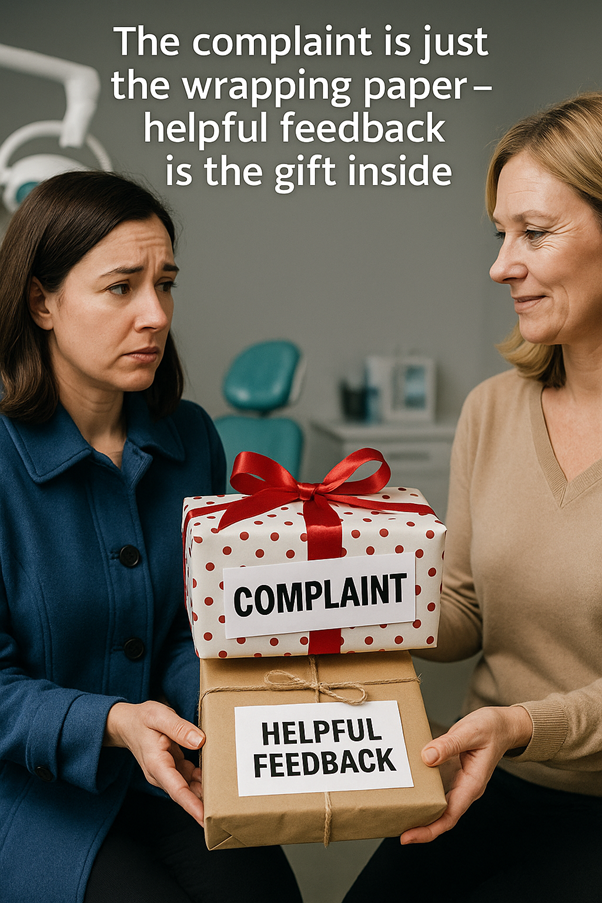
When I met with Sarah, Dr Collins, and Emma, I saw their fear etched in faces, their shoulders stiff with tension. I explained what they hadn’t yet recognised: most patient “complaints” aren’t about the filling that fractured or the rough temporary that sat too high. Those details are just the wrapping paper.
The gift hidden inside is the emotion — disappointment, frustration, the sense of being misled, unheard, or ignored. Patients rarely have the words to say, “You didn’t listen to me.” Instead, they package it as, “The treatment failed.”
Here lies the trap: when teams treat that as a procedural complaint, the patient’s greatest fear is confirmed — no one is listening. And so the grumble escalates. Not because of the clinical outcome, but because of the emotional fracture.
I asked Sarah to put down the folder, just for a moment, and imagine another path.
Next time, instead of asking a patient to put it in writing, invite them to put it into words — spoken words, human to human.
“Amira,” Sarah practised, “thank you for telling me this. I’d like to sit with you face to face so I can really understand. Please, say more.”
When Amira returned, she sat stiffly at first, her hands folded tightly in her lap. Her voice trembled as she began, but soon the words came faster, stronger.
She spoke of her high expectations from the website’s gleaming before-and-after photos, from the framed certificates on the wall, from the professional emails that promised excellence. She shared how those expectations were dashed when Dr Collins ran 20 minutes late, when her check-up felt rushed, when explanations were clipped, when the temporary filling was rough, sat “high,” and eventually fractured the opposing tooth — leaving her £235 out of pocket.
Her voice cracked with frustration. “I thought you knew me. I thought you understood.”
Sarah leaned forward, her hands open, her voice soft. “Say more… tell me everything you need me to hear.”
For once, Amira felt truly safe. She poured it all out. And when the flood had slowed, Sarah asked the question that changed everything:
“How would you like us to resolve this?”
The answer wasn’t compensation. It wasn’t revenge. It was simple. “Please fix this without charging me again. Show me you’ve listened. Demonstrate that you’ll learn from this so another patient doesn’t have to feel the same.”
No GDC. No litigation. No battle. Just human-to-human repair.
This is the transformation I bring to practices. Teams learn to lean into conversations instead of hiding behind files and procedures. Dentists learn that a patient’s words are not personal attacks — they are cries to be heard. Receptionists learn that asking for things “in writing” can inflame rather than soothe.
Cultures change. Complaints are no longer feared, but embraced as gifts of feedback — chances to reflect, to improve, and to deepen patient trust.
Amira stayed with the practice. Not because everything was perfect, but because this time she felt heard.
Dr Collins discovered that listening didn’t erode his professionalism — it strengthened it. He changed how he ran his diary, he ran on time, he asked questions and listened before he completed a thorough examination, he comprehensive explanations of treatment plans gave patients time to reflect and ask questions. Dr Collins developed his clinical skills learned how to provide quality definitive restorations instead of quick fix patches. For the first time in years, he enjoyed being a dentist again, stress was gone and replaced by a feeling of pride. Dr Collins commented without communication skill clinical skills are inadequate.
Sarah realised the policy folder could gather dust while conversations built stronger relationships. Sarah recognised that clinical complaints are the wrapping paper to helpful feedback and the gifts need unwrapping.

Emma, once nervous about being the gatekeeper, found relief in no longer asking patients to “put it in writing.”, instead inviting patients to have a conversation.
The whole team realised what patients want isn’t paperwork and process, they want to be seen, heard and understood. When you learn to truly listen — with eyes, ears, and heart — grumbles don’t escalate. They resolve. They repair. They restore trust.
If you’ve ever felt the weight of a “complaint” that began as a grumble, now is the time to change how you and your team respond. Listening is not a soft skill; it’s the foundation of trust, loyalty, and satisfaction.
Through my coaching and training, I help dentists and teams develop the skills to hear what patients are really saying — beyond the words, into the emotions and unspoken expectations. You will learn how to listen without judgement, to decode the patterns beneath the feedback, and to create new habits that prevent grumbles ever becoming complaints.
When your team can confidently hold these conversations, you’ll find fewer escalations, less stress, and stronger, deeper patient relationships that last.
If you’d like to explore how I can help your practice transform the way you handle patient feedback, book a Speak with Jane conversation today.