The kitchen was warm, filled with the soft hum of a Sunday afternoon.
Golden light streamed through the window, catching the steam rising from a pan on the hob. The scent of garlic, rosemary, and slow-cooking lamb wrapped itself around the room like a familiar embrace.
Sarah stood at the counter.
Early thirties. Thoughtful. Capable. The kind of person who liked to do things properly.
She placed the leg of lamb on the chopping board and, without hesitation, took a sharp knife and sliced a clean piece off the end and put both pieces in the roasting tin”
Her movements were confident. Practised. Certain.
Behind her, James leaned casually against the doorframe, sleeves rolled up, watching with quiet curiosity.
“Can I ask you something?” he said, gently.
Emma glanced up, smiling. “Of course.”
“Why do you cut the end off the lamb?”
She paused.
Just for a second.
Then shrugged lightly. “Because that’s how my mum taught me roast lamb”
Her tone was relaxed. Matter-of-fact. As if that was explanation enough.
James nodded slowly, but something in his expression lingered.
“Have you ever asked her why?”
Emma laughed softly. “No… I suppose I haven’t.”
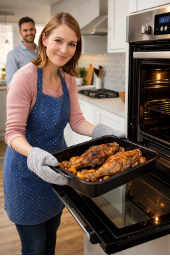
Later that afternoon…
The table was set.
White plates. Polished cutlery. A jug of gravy catching the light.
Sarah’s mother, Roz, sat opposite them. Warm. Practical. Efficient in the way of someone who had run a household for decades.
Between mouthfuls, Sarah asked, almost in passing:
“Mum, why do you cut the end off the lamb before cooking it?”
Roz didn’t hesitate.
“Because that’s how my mum taught me roast lamb”
Same tone. Same certainty.
Sarah and James exchanged a glance.
Now they were both curious.
The following weekend…
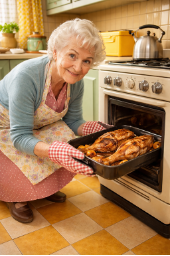
They found themselves in a smaller, older kitchen.
Sarah’s grandmother, Amy, stood by the oven.
Her hands were slower now, but precise. Years of experience in every movement.
Her voice carried a softness, but also quiet authority.
Sarah smiled. “Nan, can I ask you something?”
Amy turned, amused. “Of course, darling.”
“Why do you cut the end off the leg of lamb before cooking it?”
Amy blinked.
Then she laughed. A deep, knowing laugh that filled the room.
“Oh that,” she said, waving her hand dismissively.
“When I was younger, our oven was tiny. A full leg of lamb simply wouldn’t fit.”
She paused, eyes twinkling.
“So I cut the end off.”
Silence.
Sarah felt something shift.
James raised his eyebrows slightly.
And Amy added, almost as an afterthought:
“I never needed to after we got a bigger oven… I just carried on out of habit.”
And there it was.
Three generations.
One action.
No longer necessary.
No longer questioned.
Simply repeated.
The Quiet Truth Behind the Story
It is rarely about the lamb.
It is about how easily something practical becomes permanent.
A solution becomes a system.
A workaround becomes a rule.
A moment becomes a mindset.
And no one stops to ask:
Why are we doing it this way?
Because this happens everywhere
In kitchens.
In families.
In businesses.
In dentistry.
You were taught to:
- explain all the options
- present information clearly
- be thorough
And you do.
Perfectly.
And yet…
Patients still say:
“I’ll think about it.”
Because sometimes…
You are not cutting the lamb for today’s oven.
You are cutting it for one that no longer exists.
The question is not what you are doing
It is:
Why are you doing it?
And more importantly:
Does it still serve you… and your patients?
I invite you to explore where, in your patient interactions and practice, you may be following patterns simply because “that is how it has always been done” — without questioning whether there is a better, more effective approach.